
Why does a promotion that should feel like a victory sometimes feel strangely hollow within weeks? And why do some people chase a title, a corner office, or a certain number of followers with an intensity that looks less like ambition and more like hunger that food won’t satisfy?
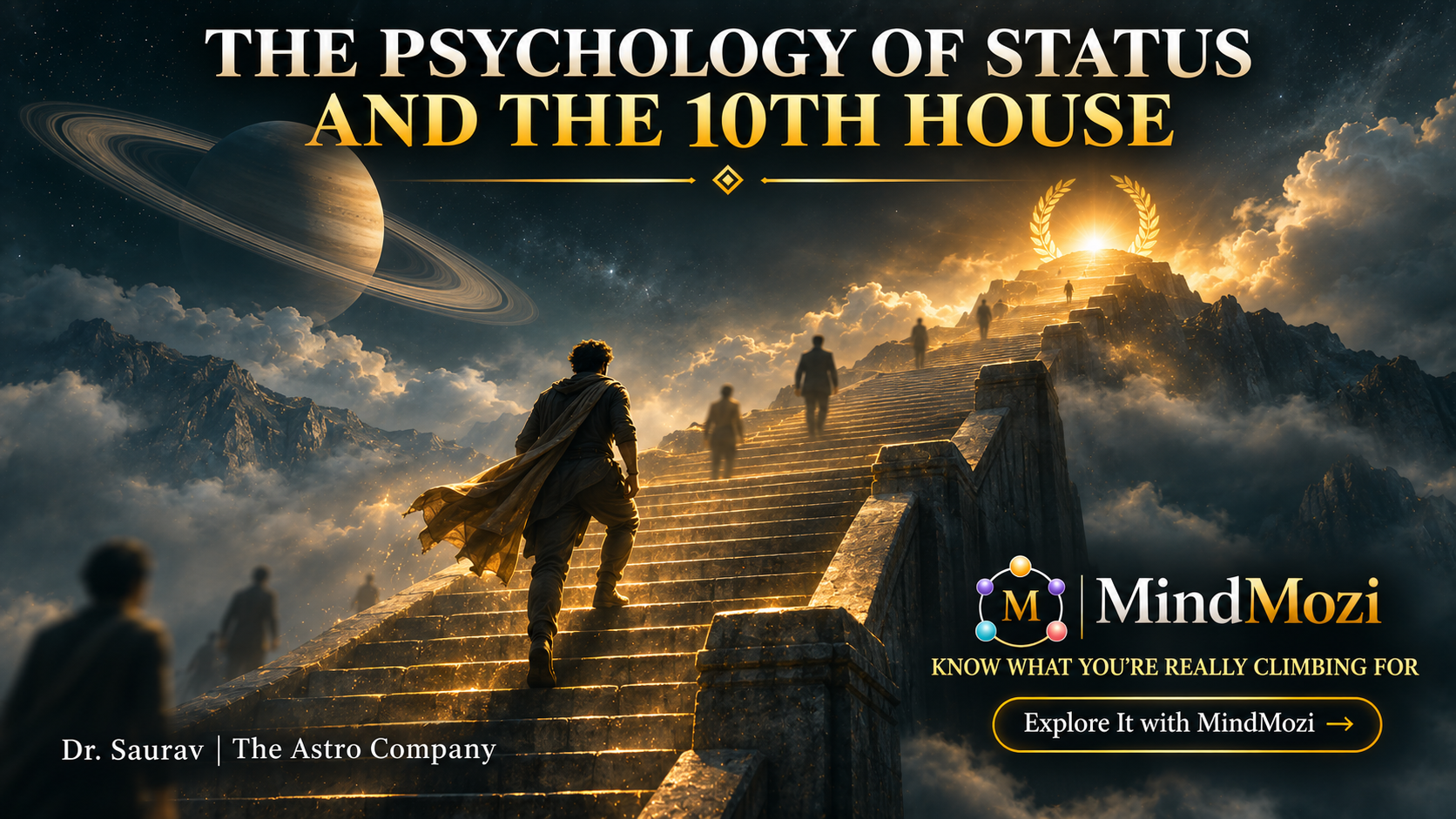
Status is not the same thing as achievement, and it is not the same thing as self-worth — though most of us spend years treating all three as interchangeable. In Vedic astrology, the house most directly tied to this entire territory is the 10th house, the house of karma, career, public standing, and the reputation we build in the world’s eyes.
1. Why the Mind Cares So Much About Status
The foundational explanation comes from social psychologist Leon Festinger, whose social comparison theory proposed that people evaluate their own abilities and worth largely by measuring themselves against others, especially when no objective standard exists. Status, in this light, isn’t really about the title or the number itself — it’s a proxy the mind uses to answer a much older, blunter question: where do I stand relative to everyone else?
Psychologists Tim Kasser and Richard Ryan took this further in their research on life aspirations, distinguishing between extrinsic goals — wealth, fame, and image — and intrinsic goals — personal growth, close relationships, and community. Their studies found that people who placed heavier emphasis on extrinsic, status-oriented goals reported lower overall wellbeing, even when they were succeeding at those very goals. The achievement wasn’t the problem; the weight placed on it was.
A third, important piece comes from psychiatrist Paul Gilbert’s social rank theory, which proposes that humans retain an evolved sensitivity to perceived rank and status within a group — and that a felt sense of low rank or defeat, rather than any single event, is closely linked to depressive and anxious states. This helps explain why a status loss — being passed over, demoted, or publicly diminished — can feel disproportionately devastating: it isn’t just the practical loss, it’s a primal signal about where you stand in the group.
Taken together: the hunger for status is real, evolutionarily old, and not inherently unhealthy — but when it becomes the primary measure of self-worth rather than one input among many, the research consistently points toward diminished wellbeing, not increased security.
2. The 10th House: Karma, Career, and the Eyes of the World
The 10th house is the house of karma in its most public sense — career, profession, authority, reputation, and the standing a person builds in society. It is one of the four kendra (angular) houses, considered among the most powerful in the chart, which is itself telling: Jyotish treats public standing as structurally central to a life, not a side concern.
Two planets share significatorship here. Saturn is the general karaka for career, service, and sustained effort — the daily discipline of work itself. The Sun is the karaka for status, authority, and recognition — the felt experience of being seen as successful, regardless of the work underneath it. A chart can show someone with excellent Saturn-driven work ethic and a weak Sun, producing real competence with little felt recognition — or the reverse, visible status without the underlying substance feeling earned.
The 10th Lord by Ascendant
Because the 10th house falls on a different sign for every ascendant, the planet actually running a person’s relationship to status and career changes chart to chart:
| Ascendant | 10th House Sign | 10th Lord | How Status Tends to Be Pursued |
|---|---|---|---|
| Aries | Capricorn | Saturn | Earned slowly, through discipline and long structural effort |
| Taurus | Aquarius | Saturn | Through institutions, systems, and collective recognition |
| Gemini | Pisces | Jupiter | Through ideas, teaching, or a broader, meaning-driven vision |
| Cancer | Aries | Mars | Through initiative, competition, and visible action |
| Leo | Taurus | Venus | Through craft, aesthetics, and steady, values-aligned building |
| Virgo | Gemini | Mercury | Through communication, analysis, and precise expertise |
| Libra | Cancer | Moon | Through care, nurturing roles, or public emotional resonance |
| Scorpio | Leo | Sun | Status pursued directly — recognition and visibility matter openly |
| Sagittarius | Virgo | Mercury | Through meticulous, useful, detail-oriented work |
| Capricorn | Libra | Venus | Through partnership, diplomacy, and relational standing |
| Aquarius | Scorpio | Mars | Through intensity, transformation, and hard-won authority |
| Pisces | Sagittarius | Jupiter | Through philosophy, higher learning, or a guiding role |
Classic Conjunctions and Combinations
- Sun–Saturn in or ruling the 10th: A famous combination for status earned the hard way — real authority, but often only after friction, delay, or having to prove oneself repeatedly before being taken seriously.
- 10th lord conjunct Rahu: An intensified, sometimes restless hunger for status and public recognition — ambitious, driven, occasionally insatiable.
- 10th lord conjunct Ketu: A genuine detachment from career-based status — can show up as indifference to titles even amid real competence, or periodic career upheavals that force a re-evaluation of what status actually means to the person.
- Jupiter aspecting the 10th house or lord: Tends to bring ethical weight to the pursuit of status — recognition sought through principle and wisdom rather than through pure visibility.
Timing
In the Vimshottari dasha system, the dasha of the 10th lord, or a Saturn Mahadasha (nineteen years), frequently marks the period when career and status themes move to the foreground — sometimes as steady advancement, sometimes as the period when a person is forced to confront whether their current relationship to status actually serves them.
3. Three Charts, Three Relationships to the Climb
(Hypothetical examples for illustration only — not real individuals.)
Chart A — Strong 10th lord Saturn, well-placed, no major affliction. This person built a solid career over two decades of unglamorous, consistent effort, and describes genuine satisfaction in the work itself rather than in how it looks from outside. This matches Kasser and Ryan’s finding that wellbeing holds up best when the underlying motivation isn’t primarily extrinsic.
Chart B — 10th lord conjunct Rahu, Sun also prominent. This person describes an intense, sometimes exhausting drive for recognition — each promotion satisfies for a few weeks before the hunger returns. This reads closely to Festinger’s social comparison engine running without an off switch — status achieved, but the comparison point simply moves.
Chart C — 10th lord afflicted, a difficult period in the 10th-lord dasha. This person experienced a visible career setback — a demotion, a public professional disappointment — and describes it as disproportionately devastating relative to its practical impact. This closely echoes Gilbert’s social rank theory: the felt loss of standing, not just the practical loss, is what hit hardest.
4. Building a Healthier Relationship With Status
Five steps drawn from the research above, adapted into something usable:
- Separate the title from the self-assessment. Ask directly: if nobody ever knew about this achievement, would it still feel worth having? Kasser and Ryan’s research suggests the goals that hold up over time are the ones that pass this test.
- Notice who you’re actually comparing yourself to. Festinger’s social comparison theory works both ways — comparing yourself to people slightly ahead can motivate growth, but comparing constantly to people far ahead, or to a curated online image, mostly produces dissatisfaction with no useful action attached.
- Let a status loss register without catastrophizing it. Per Gilbert’s social rank theory, the sting of a demotion or setback is partly primal and disproportionate by design — naming that explicitly (“this feels bigger than it is”) can reduce its grip.
- Build at least one source of worth outside the 10th house entirely. Relationships, craft, health, or private values that don’t depend on anyone else’s recognition provide ballast when status specifically takes a hit.
- Use your own 10th-lord temperament, not someone else’s. A Mercury-ruled 10th house finds genuine satisfaction through expertise and communication; a Moon-ruled one through care and emotional resonance. Chasing a status style that doesn’t match your own wiring tends to feel hollow even when it succeeds.
5. Frequently Asked Questions
Is wanting status inherently unhealthy? No. Festinger’s research treats social comparison as a normal, even useful cognitive process. It becomes a problem specifically when status becomes the primary or sole measure of self-worth, per Kasser and Ryan’s findings.
Does a weak 10th lord mean someone won’t achieve career success? Not necessarily. It more often means the path to recognition is less direct or less conventional — success built through an unusual route rather than success withheld altogether.
Why does losing status sometimes hurt more than losing money? Gilbert’s social rank theory suggests the mind tracks relative standing as something closer to a survival signal than an abstract concept — a felt drop in rank can trigger a response disproportionate to the practical stakes involved.
Can two people with the same career have completely different relationships to status? Yes — the 10th lord and its conjunctions determine why someone pursues recognition, not just whether they do. A Jupiter-influenced 10th house pursues status through principle; a Rahu-influenced one pursues it through raw ambition. Same career, very different internal experience.
6. Explore Your Own Relationship to Status With MindMozi
Know what you’re really climbing for.
Knowing your 10th lord in theory is one thing; working out whether your own ambition is driven by genuine purpose or by an unsatisfiable comparison engine is another. MindMozi, the AI-powered personal guidance and self-reflection app built by Dr. Saurav Chaturvedi, combines psychology-informed reflection with personalised Vedic astrology across five distinct AI personalities, so you can explore the question from more than one angle.
- Caring Companion — “I got the promotion I wanted and it still doesn’t feel like enough. Help me sit with that honestly.”
- Honest Best Friend — “Be straight with me: am I building something real, or just chasing the next comparison point?”
- Strict Mentor — can help you define one measure of success that doesn’t depend on anyone else’s opinion, and hold you to it.
- Calm Therapist-Style Personality — can walk you through why a recent setback at work hit so much harder than it seemed to warrant.
- Personal Vedic Astrologer — can read your own 10th house, its lord, and current dasha together, rather than guessing from a sun-sign generality.
Alongside the five personalities, MindMozi offers three things to use daily rather than once: Free Daily Psychological Energy, a short daily reflection on mindset and emotional themes; Daily Planetary Transits, read against your own birth chart rather than a generic forecast; and Daily Choghadiya, the traditional system of auspicious and inauspicious time windows, for timing decisions day to day.
MindMozi is a self-reflection and guidance tool. It does not diagnose mental-health conditions, replace professional therapy, or substitute for a licensed clinician’s care.
The Question Worth Sitting With
Status isn’t the enemy — it’s one of the oldest signals the human mind tracks, and ignoring it entirely is neither possible nor wise. The real question is whether you’re building it on something that will still feel solid when the comparison shifts, as it always eventually does. The 10th house describes the shape of your climb. It doesn’t decide whether the summit, once reached, will actually feel like enough.
Explore Further
If you want to see exactly where your own 10th house sits — lord, dignity, conjunctions, current dasha — a full reading with The Astro Company looks at all of it together. You can also explore the pattern between sessions with MindMozi.
References & Further Reading
- Festinger, L. (1954). A theory of social comparison processes. Human Relations.
- Kasser, T., & Ryan, R. M. (1996). Further examining the American dream: Differential correlates of intrinsic and extrinsic goals. Personality and Social Psychology Bulletin.
- Gilbert, P. (1992). Depression: The Evolution of Powerlessness. Psychology Press. (Foundational text on social rank theory.)
- Brihat Parashara Hora Shastra — classical source for 10th-house, Saturn, and Sun significations, as transmitted across the Parashari tradition.