

Why do some people walk away from a relationship, a career, or a whole identity — calmly, almost without a backward glance — while everyone around them is still trying to understand what happened? And why do others, who talk endlessly about “letting go” and “not caring anymore,” seem more haunted by the thing they claim to have released than anyone who never tried to detach at all?
Detachment is not one thing. There is a version of it that looks like freedom and a version of it that looks like freedom but is actually a wound in disguise — and most people, and most charts, carry both at once.
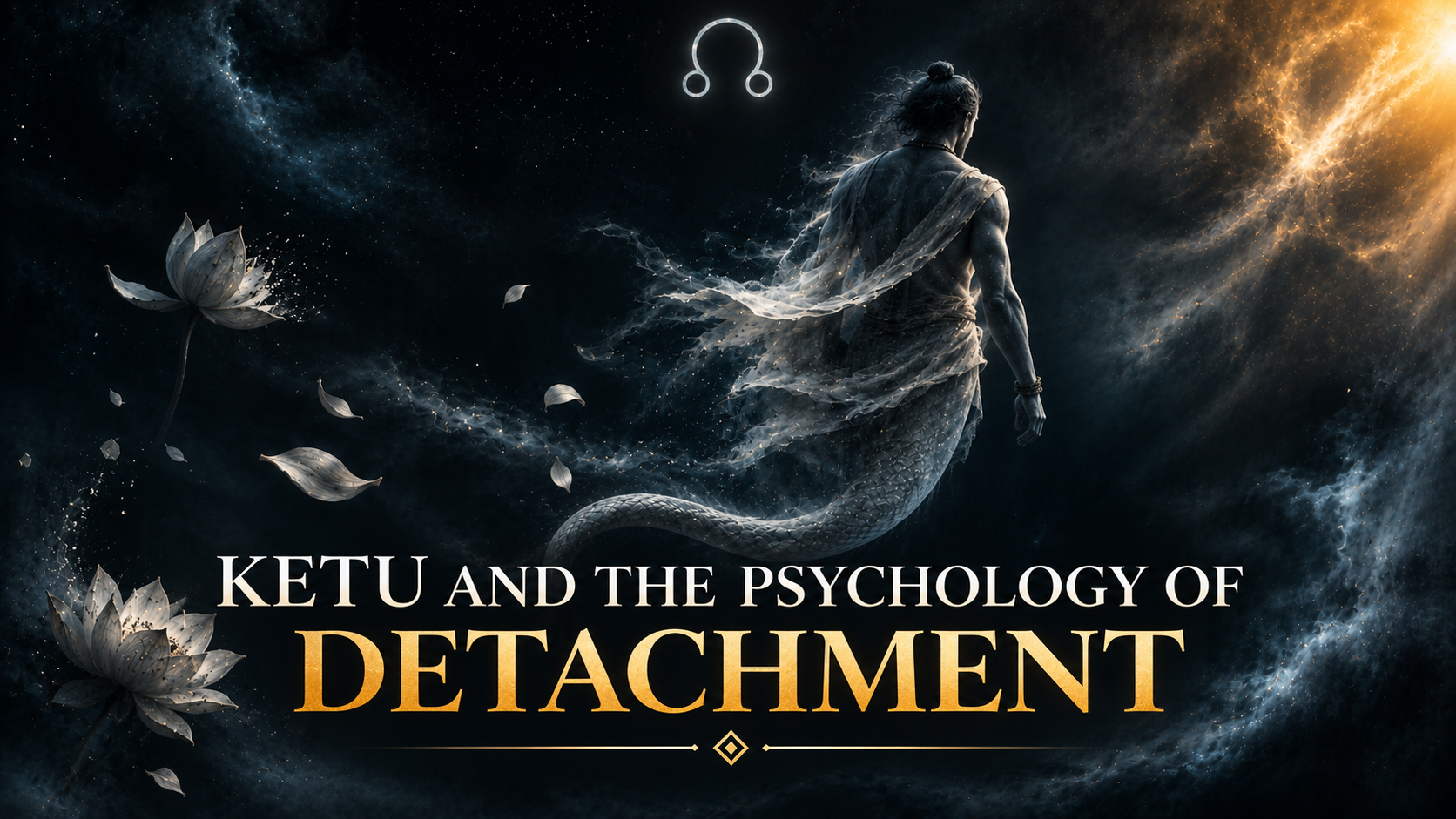
In Vedic astrology, the planet most tied to this entire territory is Ketu, the south lunar node — a shadow point with no physical body, often pictured as a serpent’s tail without a head. Ketu doesn’t just describe people who are “spiritual” or “detached” in some vague sense. It describes a very specific psychological fork: the difference between a mind that has genuinely stopped clinging, and a mind that has simply gone numb to protect itself from clinging again.
1. What Psychology Actually Means by “Detachment”
Modern psychology treats detachment as a spectrum, not a single state — and the two ends of that spectrum are almost opposites of each other, even though they can look identical from the outside.
At one end sits non-attachment — the capacity to hold people, outcomes, and identities loosely, without needing them to be a certain way in order to feel okay. This is the construct that psychologists Brian Sahdra, Phillip Shaver, and Kirk Warren Brown set out to measure directly, developing a Nonattachment Scale precisely because Western psychology had spent decades studying anxious clinging (attachment insecurity) without a matching way to measure its healthy opposite — a mind that engages fully with life without grasping at it. Their research found that people who score high on genuine nonattachment tend to report more wellbeing, not less connection; they are not withdrawn, they are simply unclenched.
At the other end sits dissociation and emotional numbing — a defense built not on ease but on threat. Psychiatrist Judith Herman’s work on trauma describes how, when connection itself has been dangerous, the mind learns to disconnect from feeling as a survival strategy; the person doesn’t transcend the need for closeness, they bury it. Anna Freud, decades earlier, had already named a narrower version of this: isolation of affect, a defense mechanism in which the facts of an experience are consciously retained while the emotional charge attached to them is split off and discarded. And in attachment research, Mario Mikulincer and Phillip Shaver describe “deactivating strategies” — a learned habit of minimizing the importance of closeness and suppressing bids for comfort, common in people whose early attempts to seek connection were met with rejection or inconsistency rather than response.
The unsettling part is that both of these states can produce the exact same sentence: “I don’t need that anymore.” One person says it from a place of genuine ease. Another says it from a nervous system that has decided wanting is too dangerous to risk. Ketu, in a chart, rarely picks a side on its own — it shows where the detachment is happening, and the rest of the chart, along with the person’s own lived history, usually decides which version is in play.
2. Ketu: The Planet With No Body
Ketu is one of the two chhaya grahas — shadow planets — in Vedic astrology, the south lunar node, mathematically opposite Rahu at all times. Classical iconography pictures Rahu as a serpent’s head with no body, and Ketu as a serpent’s body with no head. The symbolism is exact: Rahu is appetite without wisdom to guide it; Ketu is consciousness without the ego-structure to claim it as “mine.” Where Rahu pulls a person toward the world — ambition, hunger, novelty, status — Ketu pulls them away from it, toward dissolution, introspection, and what classical texts call moksha — liberation from the cycle of craving itself.
On dignity. Classical and later Jyotish authorities don’t treat Ketu’s sign placements with the same exaltation/debilitation framework used for Mars, Venus, or Saturn — as shadow points with no physical substance, the nodes are governed more by house, nakshatra, and planetary association than by a fixed dignity ladder. Some later traditions do describe Ketu as relatively comfortable in Scorpio or Sagittarius and more strained in Taurus or Gemini, broadly following its traditional co-lordship with Mars and Jupiter — but this is read as a tendency, not a rigid rule the way Moon’s debilitation in Scorpio is. What matters more consistently across texts is which house Ketu occupies, and which planets it conjoins.
Ketu by House: Where the Detachment Shows Up
| House | What Ketu There Tends to Detach From |
|---|---|
| 1st | One’s own sense of a fixed identity; a feeling of not quite being “anchored” in the body or the self |
| 2nd | Material accumulation, family wealth, and sometimes a strange relationship with one’s own voice or face |
| 3rd | Conventional ambition and sibling bonds; a restless, self-taught, outsider way of learning |
| 4th | Home, roots, and the mother’s steady presence — often a felt sense of not fully belonging anywhere |
| 5th | Ego-investment in one’s own intelligence, children, or creative output — talent without the need for applause |
| 6th | Fear of conflict or illness — paradoxically often excellent at service, healing, and crisis work |
| 7th | Conventional partnership expectations — relationships that resist ordinary definition or permanence |
| 8th | Attachment to control and certainty itself — a natural pull toward the occult, death, and transformation |
| 9th | Inherited belief systems — often a seeker who outgrows the faith they were raised in |
| 10th | Conventional career ambition — success that arrives almost sideways, rarely through straight climbing |
| 11th | Social belonging and gain through groups — friendships that come and go without much grief |
| 12th | The least resistance of all twelve — Ketu is considered to be near its most at-ease here, since the 12th house (loss, isolation, liberation) already matches its nature |
Classic Conjunctions
- Ketu–Moon: A famous combination for emotional detachment — can produce either unusual psychic sensitivity and intuition, or a mind that struggles to stay settled in ordinary emotional life, depending on the Moon’s own strength.
- Ketu–Mercury: Detachment from conventional thought patterns — often unconventional, pattern-breaking intelligence, sometimes scattered or hard-to-follow communication.
- Ketu–Venus: Detachment from romance, pleasure, or aesthetic attachment — can read as someone who loves without needing to possess, or someone who struggles to stay in relationships at all.
- Ketu–Saturn: One of the most severe combinations for renunciation — Saturn’s discipline meets Ketu’s dissolution, often producing either a monk-like capacity for austerity or a lonely, isolating heaviness, again depending on the rest of the chart.
- Ketu–Sun: Detachment from ego-recognition and authority — can weaken the native’s investment in being seen, for better or worse.
Timing: Ketu Dasha
In the Vimshottari dasha system, Ketu governs a seven-year Mahadasha period. Classical and contemporary practitioners alike tend to describe Ketu dashas as periods when something the person was attached to — a relationship, an identity, a belief, a career path — is stripped away, often not by choice. The house Ketu occupies, and the planets it conjoins or is conjoined by during sub-periods (Antardashas), usually indicate exactly what is being released and why.
3. Three Charts, Three Kinds of Walking Away
(Hypothetical examples for illustration only — not real individuals.)
Chart A — Ketu in the 7th house, conjunct Venus. This person describes themselves as “just not that into relationships,” and genuinely means it — they’re warm, available, and uninterested in performing romantic intensity. With a strong Venus and a well-placed Moon elsewhere in the chart, this reads closer to Sahdra and colleagues’ nonattachment: love without grasping, not love withheld out of fear.
Chart B — Ketu in the 4th house, conjunct an afflicted Moon. This person also says they “don’t really need a home base” — nearly identical language to Chart A, different house entirely. But here the Moon is weak and under stress from other factors in the chart, and the person’s history includes early instability at home. This looks much closer to Herman’s trauma-driven disconnection: not ease with rootlessness, but a nervous system that stopped expecting roots to be safe.
Chart C — Ketu in the 12th house, conjunct Jupiter. Here Ketu sits in the house it’s traditionally considered most comfortable in, alongside the planet of wisdom and meaning. This person tends to describe a felt pull toward solitude, meditation, or service that doesn’t read as avoidance of anything — they’re not escaping people, they’re drawn toward something quieter. This is closest to the moksha-karaka reading of Ketu operating with relatively little static from the rest of the chart.
4. Telling the Two Apart in Your Own Life
A simple five-step way to check whether your own “I’m over it” is genuine nonattachment or a Ketu-shaped defense in disguise:
- Notice the body, not just the sentence. Say the detached thing out loud — “I don’t need that anymore.” Genuine nonattachment tends to feel light or neutral in the body. A defense often carries a small flinch, a held breath, or a flatness that feels effortful to maintain.
- Ask what would happen if it came back. If the person, job, or identity you’ve “released” suddenly returned and wanted you, would you feel calm curiosity, or a surge of panic about having to manage closeness again? The second answer usually points to avoidance, not peace.
- Check if the detachment is selective or total. Real nonattachment, per Sahdra and colleagues’ findings, tends to coexist with warmth and engagement elsewhere in life. A trauma-driven shutdown is often more global — numbness bleeding into areas that have nothing to do with the original wound.
- Look for the isolation-of-affect pattern Anna Freud described. Can you narrate the facts of what happened in detail, but genuinely struggle to locate any feeling about it at all? That gap between fact and feeling is usually the defense talking, not wisdom.
- Practice re-engaging in a low-stakes way. Nonattachment doesn’t flinch from gentle re-engagement; it just doesn’t need it. If the idea of calling the person back, re-applying for the role, or re-opening the identity makes you recoil rather than simply decline, that’s useful information about which kind of “detached” you actually are.
5. Frequently Asked Questions
Is Ketu always a “bad” placement? No. Ketu is frequently described as the planet of moksha — liberation — and a well-placed Ketu, especially in the 9th or 12th house or well-conjoined, is often associated with spiritual depth, intuition, and genuine ease with impermanence, not misfortune.
Does a strong Ketu mean someone will become a renunciate or monk? Not literally, for most people. It more often shows up as an inner orientation — a person who doesn’t build their sense of self primarily on possessions, status, or permanence —ethat coexists with an entirely ordinary life.
Can therapy change a Ketu-driven pattern? Astrology describes a tendency, not a verdict. Clinical work on dissociation, isolation of affect, and deactivating attachment strategies all point to the same conclusion: these patterns, however old, are responsive to safe, consistent relationships and therapeutic work over time.
How is Ketu different from Saturn, which also involves loss and restriction? Saturn teaches through structure, delay, and consequence — it wants you to earn things through time and discipline. Ketu teaches through dissolution — it tends to simply remove the thing, often suddenly, regardless of what was earned, because the lesson is about release itself rather than earning.
6. Explore Your Own Pattern With MindMozi
Reading about Ketu is one thing; finding out where it actually sits in your own chart — and which kind of detachment it’s driving — is another. MindMozi, the AI-powered personal guidance and self-reflection app built by Dr. Saurav Chaturvedi, was designed exactly for this: it combines psychology-informed self-reflection with personalised Vedic astrology across five distinct AI personalities, so you can explore the same question from more than one angle.
- Caring Companion — “I keep saying I don’t care about this anymore, but it still keeps me up at night. Help me sit with that honestly.”
- Honest Best Friend — “Be straight with me: am I actually at peace with this, or have I just gotten good at pretending I am?”
- Strict Mentor — can set you a concrete, time-bound way to test whether your detachment holds up when the thing you “released” actually reappears.
- Calm Therapist-Style Personality — can walk you gently through the gap between the facts you can narrate and the feelings you can’t quite locate.
- Personal Vedic Astrologer — can read your own Ketu’s house, conjunctions, and current dasha period together, rather than guessing from the sign alone.
Alongside the five personalities, MindMozi offers three things to use daily rather than once: Free Daily Psychological Energy, a short daily reflection on mindset and emotional themes; Daily Planetary Transits, read against your own birth chart rather than a generic forecast; and Daily Choghadiya, the traditional system of auspicious and inauspicious time windows, for timing decisions day to day.
MindMozi is a self-reflection and guidance tool. It does not diagnose mental-health conditions, replace professional therapy, or substitute for a licensed clinician’s care.
The Question Worth Sitting With
Ketu never asks whether you wanted to let go. It simply removes, dissolves, or quietly empties out whatever it touches — and leaves you to decide what kind of person that makes you: someone who’s finally free, or someone who’s just gotten very skilled at not feeling the loss. Most people carry a little of both. The work isn’t choosing a side once and for all — it’s learning, pattern by pattern, which one is actually running the show.
Explore Further
If this is the part of your chart you keep circling back to — what you’ve released, what’s released you, and which is which — a full reading with The Astro Company looks at your Ketu’s house, nakshatra, conjunctions, and current dasha together, rather than in isolation. You can also explore the pattern between sessions with MindMozi.
References & Further Reading
- Sahdra, B. K., Shaver, P. R., & Brown, K. W. (2010). A Scale to Measure Nonattachment: A Buddhist Complement to Western Research on Attachment and Adaptive Functioning. Journal of Personality Assessment.
- Herman, J. L. (1992). Trauma and Recovery. Basic Books.
- Freud, A. (1936). The Ego and the Mechanisms of Defense.
- Mikulincer, M., & Shaver, P. R. (2007). Attachment in Adulthood: Structure, Dynamics, and Change. Guilford Press.
- Sifneos, P. E. (1973). On the concept of alexithymia.
- Brihat Parashara Hora Shastra — classical source for Ketu’s significations and house results, as transmitted and discussed across the Parashari tradition.