
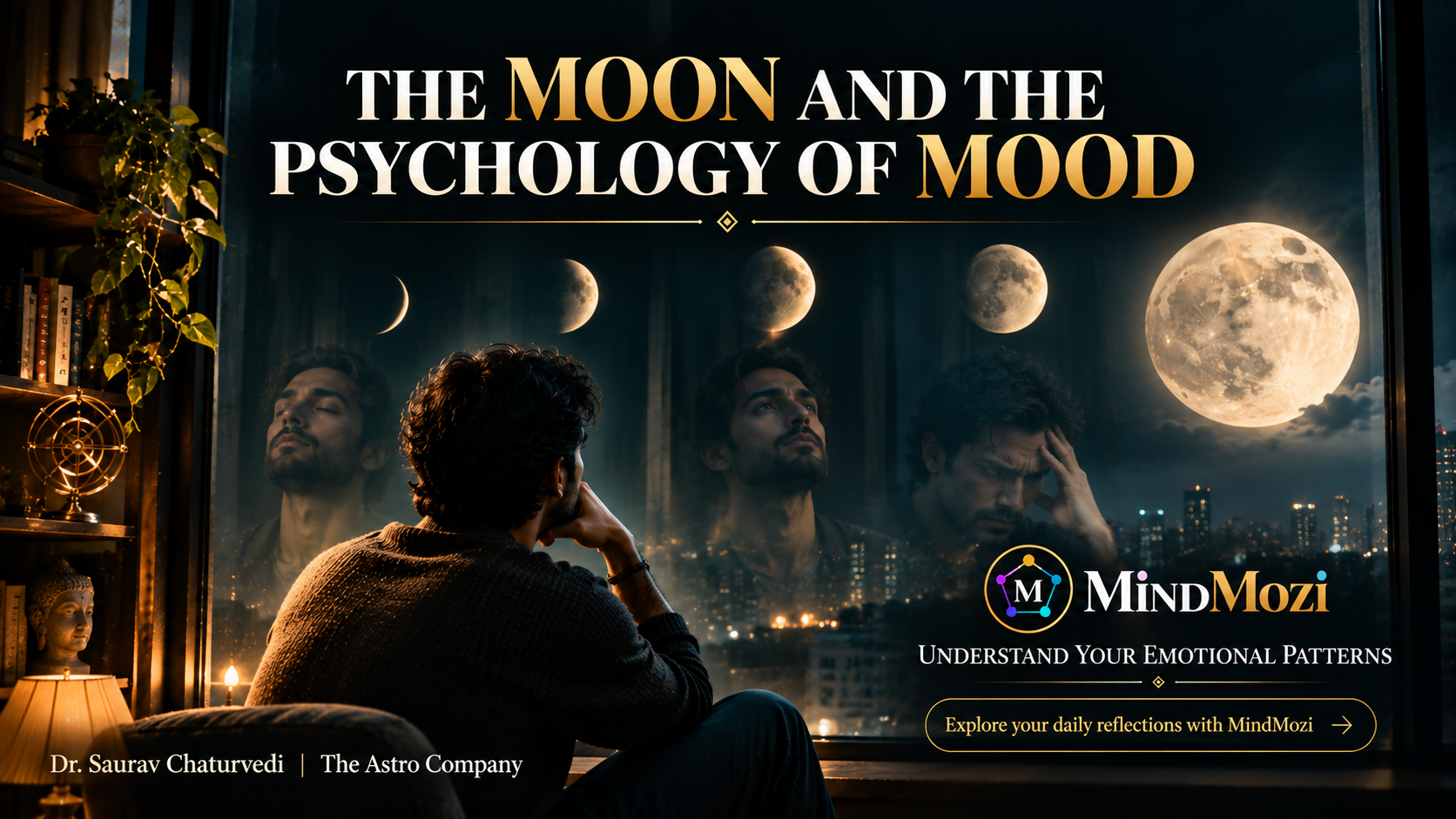
Why do our emotional states change? What does psychology say about mood regulation, and why does Vedic astrology give the Moon such an important place in understanding the mind?
Have you ever had a day when everything seemed perfectly manageable, and then, without any obvious reason, the same problems suddenly felt overwhelming?
Perhaps you became unusually sensitive to someone’s words. Maybe you felt restless, withdrawn or emotionally exhausted. Or perhaps you woke up feeling unusually optimistic, even though nothing significant had changed in your life.
We often describe these experiences by saying, “My mood is off today.”
But what exactly is a mood?
And why does it change?
Psychology approaches mood through the interaction of biological rhythms, sleep, stress, cognition, memory, physical health and our environment. In traditional Vedic astrology, the Moon is given a central symbolic role in understanding the mind, emotional responsiveness and subjective experience.
These are two different frameworks. They should not be confused with one another. But examining them side by side can give us an interesting way to think about our emotional lives.
1. What is mood, and how is it different from an emotion?
We often use the words mood and emotion interchangeably. Psychology makes a useful distinction.
An emotion is generally a response to something: an event, a thought, a memory, a perceived threat or an interaction.
For example:
- Someone criticises you, and you feel hurt.
- You receive good news, and you feel excited.
- You face uncertainty, and you experience fear.
A mood, on the other hand, is often a more sustained emotional state. It may not have one obvious trigger. It can influence how we interpret several different events throughout the day.
Imagine waking up feeling irritable.
Your coffee is slightly late. A colleague asks an ordinary question. A traffic jam develops. Each event may seem more frustrating than it normally would.
The events are different, but your underlying mood may be influencing how you experience them.
This is important because our mood does not simply reflect what is happening around us. It can also influence how we interpret what is happening.
2. Why does our mood change?
Mood is not controlled by one psychological mechanism. It emerges from several interacting systems.
A. Sleep and circadian rhythms
Sleep is one of the most important factors in emotional regulation.
Insufficient or disrupted sleep can affect attention, emotional reactivity, impulse control and our ability to regulate responses to stressful situations.
Our circadian rhythm—the internal biological timing system—helps coordinate sleep, alertness, hormone release and other physiological processes.
This means that a person who has slept poorly may experience ordinary challenges as more demanding.
Sometimes, what feels like an emotional problem is partly a recovery problem.
B. Stress and cognitive interpretation
The same event can produce different emotional responses depending on our expectations, previous experiences and current stress levels.
Consider a delayed reply from someone you care about.
One person may think, “They’re probably busy.”
Another may think, “Something is wrong. Perhaps they’re losing interest.”
The external event is identical. The interpretation is different.
Our emotional state is influenced not only by what happens, but also by the meaning we assign to it.
C. Memory and emotional associations
Our brains do not process every experience independently.
A present situation can activate memories of previous experiences. A particular tone of voice, facial expression or type of uncertainty may remind us of something painful.
We may react more strongly than the current situation alone would seem to justify.
This does not mean that the reaction is imaginary. It means that the current event may be interacting with an older emotional association.
D. Physical health and daily behaviour
Nutrition, movement, illness, pain, medication, hormonal changes and substance use can all influence how we feel.
For example, fatigue can reduce our tolerance for frustration. Persistent stress can affect sleep. Pain can influence attention and emotional resilience.
Mood should therefore not always be interpreted as a purely psychological or spiritual experience.
If changes in mood are persistent, severe or interfere with everyday life, a qualified healthcare professional can help assess possible psychological and physical contributors.
3. Does the Moon actually influence human mood?
This is where the discussion becomes interesting.
The Moon has a powerful cultural and symbolic presence. Across history, people have associated lunar phases with sleep, behaviour, fertility and emotional changes.
But what does scientific research actually establish?
The evidence does not support the popular claim that a full Moon reliably makes people emotional, aggressive or mentally unstable.
A 2023 study by Kym Kaufmann examined 7,153 behavioural occurrences across 627,763 patient-days in a psychiatric hospital over seven years. It found no statistically significant lunar pattern in those occurrences.
Other research examining psychiatric presentations has also failed to establish a reliable increase during particular lunar phases.
There is, however, a more nuanced research question: sleep.
A 2013 laboratory study by Cajochen and colleagues reported changes in sleep measures around the full Moon, including reduced deep-sleep activity and a shorter sleep duration. A 2021 study by Casiraghi and colleagues found later sleep onset and shorter sleep before the full Moon in several populations, including participants in urban environments.
But the findings are not uniform. A large population-based study published in 2016 found no significant overall effect of lunar phases on sleep quality or duration. A study involving 852 participants, published in 2022, reported associations between the waxing phase and certain sleep measures, with differences between men and women.
So what can we conclude?
There are studies exploring possible relationships between lunar cycles and sleep. Their results are mixed and require careful interpretation.
That is very different from demonstrating that the Moon directly determines a person’s mood, personality or mental health.
We should not use lunar phases to explain away depression, anxiety, emotional distress or psychiatric symptoms.
4. Why is the Moon so important in Vedic astrology?
In traditional Jyotish, the Moon is one of the most important grahas for understanding the mind.
The Sanskrit term Manas broadly refers to the mind, including sensory processing, thoughts, reactions and the movement of subjective experience.
The Moon is traditionally associated with Manas, emotional responsiveness, nourishment, receptivity and the experience of comfort and security.
This makes the Moon particularly relevant when examining how a person experiences life internally.
For example, two people may face the same professional setback.
One may immediately look for a solution. Another may experience emotional disappointment. A third may withdraw and need time before responding.
Psychology would investigate the person’s learning history, coping strategies, personality, stress and current circumstances.
A Jyotish astrologer may examine the Moon’s placement, dignity, house, sign lord, conjunctions and aspects as part of a broader symbolic interpretation.
These are different forms of explanation. A birth chart should not be treated as a scientifically validated psychological assessment.
5. How to examine the Moon in a Vedic birth chart
A serious interpretation does not stop at the Moon sign.
Several chart factors need to be considered together.
A. Moon sign and dignity
The Moon occupies a sign that provides the starting context for interpretation.
In traditional Jyotish:
- The Moon is exalted in Taurus.
- It is in its own sign in Cancer.
- It is debilitated in Scorpio.
These dignity conditions are important, but they do not independently determine whether someone is emotionally stable, sensitive or volatile.
The strength of the Moon must be considered in relation to its dispositor, aspects, conjunctions, house placement and other chart factors.
B. The house occupied by the Moon
The house shows the area of life through which lunar themes may be expressed.
For example:
- 1st house: The Moon may become especially prominent in how the person experiences and presents themselves.
- 4th house: Themes of home, emotional foundations, comfort and belonging become important.
- 5th house: Emotional expression may be explored through creativity, learning, affection and intelligence.
- 7th house: Relationships and interpersonal exchange may become significant to the person’s subjective experience.
- 10th house: Public life, professional responsibilities and visibility may become prominent areas of emotional investment.
- 12th house: Privacy, withdrawal, sleep, retreat and inward experience may become relevant themes.
These are interpretive starting points, not fixed personality descriptions.
C. The Moon’s dispositor
The dispositor is the planet ruling the sign occupied by the Moon.
For example, if the Moon is in Leo, the Sun becomes its dispositor.
An astrologer must then examine the Sun’s house, sign, dignity, conjunctions and aspects.
Why does this matter?
Because the Moon cannot be interpreted independently of the planet that rules its sign. The condition of the dispositor adds another layer to the interpretation.
D. Aspects and conjunctions
The planets influencing the Moon can modify its traditional interpretation.
For instance:
- A connection with Jupiter may be considered in relation to wisdom, optimism, guidance and emotional perspective.
- A connection with Saturn may bring themes of restraint, duty, seriousness and emotional responsibility.
- A connection with Mars may introduce themes of action, intensity, courage and reactivity.
- A connection with Mercury may emphasise thinking, communication, analysis and mental activity.
- A connection with Rahu may be interpreted through themes of amplification, unusual preoccupation or heightened desire.
These are broad symbolic possibilities. The outcome depends on the nature of the relationship, planetary dignity, functional lordship, house ownership, dispositor and the full chart.
A conjunction does not automatically create a psychological problem.
E. Paksha Bala and lunar strength
The Moon’s phase is also relevant in traditional Jyotish.
Paksha Bala refers to strength associated with the lunar fortnight. The waxing and waning relationship between the Moon and Sun is considered in classical planetary-strength assessment.
The bright Moon is traditionally treated as having greater natural beneficence than a very dark Moon, but this should not be reduced to a claim that waxing Moon individuals are always happier or waning Moon individuals are emotionally unstable.
Strength, beneficence and actual chart results are not interchangeable concepts.
F. The Moon’s lordship and operating Dasha
The Moon also rules a house according to the ascendant.
Its functional role therefore changes across different ascendants. A reading must consider which house the Moon owns, where it is placed and how it is connected with other house lords.
The operating Dasha can bring lunar themes into focus when the Moon or its connected planets are activated.
Transits may provide timing context, but they should not be used to predict a person’s emotional state with certainty.
6. Three hypothetical examples: the same Moon, different possibilities
Consider three simplified hypothetical configurations.
These examples demonstrate why one placement cannot be used as a complete personality diagnosis.
Example 1: Moon in the 4th house, supported by Jupiter
A traditional interpretation might emphasise emotional foundations, family, learning, guidance and a search for inner stability. The Jupiter connection may add themes of perspective and support.
It would be simplistic to conclude that this person will always be emotionally calm.
Example 2: Moon connected with Saturn
This may be interpreted through themes of emotional restraint, responsibility, seriousness and delayed expression.
In one chart, this may support patience and endurance. In another, it may describe a heavier experience of duty or emotional inhibition.
The Moon’s dignity, Saturn’s functional lordship, the house involved and other influences all matter.
Example 3: Moon connected with Mars
This may be interpreted through themes of quick responses, initiative, emotional intensity or a tendency to act before reflecting.
Depending on the chart, the same connection may be expressed as courage, decisiveness, impatience or conflict.
These examples are traditional astrological interpretations, not scientifically validated predictions of behaviour.
7. What can we learn from the psychology–Jyotish comparison?
Psychology and Jyotish approach the mind differently.
Psychology investigates observable processes and develops explanations through research, measurement and theory.
Jyotish uses a symbolic planetary and house framework to interpret patterns of experience and life themes.
There is one useful point of comparison: both encourage us to look beyond a single visible reaction.
A person’s mood is not simply a response to the latest event. It may be influenced by sleep, stress, memory, interpretation, physical health and relationship experiences.
Likewise, a traditional Jyotish interpretation should not stop at the Moon sign. It examines the Moon in the context of the entire horoscope.
But we must not confuse conceptual similarity with scientific proof. The fact that both frameworks discuss the mind does not establish that planetary positions cause psychological states.
8. Five practical ways to understand your own mood
You do not need to know your birth chart to begin understanding your emotional patterns.
Try these steps:
- Track sleep: Note when you slept, how long you slept and how rested you felt.
- Identify triggers: Write down what happened before a noticeable mood change.
- Separate event from interpretation: What actually happened, and what meaning did you assign to it?
- Check physical factors: Consider stress, pain, illness, activity, medication and other relevant health factors.
- Look for patterns over time: A single difficult day tells you very little. Repeated observations may reveal more useful patterns.
The goal is not to control every emotional experience. It is to understand it with greater clarity.
9. Explore your emotional patterns with MindMozi
MindMozi is an AI-powered personal guidance and self-reflection app developed by Dr. Saurav Chaturvedi. It combines psychology-informed reflection, personalised Vedic astrology, daily guidance and five distinct AI personalities in one platform.
The idea is simple: sometimes we need a supportive conversation, sometimes an honest challenge, sometimes practical direction, and sometimes a traditional astrological perspective.
MindMozi offers five conversational personalities:
- Caring Companion: A supportive space to express feelings and explore difficult experiences without judgement.
- Honest Best Friend: A candid perspective that challenges assumptions and helps examine alternative explanations.
- Strict Mentor: Practical guidance, structure and accountability for taking action.
- Calm Therapist-style Companion: Helps users organise thoughts, explore emotional patterns and reflect on experiences. It is not a replacement for a qualified mental health professional.
- Personal Vedic Astrologer: Explores the user’s birth chart, planetary periods and traditional Jyotish interpretations.
For this topic, you could ask:
Caring Companion: “My mood has been changing a lot lately, and I don’t always understand why. Help me explore what might be affecting me.”
Honest Best Friend: “I keep blaming external situations for my mood. Help me examine whether my interpretation of events is making things worse.”
Strict Mentor: “Help me create a simple daily routine to track my sleep, stress, emotional triggers and mood.”
Calm Therapist-style Companion: “Help me distinguish what happened, what I thought about it, what I felt and how I responded.”
Personal Vedic Astrologer: “Explain the Moon’s condition in my birth chart, including its sign, house, dispositor, aspects, conjunctions, dignity and functional lordship. Give alternative traditional interpretations without treating placements as psychological diagnoses.”
MindMozi also offers three daily guidance features:
Free Daily Psychological Energy: A daily psychological reflection that helps users think about their emotional themes, mindset and approach to the day.
Daily Planetary Transits: Current planetary movements interpreted in the context of the user’s birth chart, offering a personalised traditional astrological perspective.
Daily Choghadiya: Traditional Vedic time-window guidance that helps users understand the day’s favourable and less favourable periods for different activities.
These features make MindMozi more than a conversational AI app. It brings daily psychological reflection, personalised Vedic astrology, traditional timing guidance and five different conversational perspectives together.
MindMozi — Five Minds. One App. Total Clarity.
10. The Moon may be a symbol, but your mood deserves attention
The Moon has occupied a central place in human imagination for thousands of years. In Jyotish, it provides an important symbolic language for exploring the mind and emotional experience.
Psychology, meanwhile, reminds us that mood is influenced by multiple interacting factors, many of which can be observed and addressed.
So the next time your mood changes, rather than immediately blaming the Moon—or blaming yourself—pause and ask:
Did I sleep well? Am I under stress? What happened today? What meaning did I assign to it? Is there a pattern I have not noticed yet?
Self-understanding begins when curiosity replaces automatic judgement.
If you want to explore the Moon and its role in your own horoscope, you can consult Dr. Saurav Chaturvedi through The Astro Company.
If you want to reflect on your daily emotional patterns through multiple perspectives, explore MindMozi.
MindMozi supports general guidance and self-reflection. It is not a diagnostic tool or a replacement for professional mental health care.