
There is a strange contradiction in human behaviour:
We can desperately want something to change — a new career, a healthier relationship, a different city, a new identity, a better life — and still feel anxious when the opportunity to actually change arrives.
We say:
“I want to leave.”
“I want to start over.”
“I want something different.”
And then, when change becomes real, something inside us says:
“Wait. Maybe not yet.”
Why?
Because wanting a different outcome and feeling psychologically ready for uncertainty are two different things.
We don’t always fear change itself
Often, what we fear is what change makes uncertain.
A familiar situation gives us predictability.
Even if the situation isn’t ideal, we know how it works.
We know what tomorrow probably looks like.
We know our role.
We know the people involved.
We know what is expected from us.
Change removes some of that information.
And that creates uncertainty.
Research on intolerance of uncertainty has shown that difficulty tolerating uncertain situations is an important psychological factor across anxiety-related problems. PubMed
This creates an interesting paradox:
The known can feel safer than the unknown, even when the known is painful.
That is why someone can remain in an unfulfilling relationship.
Stay in a job they dislike.
Continue living according to an outdated identity.
Or postpone something they have wanted for years.
Not because they don’t want change.
Because the alternative is uncertain.
Familiar pain can feel safer than unfamiliar possibility
Imagine someone who has spent five years in a career they no longer enjoy.
They receive an opportunity to start something completely different.
Logically, the opportunity makes sense.
Emotionally, it feels terrifying.
The old career gives them frustration.
The new career gives them uncertainty.
And the brain doesn’t necessarily evaluate those two experiences simply as:
bad vs good.
It also evaluates:
known vs unknown.
That distinction matters.
Sometimes people don’t choose what is best.
They choose what is psychologically predictable.
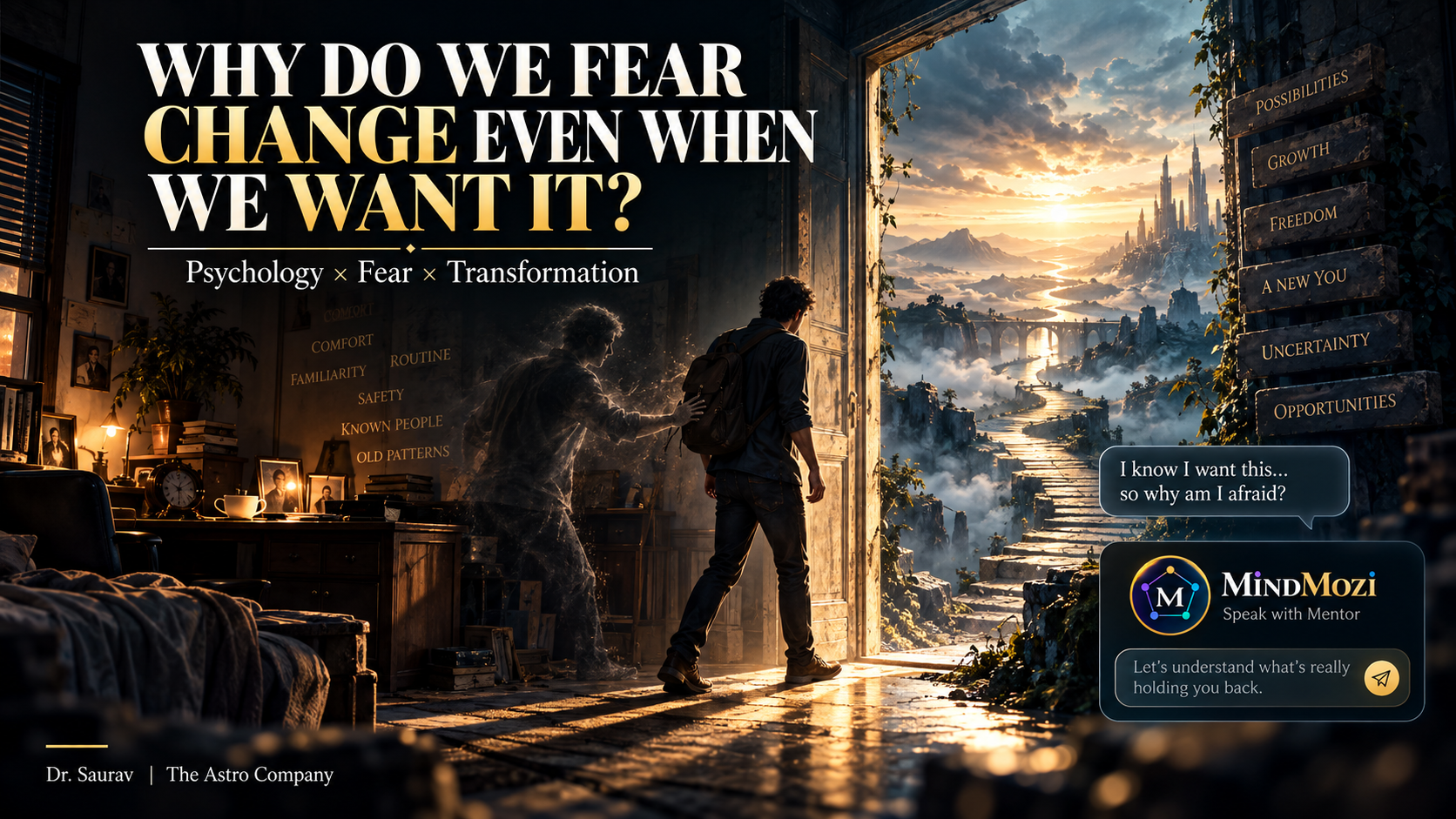
Change also threatens identity
There is another layer.
Change doesn’t only ask:
“What will happen to my life?”
Sometimes it asks:
“Who will I become?”
A person leaving a long relationship may have to discover who they are without that partner.
Someone leaving a successful career may have to discover who they are without the professional identity.
Someone setting boundaries with family may have to discover who they are when they stop playing their old role.
This is why major transitions can feel strangely personal.
You aren’t simply changing circumstances.
You may be changing your relationship with yourself.
Psychology calls for flexibility
One useful concept here is psychological flexibility — the ability to remain connected with the present moment and act according to meaningful values even when uncomfortable thoughts and emotions are present.
Recent reviews continue to find psychological flexibility relevant to mental health and psychological functioning, while research on Acceptance and Commitment Therapy explores ways of reducing psychological inflexibility and increasing flexible, values-based action. PubMed
The goal, therefore, isn’t:
“Stop being afraid.”
It is:
“Can I move even while some fear is present?”
That’s a very different question.
The astrology perspective
Vedic astrology offers a symbolic language for thinking about this tension.
Saturn is traditionally associated with limitation, responsibility, fear, delay and the structures that make life feel predictable.
Rahu, in contrast, is often interpreted through themes of desire, unfamiliar territory, experimentation and movement beyond established boundaries.
From a symbolic perspective, the tension between Saturn and Rahu can therefore be read as:
“I know I need to move forward, but part of me wants to remain inside what I already understand.”
The Moon can also be considered when exploring emotional security and attachment to familiarity.
But this is an astrological interpretive framework, not a scientifically established explanation of why someone fears change.
Psychology and astrology are answering different questions.
Psychology asks:
What mechanisms may be producing this behaviour?
Astrology asks:
What symbolic patterns might help us reflect on this behaviour?
Keeping that distinction clear makes the conversation much more interesting.
Ask yourself this
Think about one change you keep postponing.
Now complete these sentences:
“If I actually make this change, I am afraid that…”
And then:
“If nothing changes for the next three years, I am afraid that…”
The second question is often more revealing.
Because sometimes the real problem isn’t fear of change.
It’s the fear of discovering that staying the same also has a cost.
Change doesn’t require certainty
You don’t need to know exactly what happens next.
You don’t need to feel completely fearless.
You don’t even need to feel ready.
Sometimes the psychological challenge is simply learning to tolerate enough uncertainty to take the next meaningful step.
That is where transformation often begins.
Not when fear disappears.
But when fear stops making every decision.
Where MindMozi fits in
This is also the kind of question I built MindMozi to explore.
MindMozi is an AI trained by me across psychology, astrology and philosophy, with different perspectives you can talk to depending on what you’re trying to understand.
You can speak with the Mentor when you need direction.
The Best Friend when you need an honest but supportive perspective.
The Oracle when you want an astrological lens.
Or simply use it as an AI Companion to think through something you haven’t been able to articulate clearly.
Sometimes you don’t need someone to tell you what decision to make.
You need another perspective to understand why the decision feels so difficult.
The deeper question
Maybe the question isn’t:
“Why am I afraid of change?”
Maybe it is:
“What am I afraid I will lose if I change?”
Because behind many forms of resistance is an attachment:
to certainty,
to identity,
to familiarity,
to approval,
or simply to the version of ourselves we already know.
And sometimes growth begins when we realise:
The life we are afraid to leave may already be a life we have outgrown.
Want to explore this through your own birth chart? You can consult Dr. Saurav Chaturvedi through The Astro Company.
Or explore the question conversationally with MindMozi.
Research & Further Reading
- Carleton, R. N. — Into the unknown: A review and synthesis of contemporary models involving uncertainty.
- Morriss, J. — Psychological mechanisms underpinning change in intolerance of uncertainty across anxiety-related disorders.
- Sahib et al. — Intolerance of uncertainty and emotion regulation: A meta-analytic and systematic review.
- Macri & Rogge — Examining domains of psychological flexibility and inflexibility as treatment mechanisms in Acceptance and Commitment Therapy.
- Chalghaf et al. — Psychological Flexibility and Mental Health: Theoretical Foundations, Empirical Support, and Applications Across Clinical Contexts.
The research supports the relevance of uncertainty intolerance and psychological flexibility, but it does not scientifically validate astrology as a causal explanation.