
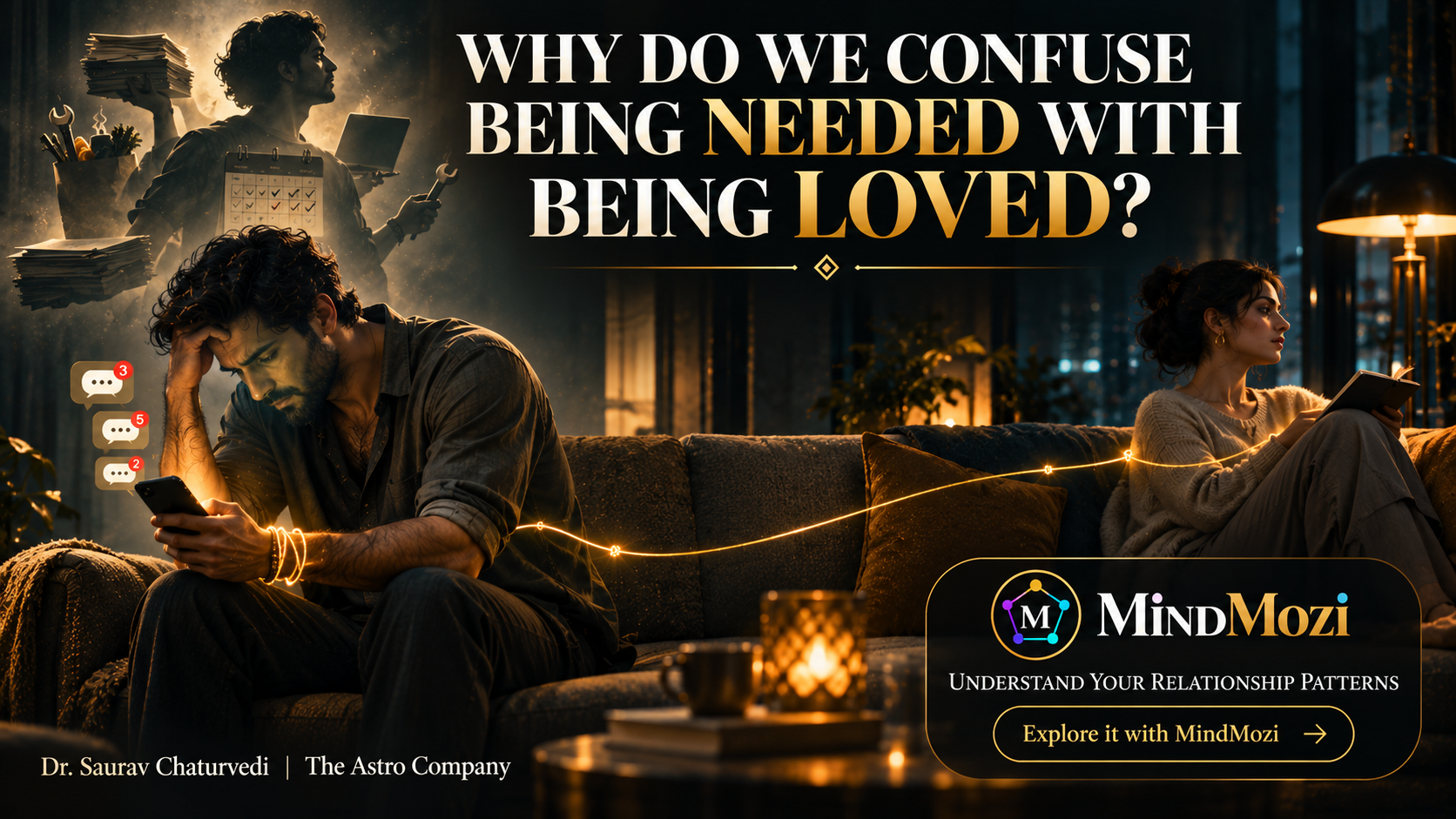
Psychology, emotional dependency, relationship patterns and the Vedic astrology perspective.
There is a particular kind of relationship in which one person is always available.
They solve problems. They remember everything. They provide emotional support. They sacrifice their time, rearrange their priorities and become the person everyone turns to when life becomes difficult.
From the outside, they may appear deeply loved.
But privately, they may be carrying a question they rarely say aloud:
If I stopped being useful, would this person still want me?
This question reveals an important distinction in relationship psychology: the difference between being needed and being loved.
Being needed can make us feel important. Being loved makes us feel valued even when we have nothing to offer at that particular moment.
The two experiences can coexist, but they are not interchangeable.
1. Why being needed feels so powerful
Human beings have a fundamental need for connection, belonging and significance. Relationships give us opportunities to contribute, care for others and experience mutual support.
Helping someone can be genuinely rewarding. It can strengthen trust, create intimacy and communicate affection.
The difficulty begins when our sense of worth becomes dependent on how much another person needs us.
Consider two internal experiences:
- “I enjoy supporting this person because I care about them.”
- “I need this person to depend on me because otherwise I don’t know what I mean to them.”
The first describes care. The second suggests that usefulness may have become a source of emotional security.
In the second situation, helping is no longer only an expression of affection. It can also become a way of protecting ourselves from rejection, abandonment or irrelevance.
We may begin to confuse someone’s dependence on us with their emotional commitment to us.
2. The psychology behind the need to be indispensable
Several psychological processes can contribute to this pattern. None of them, by itself, establishes a diagnosis.
A. Self-worth through usefulness
Some people learn to associate being valuable with being helpful, responsible or emotionally available.
They may have grown up in environments where they received more appreciation for achievement, obedience, caretaking or solving problems than for simply expressing their needs.
Over time, an internal rule can develop:
I am valuable when I do something for someone.
This can make receiving affection without earning it feel unfamiliar.
When a partner says, “I love you,” the person may appreciate the words but still feel more secure when the partner needs their advice, money, support or constant attention.
B. Fear of abandonment
For someone who is sensitive to rejection, being indispensable can feel like a form of protection.
The reasoning may be unconscious:
“If they depend on me, they won’t leave.”
But dependence does not guarantee commitment. A person can rely heavily on someone without offering emotional reciprocity, respect or long-term commitment.
This creates a painful contradiction: the more someone tries to become irreplaceable, the more anxious they may become about being replaced.
C. Attachment patterns
Attachment theory offers a useful framework for understanding how people seek security in close relationships.
People with higher attachment anxiety may become especially sensitive to signs of distance or rejection. Some may respond by increasing their efforts to secure closeness, seeking reassurance or becoming excessively attentive to a partner’s needs.
Other people may cope with vulnerability by minimising their own needs, becoming highly self-reliant or avoiding emotional dependence.
These are tendencies, not fixed personality categories. Attachment patterns can vary across relationships and change with experience.
D. The caretaker identity
There is another subtle pattern: some people become so accustomed to looking after others that they struggle to identify who they are outside that role.
They may choose partners who need rescuing, repeatedly take responsibility for other people’s emotions, or feel uncomfortable when a relationship becomes balanced.
Why?
Because equality can remove the role that has made them feel important.
They know how to be the rescuer. They may not know how to be an equal partner who can receive care.
The term codependency is often used in everyday conversation to describe some of these dynamics. However, it is not a single, universally agreed clinical diagnosis. It is more useful to examine the actual behaviours: over-responsibility, difficulty setting boundaries, loss of personal identity and one-sided emotional labour.
3. When caring becomes a way of securing love
Imagine someone who always makes the first call, resolves every disagreement, remembers every important date and adjusts their schedule whenever their partner needs something.
Initially, these actions may come from genuine affection.
But gradually, something changes.
They become uncomfortable when their partner handles a problem independently. They feel rejected when their help is not required. They may even become frustrated when the other person becomes more emotionally independent.
This does not necessarily mean they consciously want the other person to struggle.
It may mean that their own sense of importance has become tied to being the solution.
The relationship can then develop an imbalance:
- One person repeatedly takes responsibility.
- The other person becomes accustomed to receiving that support.
- The caretaker begins expecting appreciation, closeness or reassurance in return.
- When those expectations are not met, resentment develops.
- The caretaker may give even more, hoping to restore the connection.
This pattern is not inevitable, and responsibility does not always sit with one person. A partner who repeatedly accepts support while avoiding reciprocity can also contribute to the imbalance.
The important question is whether care is freely given or emotionally required as proof of love.
4. Being needed versus being loved: how can we tell the difference?
Being needed is not inherently unhealthy. Healthy relationships involve mutual reliance. We need one another in practical, emotional and relational ways.
The distinction is whether the relationship also allows each person to exist beyond what they provide.
| Being needed | Being loved |
|---|---|
| Someone values what you do for them. | Someone values who you are. |
| Your importance may rise when they have a problem. | Your importance remains when life is going well. |
| You feel pressure to remain useful. | You can rest without fearing rejection. |
| Your needs may repeatedly take second place. | Both people’s needs matter. |
| Independence may feel threatening. | Independence can coexist with intimacy. |
| You are valued for what you provide. | Your presence, identity and individuality are valued too. |
These are not mutually exclusive categories. A healthy partner can need your support and love you deeply.
The real distinction is whether the relationship survives ordinary moments when you are not solving, fixing, giving or rescuing anything.
A useful question to ask yourself is: Would I still feel secure in this relationship if I stopped doing all the things that make me indispensable?
5. The Vedic astrology perspective: why do some people identify with the caretaker role?
Vedic astrology does not provide a scientifically established explanation for emotional dependency or attachment patterns. It offers a traditional symbolic framework through which astrologers interpret emotional needs, relationship expectations, responsibilities and interpersonal tendencies.
A meaningful reading requires the whole horoscope. No single planet or house can establish that someone is dependent, a rescuer or unable to maintain boundaries.
Several factors can be examined together.
The Moon: emotional security and responsiveness
The Moon represents the mind, emotional responsiveness and subjective experience in traditional Jyotish.
Its house placement, dignity, sign lord, conjunctions and aspects can be considered when exploring how a person seeks emotional security.
For example, a strongly relationship-oriented Moon configuration may be interpreted as placing considerable importance on emotional exchange and belonging. A more pressured configuration may be interpreted as involving greater emotional sensitivity or difficulty finding inner steadiness.
Neither interpretation automatically means that the person needs to be needed.
Venus: affection, attraction and relationship satisfaction
Venus is associated with affection, pleasure, harmony and relationship experience.
Its condition and the houses it rules can provide context for how a person approaches intimacy, appreciation and emotional fulfilment.
An astrologer would examine Venus alongside the Moon, the 7th house and its lord rather than interpreting Venus in isolation.
The 7th house and its lord: partnership and reciprocity
The 7th house is a central reference point for committed partnerships and one-to-one relationships.
Its lord’s placement, dignity, aspects and conjunctions can add context to relationship expectations.
A connection between the 7th lord and the 6th, 8th or 12th houses may invite a more detailed examination of service, conflict, vulnerability, shared obligations, loss or sacrifice. But these connections have multiple possible manifestations and must be judged in the context of the complete chart.
The 4th house: inner security
The 4th house is traditionally associated with emotional foundations, home, comfort and inner contentment.
When exploring the need to feel secure through another person, the 4th house, its lord and the Moon can be considered together.
This is particularly relevant because someone may appear extremely confident and capable in public while privately seeking reassurance through a close relationship.
The 6th house: service, duty and obligation
The 6th house is associated with service, duties, conflict, debts and responsibilities.
In a relationship-focused interpretation, connections between the 6th house and relationship factors may be explored for themes of obligation, unequal effort or a tendency to approach relationships through responsibility.
However, the 6th house is not a codependency indicator. It can also represent disciplined service, problem-solving and the ability to handle practical difficulties.
Saturn: responsibility, commitment and emotional restraint
Saturn is associated with duty, discipline, endurance, boundaries and responsibility.
Its relationship with the Moon, Venus or the 7th lord may be considered when examining themes of emotional restraint, commitment and the weight of responsibility.
Depending on the entire chart, these combinations may be interpreted as mature commitment and reliability, or as experiences of emotional heaviness and obligation.
The distinction cannot be made from a single conjunction.
Why the Navamsha matters
The Navamsha (D9) is an important divisional chart in traditional Vedic astrology, particularly in assessing marriage and the deeper strength and context of planetary indications.
For a relationship question, an astrologer may compare the D1 and D9 charts, examine relevant planetary dignity and lordships, and consider the operating Dasha.
The purpose is not to label someone as emotionally dependent. It is to explore how relationship themes may be expressed and how they change over time.
The central Jyotish question is not simply whether someone gives too much. It is how emotional security, affection, partnership, service and responsibility interact across the horoscope.
6. How to stop confusing usefulness with love
The solution is not to stop caring for people. It is to develop relationships in which care does not require self-erasure.
1. Notice when you are helping out of fear
Before offering help, ask:
“Am I doing this because I genuinely want to, or because I am afraid of what might happen if I don’t?”
The answer may be mixed. The objective is awareness, not guilt.
2. Practise receiving without immediately reciprocating
Allow someone to help you without feeling that you must repay them instantly.
Healthy intimacy involves both giving and receiving.
3. Set boundaries without treating them as rejection
You can love someone and still say no.
You can be supportive without being available every minute.
You can care about another person’s difficulties without assuming responsibility for solving every one of them.
4. Build an identity outside relationships
Maintain friendships, interests, goals, physical activities and ambitions that do not depend on your partner’s participation.
Your relationship can be an important part of your identity without becoming its entire foundation.
5. Observe reciprocity
Ask yourself:
- Does this person show interest in my life when they do not need anything?
- Can I express vulnerability without feeling inconvenient?
- Are my boundaries respected?
- Does the relationship make room for both people’s needs?
- Can we enjoy each other’s company without a problem that needs solving?
If the answers repeatedly point towards one-sidedness, the issue may not be only your need to feel useful. The relationship itself may need attention.
If these patterns are persistent, distressing or difficult to change, working with a qualified mental health professional can help.
7. Explore your relationship patterns with MindMozi
Sometimes, understanding a relationship requires more than one perspective.
MindMozi is an AI-powered personal guidance and self-reflection app developed by Dr. Saurav Chaturvedi. Its approach combines psychology-informed reflection, Vedic astrology and five distinct AI personalities to help users examine personal questions from different angles.
MindMozi is designed around five perspectives:
- Caring Companion: A supportive space to express difficult feelings without judgement.
- Honest Best Friend: A candid perspective that challenges assumptions and uncomfortable patterns.
- Strict Mentor: Practical guidance, accountability and steps towards behavioural change.
- Calm Therapist-style Companion: Helps organise emotions, thoughts and personal experiences through reflective conversations. It is not a substitute for a qualified therapist.
- Personal Vedic Astrologer: Explores your birth chart, planetary periods and traditional Jyotish interpretations in the context of your questions.
For this particular topic, you could ask:
Caring Companion: “I feel important when someone depends on me, but I become anxious when they don’t need my help. Help me understand this feeling.”
Honest Best Friend: “Am I genuinely caring for my partner, or am I using my helpfulness to make myself indispensable? Challenge my assumptions.”
Strict Mentor: “Help me create boundaries so I can care about someone without taking responsibility for every problem in their life.”
Calm Therapist-style Companion: “Help me explore the difference between feeling loved, feeling useful and feeling afraid of being abandoned.”
Personal Vedic Astrologer: “Examine the Moon, Venus, 4th house, 6th house, 7th house and their lords in my birth chart. Explain how traditional Jyotish might interpret emotional security, service and relationship expectations. Include alternative interpretations and limitations.”
More than five conversational perspectives
MindMozi also offers daily features that make it useful beyond occasional conversations:
- Free Daily Psychological Energy: A daily psychological reflection to help users consider their mindset, emotional themes and approach to the day.
- Daily Planetary Transits: Astrological updates connecting current planetary movements with the user’s birth chart and relevant astrological context.
- Daily Choghadiya: Traditional Vedic time-window guidance for understanding favourable and less favourable periods for different activities.
This brings together everyday reflection, personalised astrological guidance and five distinct conversational perspectives in one AI-powered app.
MindMozi — Five Minds. One App. Total Clarity.
8. The question worth remembering
Perhaps the most important shift is this:
You do not have to become indispensable to deserve affection.
A relationship should not require you to remain exhausted, constantly available or endlessly useful just to feel secure.
It is perfectly healthy to be needed by someone you love. But you should also be able to rest, have boundaries, pursue your own life and occasionally need support yourself.
The right relationship does not only value what you do for someone. It makes room for who you are when you are doing nothing at all.
Explore further
If you want to understand how these themes appear in your own birth chart, you can consult Dr. Saurav Chaturvedi through The Astro Company.
If you want to explore your thoughts and relationship patterns through multiple perspectives, try MindMozi, the AI-powered guidance and self-reflection app with five personalities, free daily psychological energy, daily planetary transit insights and Choghadiya guidance.
MindMozi supports self-reflection and general guidance. It is not a diagnostic tool and does not replace professional mental health care.