
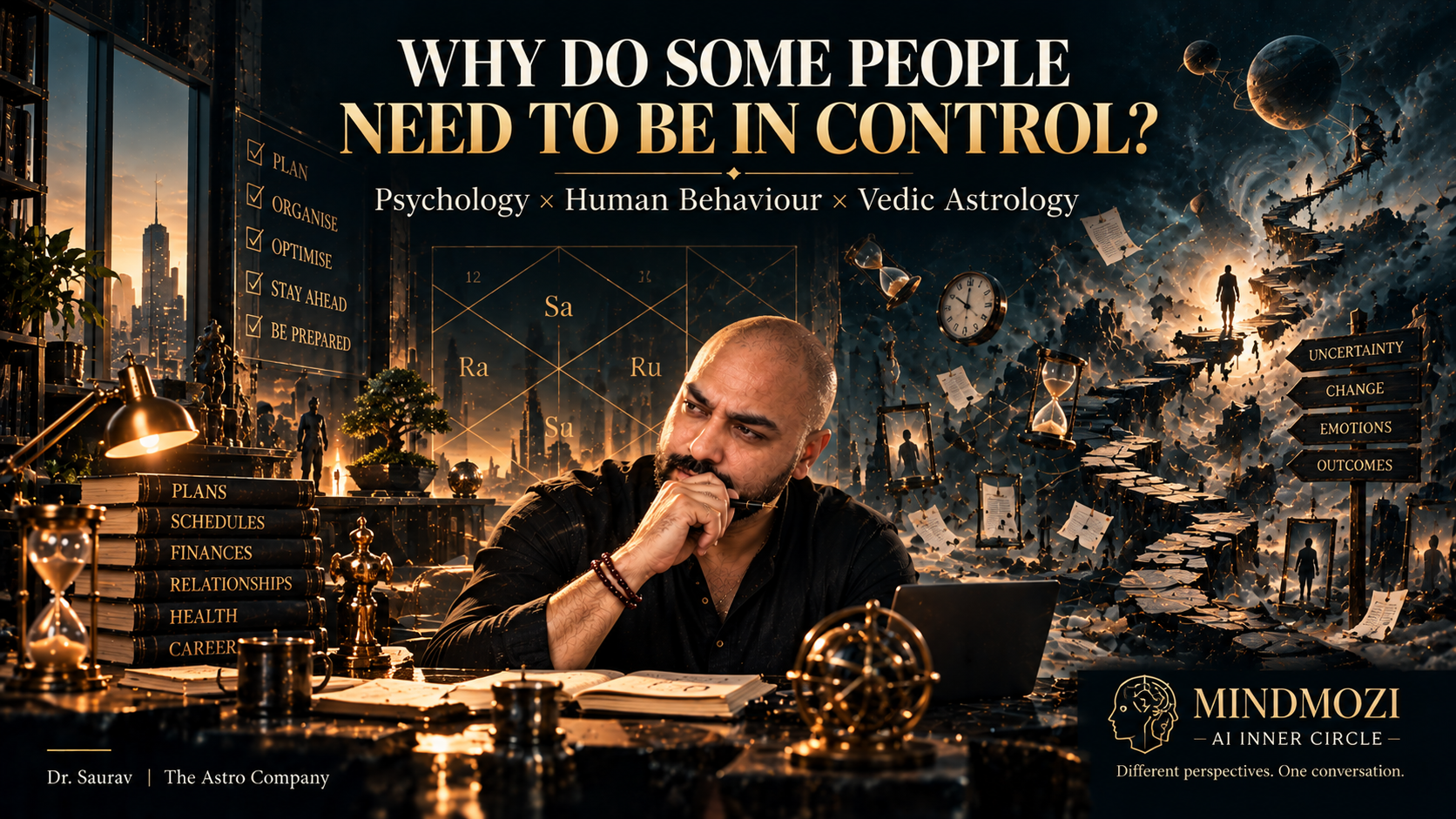
Why Do Some People Need to Be in Control?
Some people don’t just like having a plan.
They need one.
They want to know what is happening, what will happen next, who is responsible, what everyone should do, and what happens if something goes wrong.
When reality refuses to cooperate, they become uncomfortable.
Sometimes anxious.
Sometimes irritated.
Sometimes controlling.
But why?
Perhaps the deeper question isn’t:
“Why does this person need so much control?”
It is:
“What does control give them psychologically?”
Control isn’t necessarily a bad thing
We often use the word controlling as though it automatically describes a negative personality trait.
But psychology makes an important distinction between wanting control and controlling other people.
The desire for control can simply mean wanting to make your own decisions, influence outcomes and feel capable of affecting what happens in your life.
Psychologists have studied this as an individual difference called desirability of control—the extent to which people generally prefer to have control over events in their lives.
And there is a reason this desire exists.
A sense of control gives us something psychologically important:
agency.
The feeling that our actions matter.
That our choices can influence what happens next.
Research has associated perceived control with coping, wellbeing and responses to stress.
So the problem isn’t:
“I want control.”
The more interesting question is:
“What happens to me when I don’t have it?”
When control becomes a psychological strategy
Imagine two people facing the same uncertain situation.
Person A thinks:
“I don’t know what will happen, but I’ll deal with it when it does.”
Person B thinks:
“I need to know exactly what is going to happen.”
Person B may begin planning excessively.
Checking repeatedly.
Asking for reassurance.
Correcting other people.
Trying to predict every possible outcome.
From the outside, this can look like a desire for power.
But sometimes the behaviour is actually an attempt to reduce psychological uncertainty.
Understanding the mechanism doesn’t excuse controlling behaviour.
But it can help explain it.
Why uncertainty feels so uncomfortable
Think about everything you cannot completely control:
Other people’s decisions.
Relationships.
Career outcomes.
Timing.
Health.
Markets.
The future.
We can influence many of these things.
But we cannot guarantee them.
And that creates an important psychological distinction:
Influence is not the same as control.
You can prepare for an interview.
You cannot control whether you get the job.
You can communicate honestly.
You cannot control another person’s response.
You can love someone deeply.
You cannot guarantee that they will stay.
You can work incredibly hard.
You cannot completely control when success arrives.
For some people, accepting that boundary is relatively easy.
For others, it is deeply uncomfortable.
The hidden fear underneath control
This is where controlling behaviour becomes psychologically interesting.
Consider the thought:
“If I don’t control this, something bad will happen.”
There may be a deeper fear underneath it.
“If I don’t plan everything, I’ll fail.”
“If I don’t monitor the relationship, I’ll be abandoned.”
“If I don’t make the decision, someone will make the wrong one.”
“If I don’t stay productive, I’ll lose my value.”
“If I don’t know what happens next, I won’t be able to handle it.”
Now the behaviour looks different.
The control may not be the core problem.
It may be the strategy being used to manage fear.
Control in relationships
Relationships expose this particularly well.
You can control your own behaviour.
You can communicate.
You can establish boundaries.
You can decide what you will and won’t accept.
But you cannot control another person’s feelings.
You cannot manufacture love.
You cannot guarantee loyalty.
You cannot force emotional availability.
You cannot completely prevent rejection.
Yet uncertainty in relationships can sometimes trigger attempts to regain control:
More questions.
More checking.
More reassurance.
More rules.
More monitoring.
The paradox is that attempts to create security through control can sometimes damage the trust they were supposed to protect.
This doesn’t mean every controlling person is insecure.
Human behaviour is more complicated than that.
But it does suggest an important question:
What need is the controlling behaviour trying to satisfy?
The astrological perspective
Vedic astrology approaches these patterns through a completely different framework.
It doesn’t scientifically establish that particular planetary placements cause controlling behaviour.
But traditional astrology contains several symbols that can be interpreted through themes of agency, authority, structure and desire.
Mars is associated with action, assertion and the drive to act.
Saturn with boundaries, structure, discipline and limitation.
The Sun with individuality, authority and self-definition.
Rahu with amplification, craving and fixation.
But none of these should be reduced to:
“Strong Mars = controlling.”
or:
“Strong Saturn = rigid.”
The same symbolism can manifest differently.
Mars can represent aggression.
Or courage.
Saturn can represent rigidity.
Or discipline.
The Sun can represent domination.
Or healthy autonomy.
The entire chart—and the person’s actual life—matters.
Control versus agency
Perhaps the healthiest goal isn’t to eliminate the desire for control.
It is to understand where control ends.
Agency says:
“I will do what is within my power.”
Rigid control says:
“I need reality to behave according to my plan.”
Agency is flexible.
Rigid control is exhausting.
Because reality eventually reminds us that some things were never ours to control.
You can control your preparation.
Not the outcome.
You can control your boundaries.
Not another person’s choices.
You can control your effort.
Not the timing of success.
You can control your response.
Not reality itself.
The question beneath the behaviour
If you notice yourself becoming controlling, try asking:
“What am I actually trying to protect?”
Your success?
Your relationship?
Your reputation?
Your security?
Your sense of competence?
Your fear of being helpless?
That question takes us beneath the behaviour.
And beneath the behaviour is often where the real psychological pattern lives.
Perhaps the goal isn’t to control less
Maybe it is to control more intelligently.
Control what belongs to you.
Release what doesn’t.
Prepare without demanding certainty.
Set boundaries without trying to control another person.
Take responsibility without believing you control every outcome.
That is agency without the illusion of omnipotence.
And perhaps that is the deeper lesson hidden inside the psychology of control:
**We don’t become stronger by controlling everything.
We become stronger by becoming capable of functioning when we can’t.**
This is the kind of intersection between psychology, Vedic astrology and philosophy that I explore through The Astro Company.
And if you want to explore these patterns interactively, MindMozi brings these three perspectives together through an AI trained by Dr. Saurav.
Instead of only asking:
“Why am I like this?”
you can ask:
“What psychological need is this behaviour trying to fulfil?”
Sometimes the behaviour we judge most quickly is protecting a fear we haven’t yet understood.
Research & Further Reading
- Burger, J. M. & Cooper, H. M. — The Desirability of Control.
- Leotti, L. A., Iyengar, S. S. & Ochsner, K. N. — Born to Choose: The Origins and Value of the Need for Control.
- Fielder, J. C. et al. — research examining perceived control and stress.
- Wen, J. H. & Sin, N. L. — research on perceived control and responses to acute stressors.
- Burger, J. M. — research on desire for control and interpersonal interaction.