
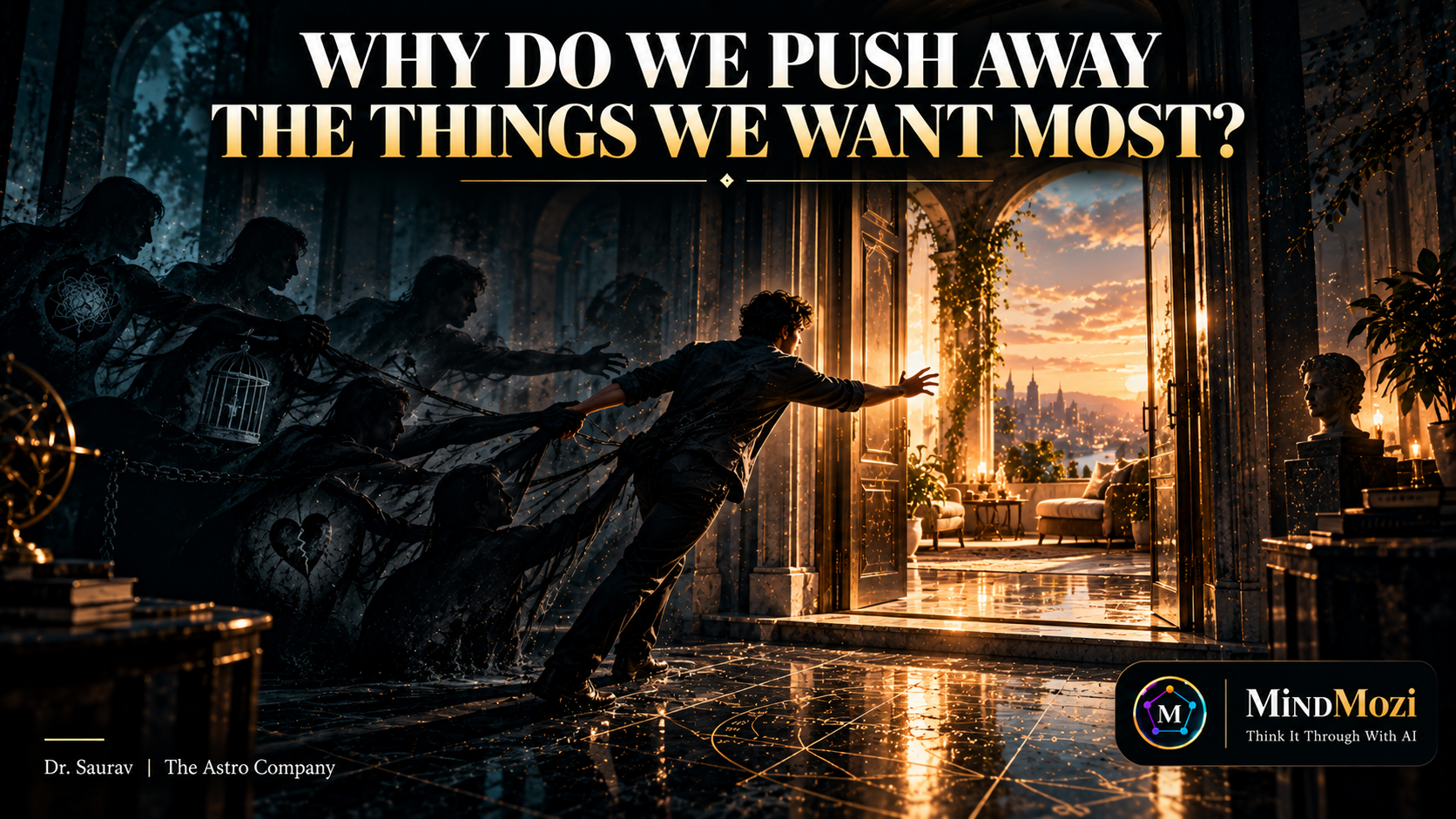
Have you ever wanted something deeply, only to find yourself avoiding it when it finally became possible?
Perhaps you wanted a meaningful relationship, but when someone genuinely available entered your life, you became distant. Perhaps you worked for years toward a professional opportunity, only to procrastinate when it was time to take the decisive step. Or perhaps you wanted to be understood, yet found yourself hiding the very parts of yourself you wished someone would accept.
These patterns can feel irrational. If we want something, shouldn’t we move toward it?
Not necessarily.
Human beings do not pursue rewards in isolation. We also anticipate risks, imagine possible losses, protect our identities, and try to manage uncomfortable emotions. Sometimes, the very thing we desire carries the possibility of an experience we fear.
We may want intimacy, but fear vulnerability. We may want success, but fear responsibility or exposure. We may want change, but fear losing the identity built around our present circumstances.
The result is a psychological conflict: we move toward the reward and away from the emotional risk attached to it.
Psychology offers several ways to understand this conflict. Vedic astrology offers a different, traditional interpretive framework through which people examine desire, attachment, fear, identity, and withdrawal. The two approaches should not be confused, but examining their questions side by side can produce a richer discussion of human behaviour.
1. When desire and fear operate at the same time
A common mistake is to assume that avoidance means a person does not genuinely want something.
Sometimes that is true. We may discover that a goal was imposed on us, that we were pursuing approval, or that the outcome no longer reflects our values.
But avoidance can also occur when a goal matters enormously.
Imagine someone who wants a stable romantic relationship. They meet a person who communicates consistently, respects boundaries, and expresses genuine interest. Instead of feeling only relief, they begin noticing flaws, delaying replies, questioning their attraction, or looking for reasons to leave.
Several explanations are possible. They may have recognised genuine incompatibility. They may need more time. They may be responding to a familiar pattern in which closeness feels threatening. One behaviour alone cannot tell us which explanation is correct.
The crucial question is not simply, “Do I want this person?”
It is also, “What might happen to me emotionally if I allow this relationship to become important?”
Closeness creates the possibility of rejection. Being known creates the possibility of being judged. Depending on another person introduces uncertainty. Even a healthy relationship cannot eliminate the risk of loss.
The mind may therefore treat distance as protection.
The same principle can appear outside relationships. A person may delay launching a business because the possibility of failure feels uncomfortable—but also because success would make them visible, accountable, and responsible for maintaining a new standard.
The desired outcome and the feared consequence can coexist.
2. The psychology of avoidance: relief now, cost later
One useful psychological concept is experiential avoidance: attempts to escape, suppress, or control uncomfortable internal experiences, such as fear, shame, uncertainty, sadness, or vulnerability.
Avoidance can provide immediate relief. If a difficult conversation makes us anxious, cancelling it may reduce that anxiety. If an important application makes us feel exposed, postponing it can make the discomfort temporarily disappear.
That relief can reinforce the behaviour.
The mind learns a simple lesson: “When I withdraw, I feel better.”
The difficulty is that short-term relief may come at the expense of a long-term goal. Repeatedly avoiding difficult conversations can weaken relationships. Avoiding meaningful opportunities can prevent us from discovering what we are capable of. Refusing to tolerate uncertainty can make uncertainty increasingly difficult to face.
Research on Acceptance and Commitment Therapy (ACT) examines psychological inflexibility, experiential avoidance, and the ability to take values-aligned action even when difficult thoughts and feelings are present. A 2024 systematic review and meta-analysis by Macri and Rogge examined 67 unique studies involving 9,123 participants and found that ACT interventions were associated with improvements in psychological flexibility and reductions in psychological inflexibility and distress. This does not mean that every instance of avoidance is unhealthy; it means avoidance can become costly when it repeatedly prevents meaningful action.
The aim is not to eliminate fear before acting.
It is to develop the ability to act thoughtfully while fear is present.
3. Why intimacy can feel threatening
Relationship avoidance deserves particular attention because people often mistake emotional distance for a lack of feeling.
Attachment research distinguishes between different dimensions of insecurity. Attachment anxiety can involve heightened concern about rejection and abandonment. Attachment avoidance can involve discomfort with dependence, closeness, or relying on another person.
These dimensions are not diagnoses, and people do not fit neatly into permanent categories. Responses can vary across relationships and situations.
Consider two people who both fear losing a relationship.
One may seek repeated reassurance, monitor the other person’s availability, and become distressed by delayed replies. Another may suppress the need for reassurance, minimise their attachment, or withdraw whenever emotional expectations increase.
Both may be trying to manage insecurity, but their strategies look very different.
A review by Overall, Pietromonaco, and Simpson, published in Nature Reviews Psychology in 2022, discusses how attachment anxiety and avoidance can influence cognitive, emotional, and behavioural responses in romantic relationships, particularly during stress.
This offers an important distinction: wanting closeness and feeling safe with closeness are not the same thing.
However, we should not automatically interpret every hesitation as an attachment problem. A person may be responding to poor treatment, incompatible values, inadequate trust, or a genuine lack of attraction. The context matters.
4. The Vedic astrology perspective: reading a pattern, not a single planet
In Vedic astrology, psychological themes are traditionally interpreted through combinations of planetary significations, houses, house lords, planetary relationships, dignity, and the condition of the chart as a whole.
A serious interpretation should not reduce fear to Saturn, desire to Venus, or detachment to Ketu. No single planet can responsibly explain an entire human behaviour pattern.
For this topic, several chart factors may be relevant, depending on whether we are examining romantic intimacy, ambition, personal transformation, or another kind of desired outcome.
The 1st house and its lord: identity and the self
The 1st house, its lord, and their condition are traditionally important in understanding the individual and the way the chart’s themes are organised around the self.
When exploring avoidance, we might ask: Does the symbolic pattern suggest tension between maintaining a familiar identity and entering a new role?
For example, someone may want a public leadership position while also feeling threatened by the visibility it requires. Another may desire intimacy while protecting a highly independent self-image.
These are interpretive questions—not conclusions that can be drawn from the 1st house alone.
The 5th house and its lord: attraction, romance, and personal investment
The 5th house is traditionally associated with romance, attraction, intelligence, creativity, and forms of personal expression. Its lord, placement, dignity, conjunctions, and aspects may add context when the question concerns romantic interest or the desire to pursue something personally meaningful.
The 5th house should not be treated as a complete substitute for the 7th house when analysing partnership. The distinction between attraction and sustained partnership is important.
The 7th house and its lord: partnership and relational engagement
The 7th house and its lord are central traditional factors when discussing committed partnership and one-to-one relationships.
A careful analysis asks:
- Where is the 7th lord placed?
- What sign occupies that house, and what is the lord’s dignity?
- Which planets conjoin or aspect the lord?
- What is the condition of its dispositor?
- How does the 7th lord relate to the 1st lord, Venus, the Moon, and other relevant factors?
- Are there contradictory indications elsewhere in the chart?
A placement must be interpreted in the context of the ascendant, functional lordship, planetary strength, and the whole chart. It is not enough to announce that a particular placement means commitment issues.
The 8th house and its lord: vulnerability, shared resources, and transformation
The 8th house is traditionally associated with sudden changes, vulnerability, hidden matters, shared resources, and transformation, among other significations.
When the subject is fear of emotional exposure, a reader might investigate whether the 8th house or its lord forms relevant connections with the 1st or 7th lord, Venus, or the Moon.
But the 8th house does not simply mean trauma, and an 8th-house connection does not establish that someone has experienced trauma. Such a claim would go far beyond what a symbolic chart interpretation can justify.
The 12th house and its lord: withdrawal, retreat, and release
The 12th house has traditional associations that include loss, expenditure, retreat, isolation, sleep, and liberation, with interpretation depending on the larger context.
For a topic about withdrawing from a desired experience, its connections may be worth examining. Yet the 12th house is not inherently negative, nor does it automatically signify self-sabotage.
Withdrawal can represent avoidance in one context and healthy solitude, contemplation, or release in another.
Venus, the Moon, Saturn, Mars, Rahu, and Ketu
These planets can contribute different symbolic dimensions to the analysis:
- Venus: attraction, pleasure, relationships, harmony, and what is valued.
- Moon: emotional experience, responsiveness, security, and familiar patterns.
- Saturn: responsibility, limits, delay, endurance, and confrontation with difficulty.
- Mars: assertion, desire, conflict, initiative, and defensive action.
- Rahu: intensification, appetite, ambition, and unconventional or consuming pursuits in many modern Jyotish interpretations.
- Ketu: detachment, separation, reduction of worldly attachment, and inward focus in traditional and modern interpretations.
These are broad traditional significations, not validated psychological measurements. The relevant question is how they interact with the houses and lords under consideration.
For instance, a Venus–Saturn connection should not automatically be translated as “fear of love.” Depending on the chart and the interpretive tradition, it may be read through themes of restraint, duty, commitment, delay, discrimination, or tension around pleasure. The complete configuration matters.
5. What house-lord placements and combinations can add
This is where deeper Jyotish interpretation becomes more useful than a list of planet meanings.
Imagine three hypothetical chart configurations in a discussion of romantic avoidance:
Configuration A: The relationship theme connects with vulnerability.
Suppose the 7th lord has a meaningful connection with the 8th house or its lord. A traditional astrologer might investigate themes of intimacy, shared vulnerability, uncertainty, or transformation in relationships.
That does not establish that the person fears intimacy. The connection needs to be assessed alongside planetary dignity, aspects, dispositors, the 1st lord, Venus, the Moon, and the rest of the chart.
Configuration B: Desire and restraint appear together.
Suppose Venus is connected with Saturn. Rather than declaring the combination good or bad for relationships, the astrologer would examine sign, house, lordship, conjunction or aspect, planetary strength, and supporting or conflicting factors.
The symbolic question becomes whether the chart suggests a tension between attraction and caution, pleasure and duty, or desire and restraint. The same combination can be interpreted differently in different charts.
Configuration C: The relationship theme connects with withdrawal.
Suppose the 7th lord or Venus has a relevant connection with the 12th house or its lord. A traditional interpretation might explore privacy, distance, sacrifice, retreat, or the need for space within relationship themes.
But withdrawal is not always avoidance. It may represent healthy boundaries, geographical separation, spiritual priorities, or other circumstances. The complete chart and real-life context are essential.
These examples illustrate the method, not universal rules. A serious astrologer should not diagnose a relationship pattern from a single conjunction or house placement.
The same framework can be adapted to career, ambition, creativity, and personal transformation. The relevant houses and lords would change with the question.
6. What classical Jyotish can—and cannot—tell us
Classical Vedic astrology offers a structured symbolic system for interpreting planetary conditions, houses, lordships, aspects, and yogas. Texts such as Brihat Parashara Hora Shastra, Phaladeepika, and Saravali belong to the broader classical Jyotish tradition.
However, specific rules should be attributed to a classical source only after the relevant passage and translation have been checked. Interpretive traditions differ, and modern psychological language should not be presented as though it were a direct quotation from an ancient text.
Most importantly, astrology has not been established as a scientifically reliable method for diagnosing attachment insecurity, trauma, or unconscious motives. A chart should not be used to label someone as emotionally unavailable or to explain away harmful behaviour.
The value of this discussion lies in asking more precise questions—not pretending that symbolic interpretation can replace observation, research, or professional assessment.
7. Why we sometimes protect ourselves from what matters
There is another reason the paradox can be so powerful: success changes our circumstances.
A person who wants to become a successful entrepreneur may be comfortable with the identity of someone preparing to launch. Actually launching means facing customers, criticism, financial uncertainty, and the possibility of being evaluated.
Someone who longs for love may find the idea of being chosen deeply reassuring. Being chosen also means allowing another person to know them, negotiate with them, disappoint them, and see them imperfectly.
The imagined reward can remain safe as long as it stays in the future.
Reality demands participation.
Sometimes, therefore, the obstacle is not a lack of desire. It is the discomfort of moving from imagination into an uncertain reality.
This does not mean that every missed opportunity is self-sabotage. We can change our minds, recognise incompatibility, or decide that the cost of a goal is too high. The important distinction is whether we are making a considered choice or repeatedly escaping discomfort in ways that conflict with our own values.
8. How to stop turning protection into a prison
The answer is not to force yourself into every relationship, opportunity, or risk. It is to understand what your avoidance is doing for you.
Try these five questions:
- What do I want, specifically? Separate your actual desire from what you believe you should want.
- What am I afraid will happen if I get it? Look beyond the obvious fear of failure. Consider exposure, responsibility, dependence, rejection, or change.
- What relief do I get from withdrawing? Identify the immediate emotional reward that reinforces the behaviour.
- What does withdrawal cost me over time? Consider the opportunities, relationships, or experiences you repeatedly lose.
- What is one small, values-aligned step I can take while uncertainty remains? You do not need complete confidence before taking a thoughtful action.
If the pattern is persistent, distressing, or connected to trauma, working with a qualified mental-health professional can help you understand it more safely and thoroughly.
The goal is not to eliminate every protective instinct. Protection is sometimes necessary. The goal is to recognise when an old strategy is no longer serving the life you want to build.
9. A final thought: desire is not the same as readiness
We often assume that wanting something intensely means we are ready to receive it.
But desire tells us something about what attracts us. Readiness also involves our ability to tolerate the uncertainty, responsibility, and emotional exposure that may come with it.
In Vedic astrology, a thoughtful chart interpretation examines relationships between planets, houses, lords, and the condition of the whole chart rather than relying on one isolated placement. In psychology, a thoughtful explanation examines behaviour, context, emotional learning, and the function avoidance serves.
Neither approach should be reduced to a single label.
Perhaps the more useful question is not, “Why do I always ruin what I want?”
It is:
“What am I trying to protect when I move away from something that matters to me?”
The answer may reveal a fear that needs understanding, a boundary that needs respecting, or a skill that needs developing.
And sometimes, moving forward does not require becoming fearless. It requires learning that discomfort and danger are not always the same thing.
Explore your patterns further
If you want to explore how traditional Vedic astrology interprets your individual chart, you can consult Dr. Saurav Chaturvedi through The Astro Company.
If you would prefer to examine the question from multiple perspectives first, explore MindMozi—an AI trained by Dr. Saurav across psychological, astrological, and philosophical perspectives. Think through the pattern, consider alternative explanations, and use the conversation as a starting point for reflection.
Astrology is presented here as a traditional interpretive framework, not as a scientifically validated psychological diagnostic tool.