
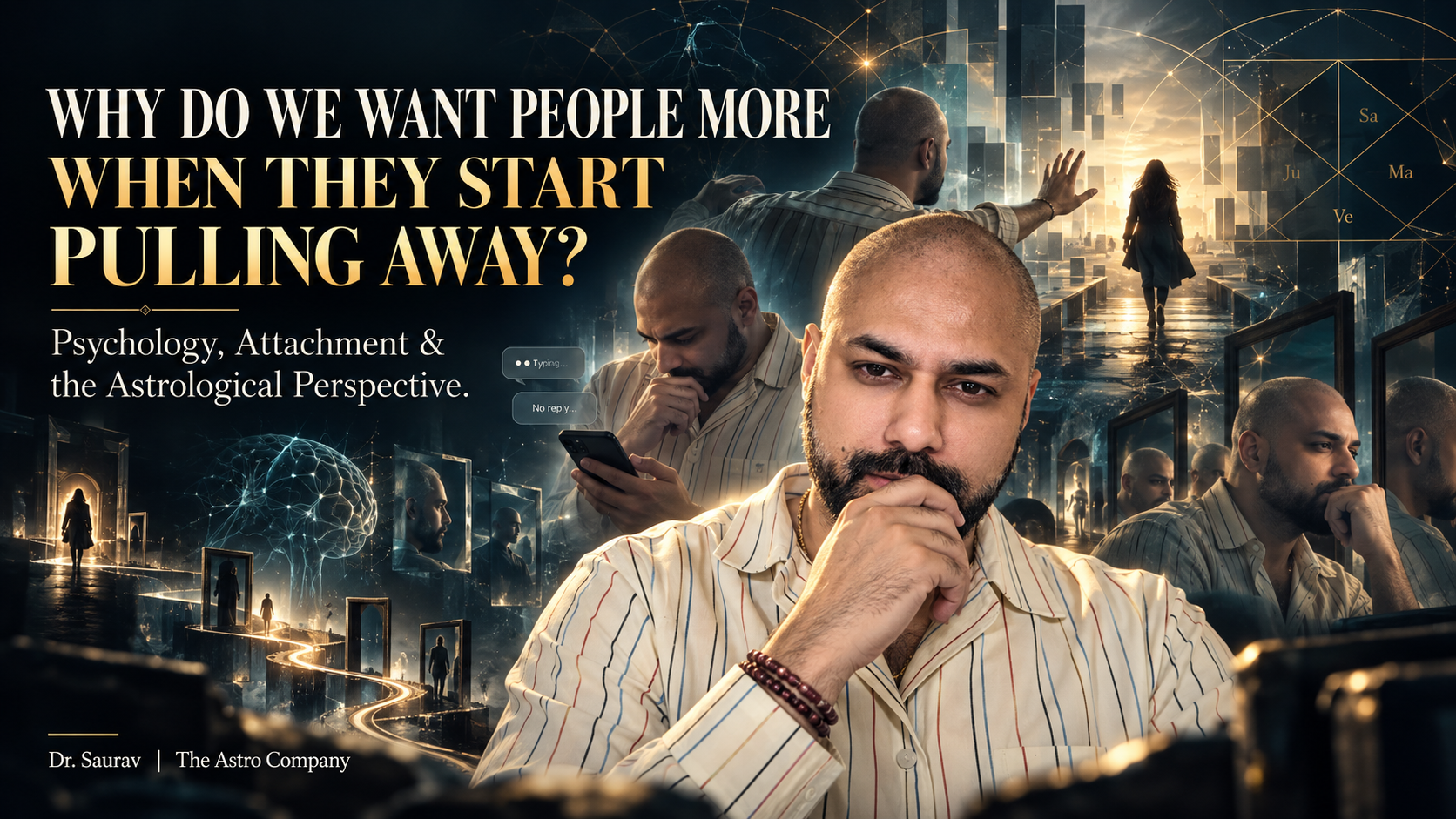
Why Do We Want People More When They Start Pulling Away?
There is a strange paradox in attraction.
Someone is available.
They respond quickly.
They show interest.
They make their feelings relatively clear.
And somehow, you don’t feel quite as consumed by them.
Then they become distant.
Their replies become slower.
Their attention becomes uncertain.
You don’t know what they’re thinking anymore.
And suddenly…
you can’t stop thinking about them.
Did they lose interest?
Are they busy?
Did I do something wrong?
Why aren’t they replying?
And perhaps the most uncomfortable question:
Why do I suddenly want them more?
It is tempting to interpret this as proof that the person has become more attractive.
But sometimes something else has changed.
The uncertainty has increased.
And uncertainty can change how the mind experiences attraction.
When Uncertainty Becomes Part of Attraction
One of the more interesting findings in social psychology comes from research by Erin Whitchurch, Timothy Wilson and Daniel Gilbert.
In their 2011 study, women were shown profiles of men who had supposedly viewed their profiles. Participants were placed into different conditions: they were told that a man liked them a lot, liked them an average amount, or that he might like them either a lot or an average amount.
The uncertain condition produced an intriguing result: participants reported greater attraction and spent more time thinking about the men.
That does not mean that uncertainty universally makes people more attracted to someone.
It was one experiment, involving a particular population and experimental context.
But it demonstrates something psychologically interesting:
Not knowing can sometimes increase mental attention.
And increased attention can itself become part of the experience of attraction.
Attraction Is Not Only About the Person
We often imagine attraction as if it were a simple measurement:
Person A is attractive.
Therefore:
I want Person A.
Human attraction is more complicated.
Our experience can also be influenced by:
- uncertainty
- perceived reciprocity
- emotional availability
- attachment patterns
- expectations
- rejection sensitivity
- previous experiences
- context
- our interpretation of the other person’s behaviour
This means that sometimes we’re responding not only to who someone is, but also to what is happening between us and them.
That distinction is crucial.
The Brain Hates an Unfinished Story
Imagine someone tells you:
“I definitely like you.”
There is little ambiguity.
Now imagine they say:
“I’m not sure how I feel about you.”
The second statement creates an information gap.
Your mind has something unresolved to process.
And unresolved social information can become cognitively sticky.
You start gathering clues.
Their message.
Their tone.
Their last interaction.
Their social-media activity.
The timing of their reply.
The problem is that when information is incomplete, the mind starts generating interpretations.
And interpretations can become emotionally powerful.
This Is Where Attachment Becomes Important
Attachment theory gives us another lens.
Adult attachment research distinguishes between dimensions including attachment anxiety and attachment avoidance, which are associated with different patterns of thinking, feeling and behaviour in close relationships.
For someone with stronger attachment anxiety, ambiguity in a relationship can become especially emotionally activating.
Questions may appear:
“Do they still want me?”
“Why did they become distant?”
“Have I done something wrong?”
“Are they going to leave?”
For someone with stronger avoidant tendencies, intimacy itself can sometimes activate a different set of concerns around dependence, vulnerability or loss of autonomy.
These patterns are not destiny.
Attachment orientations can change, and relationship experiences can contribute to greater security over time. Research on attachment security specifically examines how relationship experiences can revise insecure expectations about oneself and others.
So the important question isn’t:
“What attachment style am I?”
It is:
“What happens inside me when closeness becomes uncertain?”
Why Pulling Away Can Feel So Powerful
There are several things that can happen simultaneously.
1. Attention increases
You start monitoring the situation.
2. Uncertainty increases
You no longer know where you stand.
3. Mental simulation increases
Your brain begins generating possible explanations.
4. Emotional significance increases
Because you’re thinking about the person more, the relationship can begin to occupy more psychological space.
5. The person may become psychologically larger than the evidence justifies
This is an important distinction.
You may know very little more about the person than you knew before.
But you may now be thinking about them much more.
More mental presence can feel like more emotional importance.
But There Is a Difference Between Attraction and Anxiety
This is where things become particularly important.
Sometimes:
“I can’t stop thinking about them”
is interpreted as:
“I must really love them.”
Not necessarily.
It could also reflect:
- uncertainty
- fear of rejection
- attachment activation
- unresolved expectations
- loss of control
- the desire for reassurance
Research on rejection sensitivity describes a tendency to anxiously expect, perceive and react strongly to rejection. Such sensitivity can influence how ambiguous social information is interpreted.
So intense preoccupation is not automatically evidence of deep compatibility.
Sometimes intensity tells us something about our internal state, not simply the qualities of the other person.
Why “Playing Hard to Get” Is More Complicated Than Dating Advice Suggests
Popular culture often reduces this phenomenon to:
“Ignore someone and they’ll want you more.”
The research is considerably more complicated.
A 2023 review of research on “playing hard-to-get” found that the effects depend on factors such as perceived uncertainty, commitment, uncertainty tolerance and attachment style. The review included 18 studies and concluded that the strategy does not operate as a simple universal rule.
So there is an important distinction:
Uncertainty can sometimes increase attraction.
That is not the same as:
Creating uncertainty is a reliable way to make someone fall in love.
Those are completely different claims.
Now Let’s Look Through the Lens of Vedic Astrology
Vedic astrology approaches attraction differently.
Rather than measuring attraction experimentally, Jyotisha uses planetary and house symbolism to interpret themes such as:
- desire
- emotional security
- romantic attraction
- attachment
- intimacy
- pursuit
- obsession
- partnership
The Moon is traditionally associated with emotional experience and psychological security.
Venus is associated with attraction, pleasure, affection and relational desire.
Mars can be interpreted around pursuit, assertion, sexuality and drive.
Rahu, within the Vedic framework, is often interpreted through themes of amplification, fixation, novelty and desire for what feels compelling or difficult to obtain.
And the 5th, 7th and 8th houses introduce different dimensions of romance, partnership and deeper intimacy.
But again, one placement cannot explain an entire relationship.
Astrological interpretation depends on combinations and context.
Why Rahu Is Particularly Interesting Here
If we’re discussing the psychological experience of:
“I can’t stop thinking about this person because I don’t know where I stand,”
Rahu becomes an interesting symbolic lens.
In traditional Vedic astrology, Rahu is often associated with amplification of desire and fascination with experiences that feel novel, unusual or difficult to resolve.
That makes it a useful symbolic metaphor for a psychological phenomenon:
The mind becomes increasingly interested in what it cannot completely resolve.
But we should be precise.
Psychology does not establish that Rahu causes obsessive romantic attraction.
Astrology is offering an interpretive language.
The psychological mechanism and the astrological symbolism should remain separate.
Moon, Venus and the Need to Feel Chosen
There is another layer.
Sometimes what hurts isn’t simply:
“I want this person.”
It is:
“I want to know that this person wants me.”
Those are different desires.
The first is about attraction.
The second involves validation, attachment and relational security.
From an astrological perspective, this is where examining the Moon and Venus—and the wider relationship axis of a chart—can become interesting.
From a psychological perspective, attachment security and rejection sensitivity provide different frameworks for understanding the same emotional territory.
The Philosophical Question
There is a deeper question hiding underneath all of this.
Do we always want the person—or sometimes the resolution of uncertainty?
Consider what happens when the uncertainty finally disappears.
They tell you:
“Yes. I want to be with you.”
Sometimes the intensity remains.
Sometimes it suddenly drops.
That difference can tell us something.
If what you wanted most was the person, clarity may deepen the relationship.
If what you wanted most was resolution, getting the answer may reduce the psychological tension.
Neither makes you a bad person.
It simply means attraction can contain multiple psychological processes at once.
Ask Yourself These Questions
If someone pulling away has suddenly become much more important to you, ask:
1. Did I actually discover something new about them?
Or did their behaviour simply become less predictable?
2. Do I want them—or do I want to be chosen by them?
3. Was I strongly attracted before the uncertainty appeared?
4. Am I imagining the relationship more than actually experiencing it?
5. If they became completely available tomorrow, would I still want the same relationship?
6. Does this pattern feel familiar?
That last question can be especially revealing.
Because sometimes the person in front of us is new.
But the emotional pattern isn’t.
This Is Where MindMozi Becomes Interesting
This is exactly the kind of question that benefits from multiple perspectives.
You can ask:
Psychology:
What might be happening with attachment, uncertainty or rejection sensitivity?
Astrology:
What symbolic patterns in my chart relate to attraction, emotional security, desire and partnership?
Philosophy:
Am I pursuing the person, the possibility, or the feeling of being chosen?
This multi-perspective approach is one of the ideas behind MindMozi, an AI system developed by Dr. Saurav to explore personal questions through psychological, astrological and philosophical perspectives.
It isn’t about reducing every human problem to astrology.
It is about giving people another way to examine complicated questions about themselves.
The Real Lesson
Someone pulling away may make you think about them more.
But thinking about someone more does not automatically mean they have become more compatible with you.
Sometimes distance reveals genuine desire.
Sometimes it activates attachment anxiety.
Sometimes uncertainty creates fascination.
Sometimes rejection increases psychological salience.
And sometimes we simply become obsessed with a story because the ending hasn’t been written.
The important question is not:
“Why do I want them so much now?”
It is:
“What exactly became more valuable—the person, the relationship, or the uncertainty?”
That question can tell you much more about your attraction than the intensity itself.
Want to Explore Your Own Pattern?
If you’d like to understand your relationship patterns through your individual birth chart, you can consult Dr. Saurav Chaturvedi through The Astro Company.
If you’d prefer to explore the question conversationally first, you can also chat with MindMozi, an AI trained by Dr. Saurav across psychological, astrological and philosophical perspectives.
Research & Further Reading
- Whitchurch, E. R., Wilson, T. D., & Gilbert, D. T. (2011). “He loves me, he loves me not…”: Uncertainty can increase romantic attraction. Psychological Science.
- Simpson, J. A., & Rholes, W. S. Research on adult attachment, stress and romantic relationships.
- Mikulincer, M., Shaver, P. R., et al. Research on attachment insecurity and relational ambivalence.
- Houle, L., Barker, E., & Pronin, E. (2023). Research review on “playing hard-to-get.”