
The Question Behind the Question
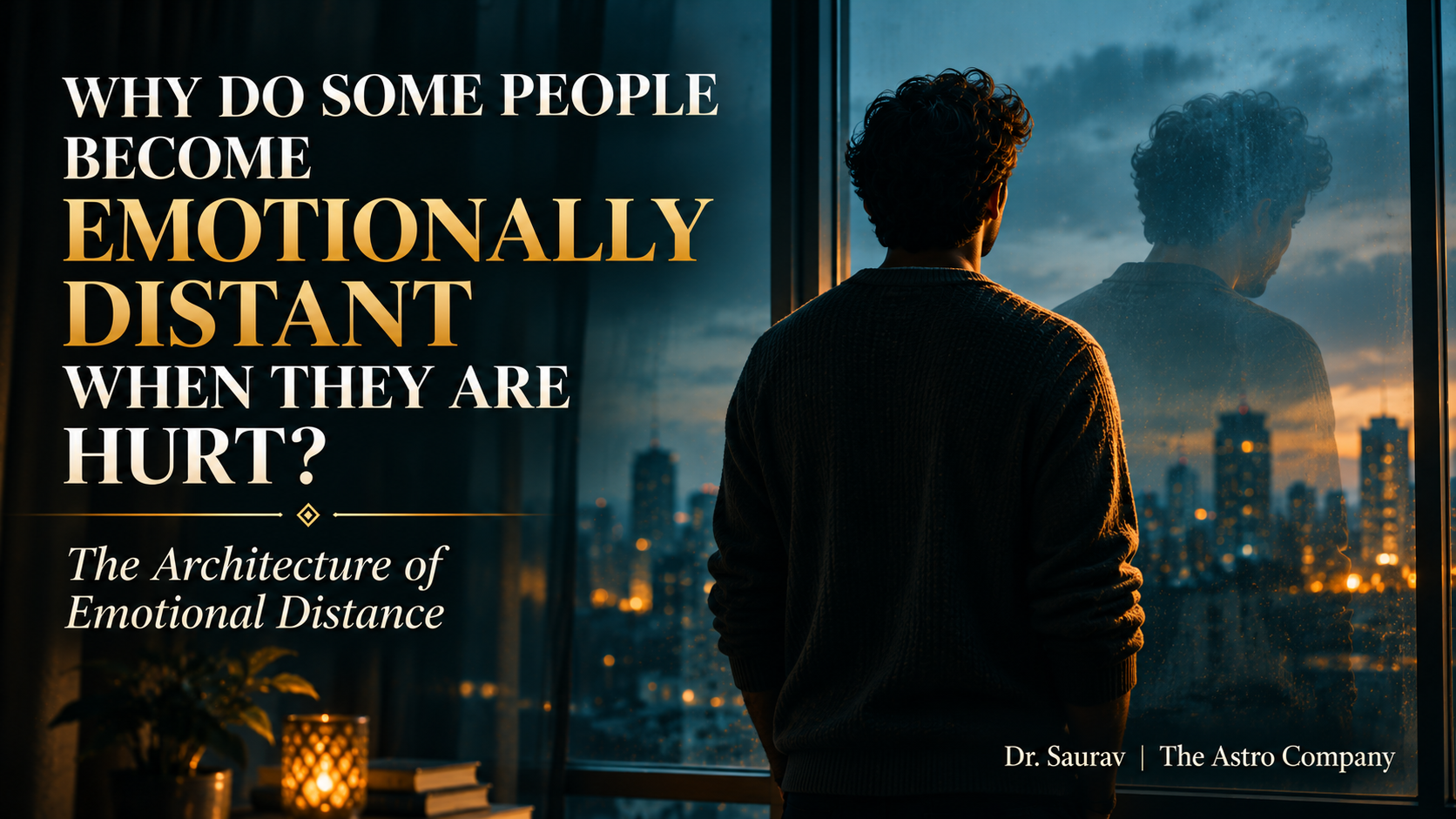
Somebody says something careless. A partner forgets something that mattered. A friend doesn’t show up when it counted. And then — nothing dramatic happens. No argument, no confrontation. Just a quiet withdrawal. The same person who used to text first now waits to be texted. The same person who used to share everything now shares less, and later, and more carefully.
Most people who do this aren’t trying to punish anyone. They’re trying to survive the next time it happens — by making sure there’s less of themselves standing in the way if it does.
What Psychology Actually Tells Us
It starts with how safety was learned, not just how pain was felt.
Attachment theory — developed by psychiatrist John Bowlby and extended through empirical research by developmental psychologist Mary Ainsworth — proposes that early relationships with caregivers teach a person what to expect from closeness itself. A child who reliably had their distress met with comfort tends to grow into an adult who can tolerate being hurt without abandoning the relationship. A child whose bids for comfort were inconsistent, dismissed, or occasionally punished tends to grow into an adult who treats emotional closeness as something to be managed carefully, at a safe distance, because closeness is where the risk lives.
Researchers Mario Mikulincer and Phillip Shaver, whose decades of work on adult attachment patterns are among the most cited in the field, describe this as a deactivating strategy: rather than seeking comfort when hurt, some people learn to suppress the need for comfort altogether — minimizing the importance of the relationship, redirecting attention toward independence and self-reliance, and pulling back before they can be hurt again. It isn’t that the pain is smaller. It’s that the nervous system has learned that reaching out when hurt didn’t reliably get rewarded, so it stops reaching.
Emotional suppression has a measurable cost — and a measurable logic.
Psychologist James Gross’s research on emotion regulation distinguishes between reappraisal (reframing a situation to feel differently about it) and suppression (hiding the emotional expression while the feeling continues underneath). Suppression is cognitively costly, and it tends to reduce felt closeness in relationships over time, even as the suppressing person reports feeling “fine.” Emotional distancing after hurt is very often suppression wearing the costume of calm: the person looks unaffected, sometimes even more composed than before, while the relational cost of that composure accumulates quietly.
It is also a form of risk management, not just an emotional reflex.
Withdrawal after hurt can be understood as an attempt to reduce future vulnerability. If closeness is where injury happens, reducing closeness reduces exposure. This is not irrational — it is a strategy that often worked, at least in the short term, in the environment where it was first learned. The problem is that the strategy frequently outlives its usefulness: a nervous system calibrated for an unsafe environment keeps running the same protocol in a safe one, pre-emptively protecting against pain that may not be coming.
Not everyone who withdraws is doing the same thing.
It’s worth distinguishing a few overlapping but distinct patterns: emotional suppression (hiding the feeling), attachment deactivation (minimizing the bond itself), and simple need for processing time (someone who isn’t avoidant at all, just slower to put words to hurt). All three can look identical from the outside — quietness, distance, a shorter reply — which is exactly why the behaviour is so often misread as indifference, when it’s frequently closer to self-protection or overload.
Where Vedic Astrology Enters the Conversation
Psychology explains the mechanism. Vedic astrology (Jyotish) offers a different, older, symbolic language for the same terrain — a traditional interpretive framework some people use to reflect on why this particular pattern shows up in this particular person.
The Moon and the inner weather system
In Jyotish, the Moon (Chandra) represents the mind, emotional responsiveness, and the sense of inner security. A Moon that is afflicted — by placement in a difficult house, by conjunction with a challenging planet, or by weak dignity in its sign — is traditionally associated with a mind that feels less inherently safe, and therefore more inclined to guard itself. This is read alongside the Moon’s house position, its dispositor, and any aspects it receives, because the same Moon placement expresses very differently depending on what else is happening in the chart.
Saturn and the architecture of self-protection
Saturn (Shani) governs restriction, discipline, delay, and emotional distance itself. A well-placed, dignified Saturn can give someone the capacity to hold boundaries with maturity and patience. A Saturn under stress — combust, debilitated, or heavily afflicted — can instead describe a person who protects themselves through withdrawal and coldness rather than considered boundaries.
Mars and the fight-or-flight axis
Mars (Mangal) governs the instinct to act when threatened. Some chart configurations are traditionally read as channeling hurt outward, into confrontation. Others, especially where Mars is weakly placed or heavily aspected by Saturn, are read as channeling that same instinct inward — into withdrawal rather than expression.
The 4th and 8th houses — the home of the heart, and the house of hidden wounds
The 4th house represents emotional foundation, closely tied to the quality of early emotional attachment. The 8th house represents what is hidden and transformed — the psychological undercurrent beneath the visible personality. A difficult 4th house alongside a stressed Moon is sometimes read as an emotional foundation shaped by early inconsistency; a prominent, afflicted 8th house as a tendency to bury emotional material, which can manifest outwardly as distance.
Why no single placement tells the whole story
Traditional Jyotish practice insists on reading multiple factors together: the Moon’s condition, Saturn’s dignity and aspects, the 4th house and its lord, the ascendant, relevant divisional charts such as the Navamsha (D9), and the current dasha and transits. A single placement is never, in serious practice, treated as a standalone diagnosis of someone’s emotional style.
Two Hypothetical Chart Illustrations
(Hypothetical examples for illustration only — not real individuals’ charts.)
Illustration A: A Moon in the 4th house, afflicted by an aspect from Saturn, with Saturn itself debilitated and the 4th lord weakly placed. This combination might be read as an emotional foundation shaped by inconsistency, with Saturn’s affliction suggesting that self-protection is being expressed defensively rather than maturely. If Jupiter forms a supportive aspect to this same Moon, the picture shifts: the same early sensitivity may still exist, but the person may also carry an internal resource for eventually re-opening rather than staying permanently closed.
Illustration B: A strong, well-dignified Mars in the 1st house, with the Moon placed in the 8th house and lightly afflicted. Hurt might initially trigger an instinct toward confrontation, but the 8th-house Moon suggests that deeper emotional processing moves underground over time, into private rumination rather than ongoing outward expression.
These two charts could describe outwardly similar behaviour — both people eventually go quiet — for different underlying reasons.
What Psychology and Astrology Each Can and Cannot Claim
Psychology’s claims about attachment and emotion regulation are empirical, built on decades of research. Vedic astrology’s claims are traditional and symbolic, built on a different foundation entirely. Using both frameworks side by side does not mean treating them as equivalent or claiming that planetary positions cause psychological patterns. Psychology explains the mechanism; astrology offers an additional, traditional lens for reflecting on one’s particular version of it.
Practical Self-Reflection
- When I pull away after being hurt, am I protecting myself from a repeat of something specific, or from closeness in general?
- Is this distance a boundary I’m choosing, or a reflex I’m not fully aware of?
- Has this pattern ever cost me something — a relationship, a chance to be known — that I only recognised afterward?
Exploring This Through MindMozi
For readers who want to sit with these questions more personally, MindMozi — the AI-powered personal guidance and self-reflection app developed by Dr. Saurav Chaturvedi — offers five distinct AI personalities suited to exploring this exact pattern:
- Caring Companion: “I always pull away when someone hurts me, even if I still care about them. Help me understand what I’m actually afraid of.”
- Honest Best Friend: “Be honest with me — am I protecting myself, or am I just avoiding the harder conversation?”
- Strict Mentor: “I keep letting good relationships quietly fade because I won’t reach out first after a hurt. Push me to change that pattern.”
- Calm Therapist-Style Personality: “Walk me through what happens in my mind in the moments right after I feel hurt, before I decide to withdraw.”
- Personal Vedic Astrologer: “Looking at my Moon, Saturn and 4th house, what does my chart suggest about how I process emotional hurt?”
MindMozi also offers Free Daily Psychological Energy, a short daily reflection on mindset and emotional themes; Daily Planetary Transits, interpreted against your own birth chart; and Daily Choghadiya, traditional Vedic time-window guidance — so you can track how a pattern like emotional distancing shifts day to day, rather than reflecting on it only once.
MindMozi is a self-reflection and guidance tool. It does not diagnose mental-health conditions, replace professional therapy or medical advice, or guarantee relationship outcomes.
Frequently Asked Questions
Is emotional distancing the same as being an avoidant attachment type? Not necessarily. Avoidant attachment is a specific, well-studied pattern, but situational withdrawal after a particular hurt can happen to people with any attachment style. Repeated, reflexive distancing across many relationships is more characteristic of a deactivating attachment strategy specifically.
Can this pattern change? Yes — attachment patterns, while stable, are not fixed for life. Consistent, safe relational experiences are associated with movement toward more secure functioning over time.
Does a difficult Moon or Saturn in a birth chart mean someone is “doomed” to be distant? No. Traditional Jyotish treats a chart as a map of tendencies and timing, modified by multiple factors, dashas, and transits — not a fixed sentence.
Consultation
If you want to understand how these patterns may be reflected in your own birth chart — the specific condition of your Moon, Saturn, and 4th house, read together rather than in isolation — you can consult Dr. Saurav Chaturvedi through The Astro Company.