

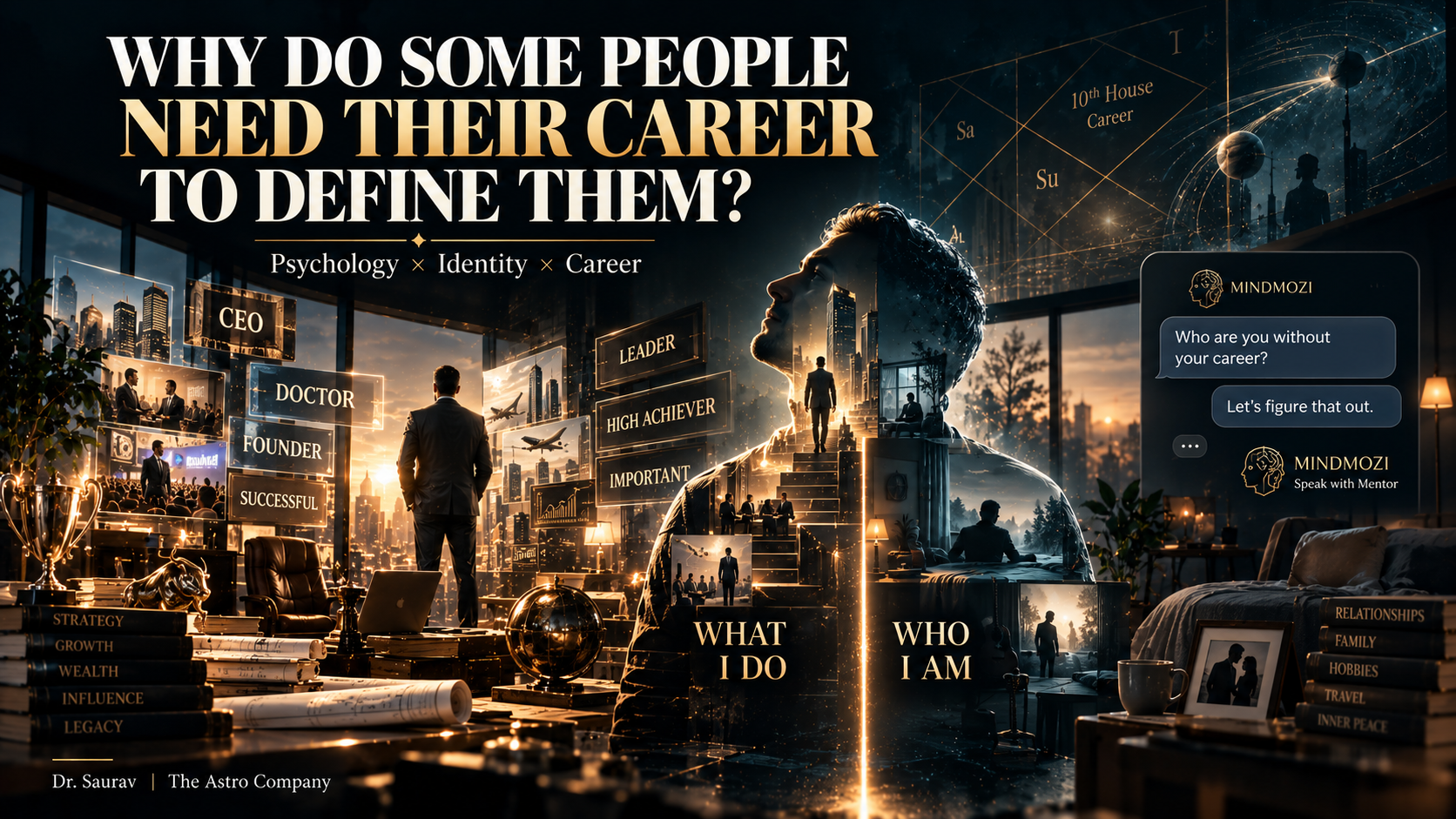
Why Do Some People Need Their Career to Define Them?
Ask someone:
“Who are you?”
And listen to the answer.
“I’m a doctor.”
“I’m a businessman.”
“I’m a founder.”
“I’m an IAS officer.”
“I’m a designer.”
“I run a company.”
We often use our occupations to introduce ourselves because work genuinely matters.
It gives us income.
Structure.
Status.
Social connection.
Purpose.
And for many people, it becomes an important part of identity.
But there is a psychological difference between:
“My career is an important part of who I am.”
and:
“Without my career, I don’t know who I am.”
That difference can become especially visible when success disappears.
Work is more than a way to earn money
Psychologists have long recognised that work can influence identity and quality of life.
The American Psychological Association’s guidelines on work and career explicitly describe work as having a pervasive impact on identity and quality of life, and note that vocational development is intertwined with identity development.
This makes intuitive sense.
Your career can tell you:
What you’re good at.
What you contribute.
Where you belong.
What status you have.
Who your colleagues are.
What your daily life looks like.
And sometimes even what you believe you are worth.
That last part is where things become psychologically complicated.
When achievement becomes identity
Imagine two people who lose their jobs.
One thinks:
“I lost my job.”
The other thinks:
“I don’t know who I am anymore.”
The external event is similar.
The psychological meaning is completely different.
The second person’s career may have become identity-central.
Their profession isn’t simply something they do.
It has become one of the main answers to:
“Who am I?”
Research on identity centrality suggests that different aspects of identity can vary in how central they are to a person’s sense of self, and that identity configurations are related to psychosocial functioning.
So when a highly central identity is threatened, the emotional impact can extend beyond the practical problem itself.
The achievement trap
There is nothing inherently wrong with ambition.
Wanting to build something meaningful can be deeply healthy.
The problem appears when achievement becomes the primary source of self-worth.
Then success doesn’t simply feel good.
It becomes necessary.
You don’t just want the promotion.
You need it.
You don’t just want the business to grow.
You need its growth to confirm that you are valuable.
You don’t just want recognition.
You need recognition to maintain your identity.
And suddenly:
Achievement becomes emotional regulation.
Success temporarily reassures you:
“I am good enough.”
Failure threatens that conclusion.
Why some people become addicted to achievement
Sometimes the most productive person in the room isn’t simply highly motivated.
They may also be running away from something.
The fear of being ordinary.
The fear of disappointing others.
The fear of becoming irrelevant.
The fear of financial insecurity.
The fear of losing status.
Or simply the fear of discovering:
“If I’m not achieving, what exactly makes me valuable?”
This is why two people can work equally hard for completely different psychological reasons.
One may be driven by curiosity.
Another by fear.
One may enjoy mastery.
Another may desperately need validation.
The behaviour looks similar from outside.
The internal experience isn’t.
Career identity can also be healthy
We should be careful not to turn this into:
“Don’t identify with your career.”
That’s unrealistic.
Work can provide genuine meaning.
It can create purpose, social connection, competence and contribution.
Research on work and psychological wellbeing has repeatedly treated work as an important part of psychological functioning.
And recent research continues to examine how professional identity relates to wellbeing and how people redefine working identity during career transitions.
The goal isn’t to make career irrelevant.
It is to make identity larger than career.
What happens when the career changes?
Consider the major transitions people experience:
Retirement.
Job loss.
Career change.
Business failure.
Promotion.
Starting a company.
Leaving a profession.
Becoming financially independent.
Even success can destabilise identity.
Because every major transition asks:
“Who am I now?”
A person who has spent twenty years being “the doctor” may struggle after leaving medicine.
A founder may struggle when the company is sold.
An executive may struggle after retirement.
A high-achieving student may struggle when they enter an environment where everyone is equally capable.
The problem isn’t necessarily that they lost a job.
They lost a familiar identity structure.
The astrology of career identity
Vedic astrology offers another symbolic framework for exploring this.
The 10th House is traditionally associated with karma, profession, action in the world, reputation and public standing.
The Sun can symbolically relate to authority, recognition and self-definition.
Saturn can represent responsibility, work, endurance and long-term achievement.
Mars can represent ambition, competition and action.
But none of these should be reduced to:
“Strong 10th House = workaholic.”
or:
“Strong Sun = obsessed with status.”
Astrology doesn’t scientifically establish those causal relationships.
The more interesting use is interpretive.
A chart may be used to ask:
How important is achievement in this person’s psychological narrative?
What does recognition mean to them?
How do they respond when their professional identity is challenged?
Do they experience work as purpose, responsibility, status—or all three?
That’s a much richer question than simply asking:
“Will I be successful?”
The danger of becoming only one thing
Imagine introducing yourself without mentioning your career.
What remains?
Your relationships.
Your interests.
Your values.
Your personality.
Your curiosity.
Your body.
Your memories.
Your beliefs.
Your capacity to love.
Your ability to learn.
Your private life.
Your character.
Your sense of humour.
Your inner world.
Your career is one part of the story.
It shouldn’t have to be the entire story.
Because if your entire identity rests on one pillar, anything that threatens that pillar threatens the whole structure.
The psychological question worth asking
Try completing these two sentences:
“I am successful when…”
and:
“I am valuable when…”
Are the answers identical?
If they are, that’s worth examining.
Because success and worth are not necessarily the same thing.
You can fail and still be valuable.
You can succeed and still be lost.
You can be unemployed and still be competent.
You can be extremely successful and still not know yourself.
MindMozi: Talk beyond the professional identity
This is also where I see a role for MindMozi.
MindMozi is an AI trained by Dr. Saurav across psychological, astrological and philosophical perspectives.
Instead of asking only:
“How can I become more successful?”
you can ask:
“Why does success matter so much to me?”
“Who am I afraid of becoming if I fail?”
“What would remain if my career disappeared tomorrow?”
And depending on what you’re trying to understand, you can approach the conversation through different AI personalities.
Sometimes you may need a Mentor.
Sometimes an honest Best Friend.
Sometimes an Oracle.
Sometimes simply an AI Companion who helps you think through the question.
The point isn’t to replace human relationships or professional support.
It’s to create another space for reflection.
Your career should be something you have—not everything you are
Ambition is not the enemy.
Achievement is not the enemy.
Career identity is not the enemy.
The real question is:
How much of your identity depends on them?
Because there is a profound difference between:
“I am a successful person.”
and:
“I am a person who currently happens to be successful.”
The first can become fragile.
The second leaves room for change.
And perhaps psychological maturity isn’t about caring less about achievement.
It is about building an identity that survives both success and failure.
Because eventually, every career changes.
The real question is:
When it does, who will you still be?
Research & Further Reading
- American Psychological Association — Professional Practice Guidelines for Integrating the Role of Work and Career Into Psychological Practice.
- Blustein, D. L. — The Role of Work in Psychological Health and Well-Being. American Psychologist.
- Meca, A. et al. — Identity Centrality and Psychosocial Functioning.
- Strauser, D. R., Lustig, D. C. & Ciftçi, A. — research examining vocational identity, career thoughts and psychological wellbeing.
- Sharma, K. — Redefining Working Identity in Career Transitions: The Role of Mindfulness and Self-Regulation. Acta Psychologica, 2026.
- Mushtaq, R. M. Z. et al. — research on work identity, job crafting and psychological wellbeing, 2026.