

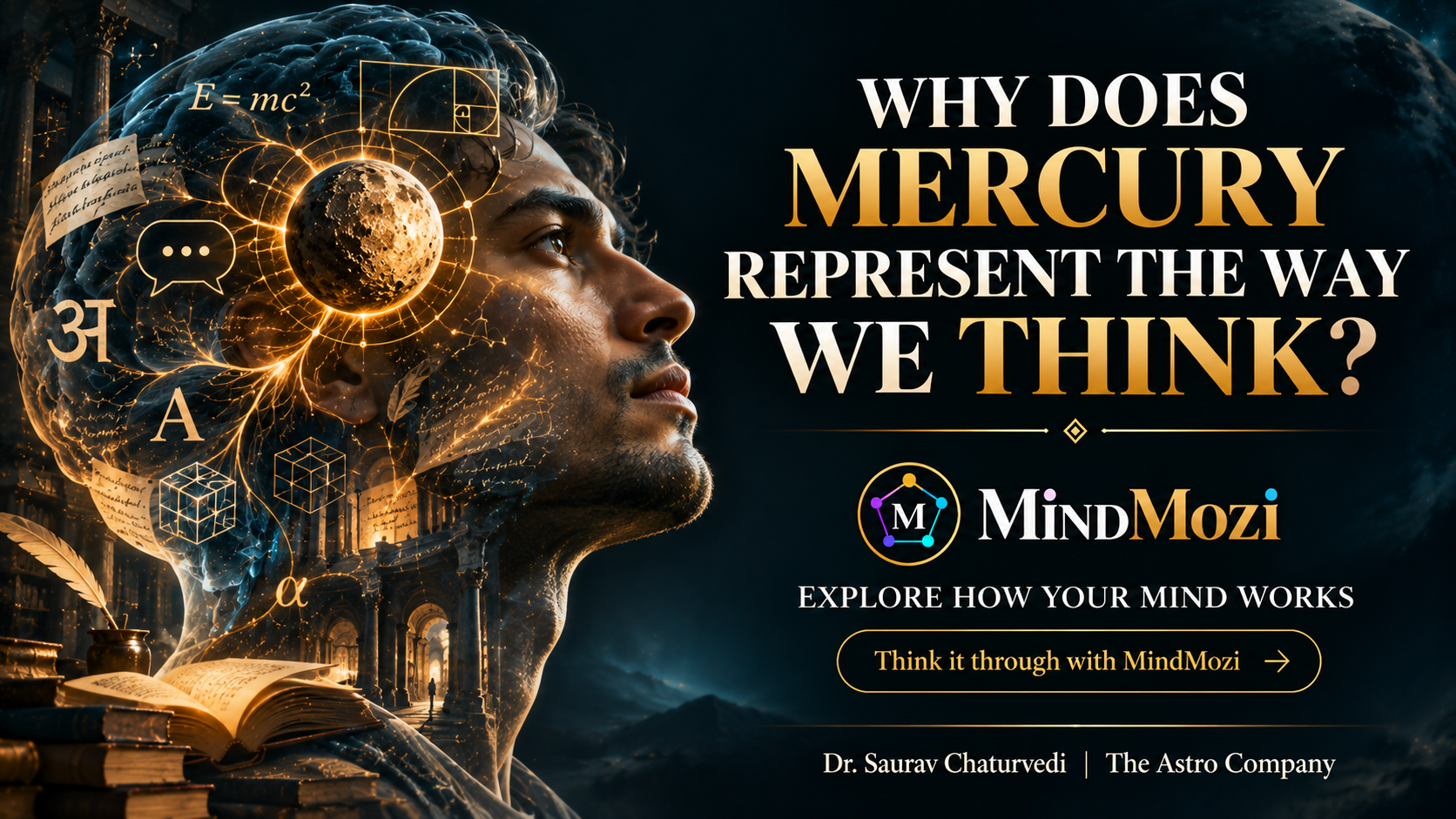
The psychology of thinking, communication and decision-making—and the traditional Vedic astrology significance of Budha.
Have you ever noticed how differently people process the same information?
One person immediately identifies the central problem. Another examines every possible detail. Someone can explain a complicated idea effortlessly, while another understands it perfectly but struggles to put it into words.
Some people think through conversation. Others need silence before they can reach a conclusion.
Why are our thinking styles so different?
Psychology studies these differences through cognition, attention, memory, language, learning and decision-making. Vedic astrology offers another interpretive framework: the planet Mercury, known as Budha, is traditionally associated with intellect, speech, reasoning, communication and practical intelligence.
But there is an important question:
Does Mercury represent how intelligent we are, or does it represent how we process and communicate information?
To explore that, we need to understand both psychology and Jyotish properly.
1. What does it actually mean to think?
Thinking is not one single mental activity.
When you read a sentence, remember a conversation, compare two options or solve a mathematical problem, different cognitive processes are involved.
Cognitive psychology studies how we acquire, organise, store and use information.
Some of its major areas include:
- Attention: What information do we notice and concentrate on?
- Perception: How do we interpret information received through our senses?
- Memory: How do we store and retrieve information?
- Working memory: How do we temporarily hold and manipulate information while performing a task?
- Language: How do we convert thoughts into words and understand what others communicate?
- Reasoning: How do we draw conclusions from available information?
- Decision-making: How do we evaluate choices and select an action?
These processes interact continuously.
For example, imagine someone gives you a complicated explanation.
You need to pay attention, understand the language, retain important details, connect them with existing knowledge and decide whether the explanation makes sense.
That is not one mental ability. It is a coordinated set of cognitive processes.
2. Why do some people think differently from others?
There are several reasons.
A. Working memory and mental organisation
Working memory is the ability to temporarily hold and manipulate information.
It allows us to remember the beginning of a sentence while processing its ending, compare several numbers, or keep different parts of a problem in mind.
A classic model developed by Baddeley and Hitch describes working memory through components that process verbal and visual-spatial information, coordinated by a central executive.
This helps explain why some tasks become difficult when too much information must be handled simultaneously.
It also explains why mental overload can make even familiar tasks feel complicated.
B. Attention and information selection
We are constantly exposed to more information than we can consciously process.
Attention helps us select what deserves priority.
Some people naturally focus on details. Others quickly identify broad patterns. Neither approach is automatically superior.
The useful approach depends on the task.
A surgeon, a researcher, an artist and a business strategist may need different ways of directing attention.
C. Analytical and intuitive thinking
Psychology has examined differences between relatively fast, automatic processing and slower, more deliberate reasoning.
For example, imagine you see a familiar face in a crowd.
You recognise the person almost instantly.
But if someone asks you to calculate a complicated percentage, you may need to slow down and work through the steps.
These are different styles of processing.
However, the popular idea that the brain contains two completely separate systems—one emotional and one logical—is an oversimplification. Dual-process theories describe useful distinctions, but researchers have identified several different forms of automatic and deliberate processing.
Intuition is not always irrational, and deliberate analysis is not always correct.
D. Language and communication
Some people can think clearly but struggle to express themselves.
Others are excellent speakers but do not necessarily analyse every issue deeply.
Thinking and communicating are related, but they are not identical.
Language provides a structure through which we express, organise and exchange information.
A person may have a strong understanding of an idea but need time to find the right words.
This distinction becomes particularly important when we discuss Mercury in Jyotish.
3. Why Mercury represents intellect and communication in Vedic astrology
In traditional Vedic astrology, Mercury is called Budha.
The Sanskrit root budh is associated with awakening, knowing and becoming aware.
Budha is traditionally connected with Buddhi, the faculty of intellect, discrimination and understanding.
Its significations include:
- Intellect and reasoning.
- Speech and communication.
- Writing and language.
- Learning and education.
- Calculation and analytical ability.
- Trade, negotiation and commerce.
- Wit, humour and adaptability.
The classical Jyotish tradition also associates Mercury with speech and communication. Its interpretation is not limited to academic intelligence.
This distinction is important.
A person may be academically gifted but communicate poorly. Another may be an excellent communicator with exceptional practical intelligence. Someone else may have strong numerical ability but little interest in public speaking.
Mercury is a useful symbolic framework for examining these different forms of intellectual expression.
However, astrology has not been scientifically established as a method of measuring intelligence, cognitive ability or communication skills.
4. Mercury is not the only planet connected with the mind
One of the biggest mistakes in simplified astrology is treating Mercury as the sole indicator of thinking.
In a traditional Jyotish interpretation, several grahas contribute different dimensions.
Moon: Manas and mental experience
The Moon is associated with Manas—the mind, sensory experience, emotional responsiveness and subjective impressions.
It is useful to distinguish Moon and Mercury symbolically:
- Moon: How do I experience and respond to what happens?
- Mercury: How do I process, interpret, organise and communicate information?
This is a conceptual distinction within Jyotish, not a scientifically validated division of brain functions.
Jupiter: Wisdom and broader understanding
Jupiter is traditionally associated with knowledge, wisdom, learning, guidance and broader understanding.
Mercury may be examined in relation to information processing and discrimination, while Jupiter adds themes of meaning, judgement, principles and knowledge.
For example, collecting information and understanding its wider significance are not necessarily the same thing.
Sun: Buddhi, identity and authority
The Sun represents authority, vitality, purpose and the sense of self in traditional Jyotish.
Its relationship with Mercury can be examined when interpreting intellectual expression, judgement and communication.
Mars: Action and decisiveness
Mars introduces themes of initiative, courage, competition and action.
A connection between Mercury and Mars may be interpreted through quick reasoning, debate, technical problem-solving or argumentative communication, depending on the complete horoscope.
Saturn: Structure and disciplined thought
Saturn is associated with discipline, patience, responsibility and structure.
A Mercury–Saturn relationship may be explored through careful analysis, methodical thinking, concentration or cautious communication.
It may also involve delay or excessive concern with details in some chart contexts.
None of these combinations should be used to label someone as intelligent, unintelligent, anxious or mentally unstable.
5. How to examine Mercury in a birth chart
A proper Mercury analysis requires much more than checking its sign.
A. Sign and dignity
Mercury rules Gemini and Virgo.
It is exalted in Virgo and debilitated in Pisces in the traditional dignity scheme.
Virgo is particularly interesting because Mercury is both its own-sign ruler and exalted there.
A strong Mercury may traditionally be associated with skill in analysis, communication, calculation, adaptability and learning.
But exaltation does not automatically make someone intellectually superior.
The complete horoscope matters.
B. House placement
The house occupied by Mercury provides context for where its significations may become prominent.
Some examples:
- 1st house: Communication, learning and intellectual expression may become visible parts of personality.
- 2nd house: Speech, language, family communication and knowledge-related resources may become important.
- 3rd house: Writing, communication, initiative, skills and practical learning may be emphasised.
- 4th house: Education, learning foundations and intellectual interests may become significant.
- 5th house: Analysis, creativity, learning, intellectual expression and traditional associations with intelligence become relevant.
- 6th house: Problem-solving, classification, technical work and analytical service may become themes.
- 7th house: Negotiation, business interaction and communication within partnerships may become important.
- 10th house: Profession involving communication, analysis, trade, writing or information may be considered.
These are broad interpretive possibilities. The result depends on house ownership, dignity, aspects and the overall chart.
C. The dispositor
Mercury’s dispositor is the planet ruling the sign Mercury occupies.
For example, Mercury in Cancer has the Moon as its dispositor.
The Moon’s placement, dignity and relationship with Mercury then become relevant.
Similarly, Mercury in Leo is disposed by the Sun.
This is important because Mercury should not be judged without considering the planet that hosts it.
D. Conjunctions and planetary aspects
Mercury’s associations with other planets can modify its traditional interpretation.
- Mercury–Moon: May be examined through the relationship between emotional impressions and intellectual processing.
- Mercury–Jupiter: May bring together analysis, learning, knowledge and broader understanding.
- Mercury–Mars: May be associated with quick thinking, debate, technical skill or direct communication.
- Mercury–Saturn: May be examined through disciplined analysis, caution, structured learning or mental rigidity.
- Mercury–Venus: May bring themes of artistic communication, aesthetics, negotiation and persuasive expression.
- Mercury–Rahu: May be interpreted through unconventional thinking, information-seeking, experimentation or intense intellectual preoccupation.
These are not fixed outcomes. Functional lordship, planetary dignity, dispositors and the complete set of aspects must be examined.
E. Combustion and retrogression
Mercury frequently comes close to the Sun astronomically, so combustion is a common consideration in Jyotish.
The degree of proximity, planetary strength, other associations and interpretive tradition matter.
Combustion should not automatically be interpreted as poor intelligence or communication problems.
Similarly, Mercury retrogression should not be reduced to a claim that a person thinks backwards, cannot communicate or repeatedly makes mistakes.
Retrogression is one factor in a broader chart analysis.
F. Functional lordship and Dasha
Mercury rules different houses for different ascendants.
This changes its functional role.
For example, Mercury’s house ownership for a Gemini ascendant is not the same as its house ownership for a Sagittarius ascendant.
The operating Mahadasha and Antardasha can bring Mercury-related themes into focus, depending on its placement, lordship and connections.
D9 and other relevant divisional charts may be considered where the question requires them, but they should not be added mechanically to every Mercury reading.
6. Three hypothetical Mercury configurations
Let’s look at three simplified examples.
Example 1: Mercury in Virgo, connected with Saturn
A traditional interpretation might emphasise precision, classification, structured learning, detailed analysis and methodical communication.
But depending on the chart, the same combination could also be interpreted through excessive criticism, caution or difficulty moving beyond details.
Example 2: Mercury connected with Jupiter
This may be examined through themes of education, teaching, explanation, interpretation and combining detailed information with broader principles.
However, a Mercury–Jupiter connection does not automatically make someone wise or academically successful.
Example 3: Mercury connected with Mars
This can introduce themes of speed, debate, direct communication, technical reasoning and competitive thinking.
Depending on the full chart, it may be expressed constructively as decisive problem-solving or less constructively as impatience in conversations.
These examples illustrate traditional Jyotish interpretation, not scientifically established cognitive predictions.
7. What can we learn from psychology and Jyotish together?
Psychology helps us break thinking into observable processes:
- Attention.
- Working memory.
- Language.
- Learning.
- Reasoning.
- Decision-making.
Traditional Jyotish offers a symbolic vocabulary:
- Moon for Manas and subjective experience.
- Mercury for Buddhi, speech and discrimination.
- Jupiter for wisdom, knowledge and broader understanding.
- Mars for action and decisiveness.
- Saturn for structure, patience and discipline.
The comparison is useful as a framework for reflection, but it does not establish that planetary positions cause or predict cognitive differences.
A scientifically meaningful assessment of cognitive ability requires appropriate psychological testing and professional interpretation, not a horoscope.
8. How to improve the way you think
You cannot improve every cognitive process through one technique. Different skills need different forms of practice.
Here are five useful habits:
- Read actively: Summarise what you read instead of simply consuming information.
- Write your thoughts: Writing can help organise complex ideas and reveal gaps in reasoning.
- Question assumptions: Ask what evidence supports your conclusion and what might contradict it.
- Practise focused attention: Reduce interruptions when working on tasks that require concentration.
- Explain difficult concepts: If you can explain an idea clearly to another person, you may have developed a better understanding of it.
And remember: thinking quickly is not the same as thinking accurately.
Sometimes the most intelligent response is to slow down.
9. Explore your thinking patterns with MindMozi
MindMozi is an AI-powered personal guidance and self-reflection app developed by Dr. Saurav Chaturvedi. It combines psychology-informed reflection, personalised Vedic astrology, daily guidance and five distinct AI personalities.
It is designed to help users examine questions from different perspectives rather than receiving only one type of response.
The five personalities are:
- Caring Companion: A supportive conversational space for exploring doubts, confusion and personal experiences.
- Honest Best Friend: Direct feedback that challenges assumptions and offers alternative perspectives.
- Strict Mentor: Practical guidance, structured thinking and accountability.
- Calm Therapist-style Companion: Helps users organise thoughts, explore emotional responses and reflect on patterns. It is not a replacement for a qualified mental health professional.
- Personal Vedic Astrologer: Explores the user’s birth chart, planetary periods and traditional Jyotish interpretations.
For this topic, try asking:
Caring Companion: “I have too many thoughts running through my mind. Help me organise them without judging me.”
Honest Best Friend: “Challenge my reasoning. Identify assumptions I am making and give me alternative explanations.”
Strict Mentor: “Help me develop a daily routine for focused learning, reading and clear thinking.”
Calm Therapist-style Companion: “Help me separate facts, assumptions, interpretations and conclusions in a situation I am overthinking.”
Personal Vedic Astrologer: “Analyse Mercury in my birth chart, including its house, sign, dignity, dispositor, aspects, conjunctions and functional lordship. Explain how traditional Jyotish interprets its relationship with learning, speech and analytical ability.”
Daily guidance beyond conversations
MindMozi also offers:
Free Daily Psychological Energy: A daily psychological reflection that helps users examine their mindset, emotional themes and approach to the day.
Daily Planetary Transits: Current planetary movements interpreted in the context of the user’s birth chart, offering personalised traditional astrological insights.
Daily Choghadiya: Traditional Vedic time-window guidance to help users understand favourable and less favourable periods for different activities.
This makes MindMozi more than an AI chatbot. It brings together five conversational perspectives, daily psychological reflection, personalised Vedic astrology and traditional timing guidance in one platform.
MindMozi — Five Minds. One App. Total Clarity.
10. The most important distinction
Mercury is traditionally associated with intellect, language, reasoning and communication.
But your ability to think clearly is not determined by one planet.
Your thinking is influenced by learning, experience, attention, memory, health, environment and the strategies you develop over time.
The most useful question is not simply whether Mercury is strong or weak.
It is:
How do you process information, how do you interpret it, and how accurately can you communicate what you understand?
That is a much more meaningful starting point for exploring the relationship between psychology and Jyotish.
If you want to explore Mercury and its role in your own birth chart, you can consult Dr. Saurav Chaturvedi through The Astro Company.
If you want to examine your thoughts through multiple conversational perspectives, daily psychological reflection and personalised astrological guidance, explore MindMozi.
MindMozi supports general guidance and self-reflection. It is not a diagnostic tool and does not replace professional psychological or medical assessment.