

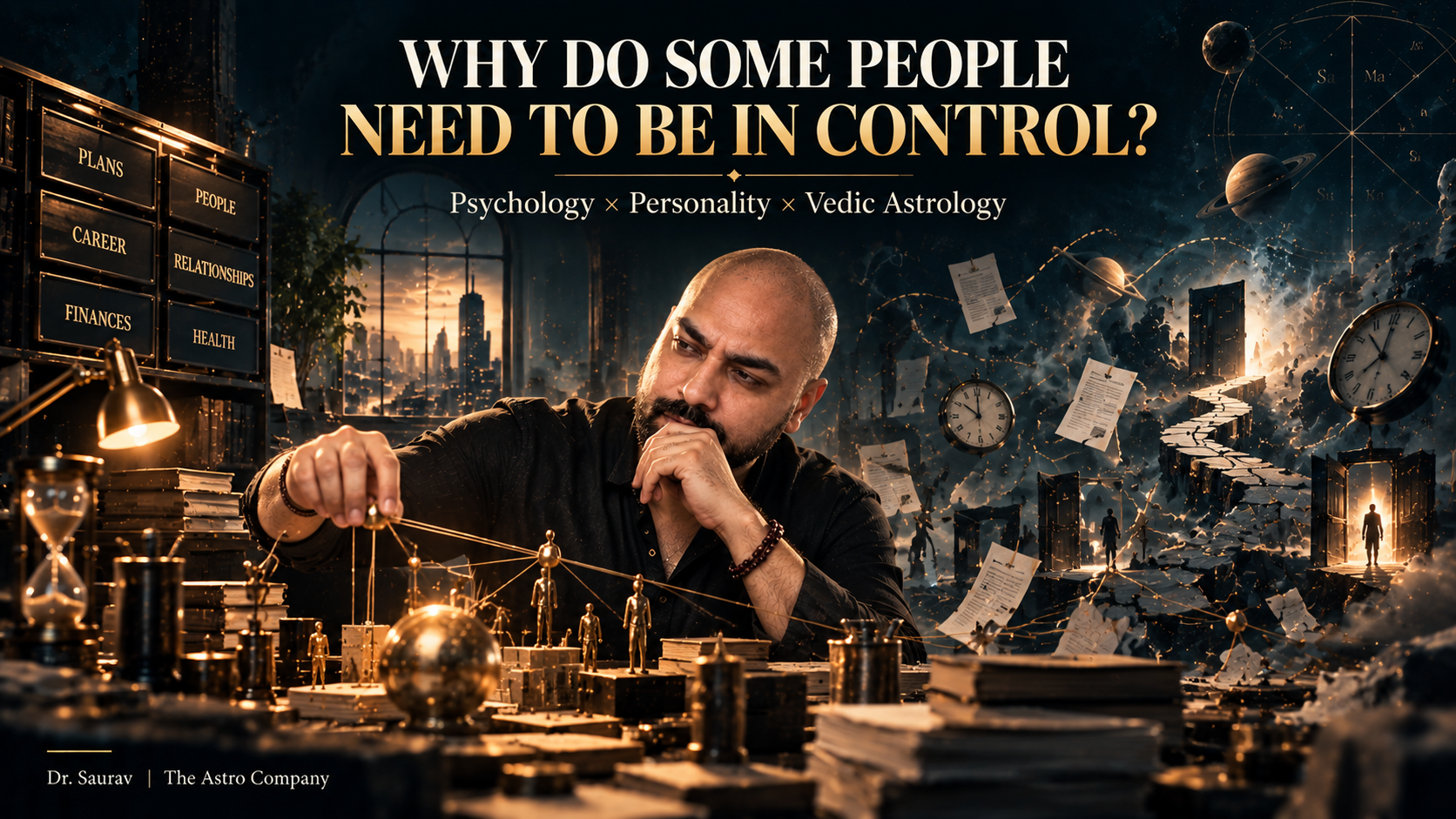
Some people find uncertainty uncomfortable.
Others seem almost unable to tolerate it.
They want to know the plan.
They want things done their way.
They dislike surprises.
They struggle to delegate.
They may interfere in other people’s decisions—not necessarily because they want power, but because uncertainty itself feels uncomfortable.
So why do some people need to be in control so much?
The answer may be more psychological than it first appears.
Control is not necessarily a bad thing
We often use the word “controlling” as if it automatically means something negative.
But psychology makes an important distinction between wanting control and controlling other people.
A desire for control can simply mean that a person prefers to make their own decisions, influence outcomes and feel capable of affecting what happens in their life.
Psychologist Jerry Burger and Harris Cooper developed the concept of desirability of control to study individual differences in people’s general motivation to control events in their lives.
And there is a reason this desire exists.
A sense of control is psychologically valuable.
Research has linked perceived control with coping, wellbeing and responses to stress, while newer experimental work suggests that temporarily increasing people’s subjective sense of control can reduce the impact of a later stressor.
So the problem isn’t:
“I want control.”
The more interesting question is:
“What happens to me when I don’t have it?”
Control can become a psychological strategy
Imagine two people facing the same uncertain situation.
Person A thinks:
“I don’t know what will happen, but I’ll deal with it when it does.”
Person B thinks:
“I need to know exactly what is going to happen.”
Person B may start planning excessively.
Checking repeatedly.
Asking for reassurance.
Correcting other people.
Trying to predict every possible outcome.
The behaviour may look like a desire for power.
But underneath it may be an attempt to reduce psychological uncertainty.
This is why controlling behaviour can sometimes be less about dominance and more about managing discomfort.
That doesn’t make controlling behaviour harmless.
But understanding the mechanism is different from judging the behaviour.
Why uncertainty can feel threatening
We cannot control everything.
Other people’s decisions.
Relationships.
Markets.
Health.
Timing.
The future.
And the human brain has to operate in an environment where outcomes are never completely predictable.
A sense of control gives us something psychologically useful:
agency.
The feeling that our actions matter.
That our decisions can influence what happens next.
When that feeling disappears, stress can increase.
Research on perceived control has repeatedly found that feeling more in control can be associated with lower stress reactivity and better adjustment.
A 2026 experimental study found that inducing a heightened sense of subjective control buffered participants against the impact of a later stressor, although the researchers also emphasize that the relationship between control and emotional responses depends on context.
So wanting some control is not a personality flaw.
It is part of being human.
Then when does control become a problem?
The problem begins when control changes from:
“I want to influence what I can.”
to:
“I need everything to happen according to my expectations.”
That’s a very different psychological position.
The first recognizes reality.
The second fights it.
A person who needs excessive control may find it difficult to tolerate:
- uncertainty
- delegation
- disagreement
- unpredictability
- dependence on others
- delayed outcomes
- mistakes
- situations where there is no perfect answer
And sometimes the greatest fear isn’t failure.
It is not knowing what will happen.
Control and relationships
Relationships expose this particularly well.
You can control your own behaviour.
You cannot completely control another person’s feelings.
You cannot control whether someone stays.
You cannot control how someone interprets you.
You cannot guarantee loyalty.
You cannot force emotional closeness.
Yet when someone feels insecure, the temptation can be to increase control.
More questions.
More checking.
More rules.
More reassurance.
More monitoring.
The paradox is that attempts to create security through control can sometimes create exactly the environment that damages trust.
Recent research examining attachment insecurity and relationship difficulties has identified dominance and need for control among several interpersonal mechanisms studied in these relationships.
Again, this does not mean every controlling person is insecure, or that insecurity explains all controlling behaviour.
Human behaviour is rarely that simple.
The astrology of control
Vedic astrology offers a very different framework for exploring this pattern.
It does not scientifically establish that particular planetary placements cause controlling behaviour.
But traditionally, several astrological principles are associated with themes that can be interpreted through agency, authority, control and resistance to uncertainty.
Mars is associated with action, assertion, competition and the drive to act.
Saturn is associated with boundaries, structure, discipline and limitation.
Sun is associated with individuality, authority and self-definition.
Rahu, in traditional interpretations, can amplify desire and fixation.
Depending on the chart, these themes may be interpreted in very different ways.
For example, strong Saturn themes need not mean:
“This person is controlling.”
They may instead describe someone who prefers structure, predictability and clear boundaries.
Strong Mars does not automatically mean aggression.
It can also represent initiative, courage and decisiveness.
And a strong Sun doesn’t necessarily mean arrogance.
It may represent a strong need for autonomy and self-definition.
This is why astrological interpretation has to consider the whole chart, rather than turning one planet into a personality diagnosis.
The deeper question isn’t “Why do I control?”
It may be:
“What am I afraid will happen if I stop controlling?”
That’s a very different question.
Maybe:
“If I don’t plan everything, I’ll fail.”
“If I don’t monitor the relationship, I’ll be abandoned.”
“If I don’t make the decision, someone will make the wrong one.”
“If I don’t stay productive, I’ll lose my value.”
“If I don’t know what happens next, I won’t be able to handle it.”
Now the behaviour becomes easier to understand.
The control may be sitting on top of a deeper fear.
And that is where psychological self-awareness becomes useful.
Control versus agency
Perhaps the healthiest goal isn’t to eliminate the need for control.
It is to distinguish between:
What I can influence.
and
What I cannot control.
Agency says:
“I will do what is within my control.”
Rigid control says:
“I need reality to behave according to my plan.”
The first creates action.
The second can create exhaustion.
Because reality always wins eventually.
The paradox of letting go
Sometimes letting go doesn’t mean becoming passive.
It means becoming more precise about where your energy belongs.
You can control your preparation.
Not the outcome.
You can control how honestly you communicate.
Not another person’s response.
You can control your boundaries.
Not another person’s behaviour.
You can control your effort.
Not the timing of success.
That distinction can be psychologically liberating.
And it is also one of the most interesting places where psychology, philosophy and astrology meet.
A question worth asking yourself
Think about an area of your life where you feel a strong need to control things.
Then ask:
“What am I actually trying to protect?”
Your success?
Your relationship?
Your image?
Your security?
Your sense of competence?
Your fear of being helpless?
The answer may tell you much more about your personality than the controlling behaviour itself.
From Control to Understanding
This is the kind of question I explore through The Astro Company—using Vedic astrology as a symbolic framework alongside psychology and human behaviour.
And for people who want to explore these patterns interactively, MindMozi is an AI trained by Dr. Saurav across psychological, astrological and philosophical perspectives.
The goal isn’t simply to ask:
“Why am I like this?”
It is to ask:
“What psychological need is this behaviour trying to fulfil?”
Because sometimes the behaviour we judge most quickly is protecting a fear we haven’t yet understood.
Research & Further Reading
- Burger, J. M. & Cooper, H. M. (1979). The Desirability of Control. Motivation and Emotion.
- Leotti, L. A., Iyengar, S. S. & Ochsner, K. N. (2010). Born to Choose: The Origins and Value of the Need for Control. Trends in Cognitive Sciences.
- Fielder, J. C. et al. (2026). Sense of control buffers against stress. eLife.
- Wen, J. H. & Sin, N. L. (2022). Perceived control and reactivity to acute stressors. Stress and Health.
- Burger, J. M. (1990). Desire for control and interpersonal interaction style. Journal of Research in Personality.