
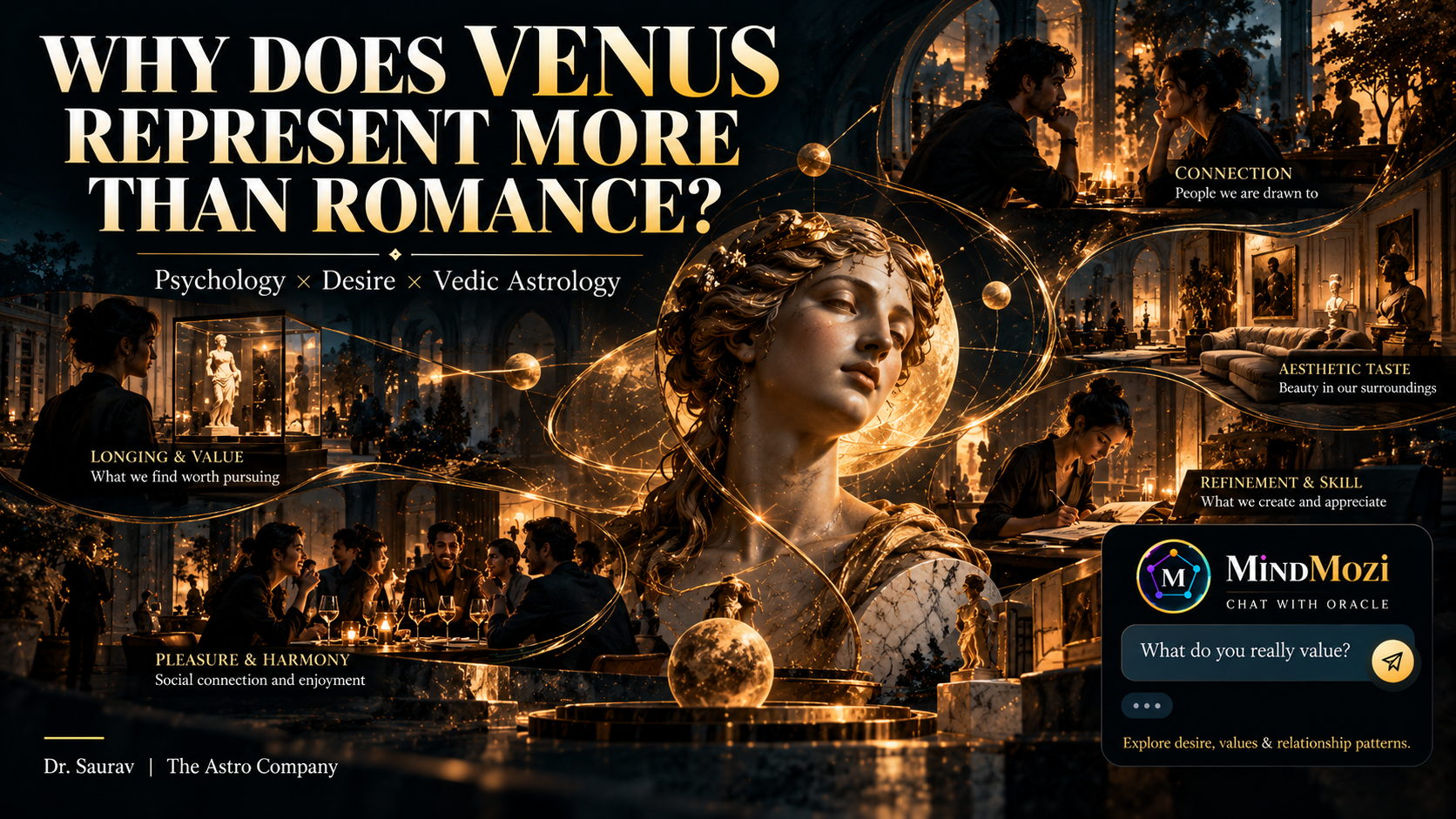
Why Does Venus Represent More Than Romance in Vedic Astrology?
Psychology × Desire × Vedic Astrology
When people hear the word Venus in astrology, they usually think of love, romance, marriage, beauty, and luxury.
But this raises an interesting question: why would a single planet represent so many different aspects of life?
What connects romantic attraction with artistic taste? What connects pleasure with money, social harmony, refinement, and the things we consider valuable?
To explore Venus meaningfully, we need to look beyond the question of whom someone loves.
We need to ask a broader question:
What does a person find desirable—and how does that desire shape the life they build?
1. Venus is not just about whom you love
In traditional Vedic astrology, Venus is known as Shukra. Its symbolism extends beyond romantic relationships to themes commonly associated with beauty, pleasure, enjoyment, refinement, attraction, and material comforts.
These associations can be explored through one central concept: value.
We are attracted to people, objects, experiences, and possibilities because we perceive something desirable in them.
For one person, value may mean emotional closeness. For another, it may mean beauty, financial comfort, intellectual refinement, social acceptance, or the freedom to enjoy life.
These priorities influence everyday decisions.
They affect how we spend money, whom we admire, what environments we seek, what we create, and which experiences make life feel rewarding.
Venus, interpreted symbolically, provides a traditional language for reflecting on these preferences.
That does not mean a planetary placement scientifically determines someone’s taste or values. It means the symbolism can serve as a framework for asking questions about them.
2. The psychology of desire: why do we want what we want?
Psychology offers several ways to examine human preferences.
We experience pleasure, seek rewards, form attachments, learn social expectations, and develop personal values through a combination of temperament, experience, culture, and circumstances.
Consider three people.
The first feels most alive in a loving relationship. The second feels fulfilled when creating something beautiful. The third values financial security because uncertainty has made life difficult in the past.
All three are pursuing something desirable—but not necessarily the same thing.
Their preferences may reflect different histories, needs, and learned associations.
This distinction matters because what attracts us is not always the same as what sustains our well-being.
An expensive object may offer temporary excitement without lasting satisfaction. Social approval may feel rewarding while making someone overly dependent on other people’s opinions. A romantic relationship may provide closeness but still be incompatible with a person’s long-term needs.
Understanding desire requires more than identifying what we like. It requires asking why we like it, what it gives us, and what it costs.
3. Venus and pleasure: enjoyment versus endless wanting
Pleasure is an important part of a meaningful life. Enjoying food, art, intimacy, music, comfort, and companionship is not inherently superficial.
The difficulty arises when the pursuit of pleasure becomes disconnected from reflection.
Think about the difference between enjoying something and needing it to feel worthy.
One person appreciates beautiful clothes without making their identity dependent on appearance. Another feels inadequate unless they can display a certain lifestyle.
One person enjoys romantic attention. Another feels valuable only when someone desires them.
The outward behaviour may look similar, but the psychological meaning can be very different.
A useful question is:
Do I enjoy this because it enriches my life—or do I depend on it to regulate how I feel about myself?
This is not a moral judgement about pleasure. It is a way of distinguishing enjoyment from dependence.
Traditional Venus symbolism can prompt reflection on these themes, but it cannot independently establish whether someone has a particular psychological pattern.
4. Venus and aesthetics: why does beauty matter?
Beauty is not merely decoration.
Art, music, architecture, clothing, and design can influence mood, communicate identity, and create a sense of coherence or belonging.
A person may love a minimalist room because it feels calm. Another may prefer rich colours, intricate patterns, and objects connected to memory or heritage.
These preferences can reflect personality, culture, experience, and individual associations.
Beauty can also be social. The things a society considers fashionable or desirable often communicate status, identity, and group membership.
This is one reason aesthetic preferences can become emotionally charged. They may express not only what we enjoy, but also how we want to be perceived.
In a traditional astrological reading, Venus is often considered when exploring beauty, artistic inclination, and refinement. The psychological interpretation should remain open-ended: a person’s taste is shaped by many factors, and no single planetary placement can scientifically explain it.
5. Venus, money, and the meaning of value
Why do two people with similar incomes make such different financial decisions?
One prioritises experiences. Another saves for security. A third spends on art, design, or possessions. Someone else values freedom from financial obligations above almost everything.
Money is not just a numerical resource. It can also represent security, autonomy, pleasure, status, opportunity, or protection against uncertainty.
This is where the symbolic association between Venus and material enjoyment becomes interesting.
Rather than reducing Venus to wealth, we can ask what a person finds worth acquiring and enjoying.
Do they value comfort? Beauty? Social experiences? Refinement? The ability to share generously? The freedom to choose?
And do those values support their broader goals?
The question is not whether pleasure or material comfort is good or bad. It is whether our choices reflect our genuine priorities—or whether we are following expectations we have never examined.
6. Venus and relationships: attraction is only the beginning
Romantic attraction is an obvious part of Venus symbolism, but attraction and relationship quality are not interchangeable.
You can be attracted to someone without sharing their values.
You can admire someone’s appearance or status without feeling emotionally safe with them.
You can experience chemistry without having compatible expectations about commitment, lifestyle, money, or communication.
Healthy relationships involve more than desire. They also depend on how people communicate, respond to conflict, respect boundaries, and make decisions together.
In traditional Vedic astrology, Venus may be examined alongside the 7th house, the 7th-house lord, the Moon, the condition of other relevant planets, and the broader chart. Different schools of interpretation may weigh these factors differently.
It is therefore simplistic to assume that one Venus placement automatically determines marital happiness, loyalty, attraction, or relationship outcomes.
A better interpretive question is:
What does this person seek in connection, and how does that desire interact with their expectations of partnership?
7. A deeper Vedic interpretation: Shukra as a symbol of refinement
In traditional Jyotish, Shukra is also associated with refinement, enjoyment, artistic qualities, and the capacity to appreciate desirable experiences. Classical texts and later interpretive traditions differ in their emphases, so a single simplified list should not be treated as the entirety of Venus’s meaning.
For a serious chart interpretation, Venus should be examined in context:
- Its sign, house, and dignity under the chosen astrological tradition.
- Its conjunctions and aspects.
- The condition of the houses and lords relevant to the question.
- Its relationship with the Moon and other relevant planetary factors.
- The operating dasha or planetary period, where the method being used considers it relevant.
These are traditional astrological techniques, not scientifically validated predictors of personality or life outcomes.
The interpretive aim should be to develop a coherent reading rather than to attach a fixed personality label to one placement.
For example, rather than declaring, “This Venus means you are materialistic,” a more reflective interpretation might ask whether comfort, beauty, approval, or security plays an unusually important role in the person’s decisions—and then examine whether their lived experience supports that hypothesis.
The chart should invite inquiry, not replace it.
8. Five questions to understand your own Venus themes
Whether you approach Venus astrologically or simply use these questions for self-reflection, consider the following:
1. What attracts me most?
People, beauty, comfort, achievement, harmony, recognition, or something else?
2. What do I consider valuable?
Are my priorities genuinely mine, or have I absorbed them from family, culture, or social media?
3. What kind of pleasure restores me?
Which experiences leave me feeling nourished rather than merely stimulated?
4. Where do I seek approval?
Do I sometimes confuse being admired with being valued?
5. What am I willing to sacrifice for what I desire?
Does the pursuit of one form of pleasure undermine another part of my life that matters more?
These questions turn the abstract idea of Venus into something practical.
Final thought
Venus is often reduced to romance because love is one of the most visible forms of human desire.
But the deeper question is much broader.
What do we find beautiful? What makes life enjoyable? What do we value enough to pursue? What attracts us—and what do we hope that attraction will give us?
Through the traditional symbolism of Shukra, Vedic astrology offers a vocabulary for exploring these questions. Psychology adds evidence-based perspectives on reward, preferences, identity, and behaviour.
Neither approach should be stretched beyond what it can establish.
Understanding Venus is not only about asking whom you will love. It is also about examining the things you desire, the values you live by, and the kind of life you are trying to create.
Explore further with MindMozi
MindMozi is an AI trained by Dr. Saurav across psychological, astrological, and philosophical perspectives. You can use its different conversational personalities to reflect on attraction, values, relationships, and personal priorities.
To explore Venus in the context of your own birth chart, you can consult Dr. Saurav Chaturvedi through The Astro Company.
Research & Further Reading
- Ryan, R. M., & Deci, E. L. (2000). “Self-Determination Theory and the Facilitation of Intrinsic Motivation, Social Development, and Well-Being.” American Psychologist, 55(1), 68–78. https://doi.org/10.1037/0003-066X.55.1.68
- Kahneman, D., & Deaton, A. (2010). “High Income Improves Evaluation of Life but Not Emotional Well-Being.” Proceedings of the National Academy of Sciences, 107(38), 16489–16493. https://doi.org/10.1073/pnas.1011492107
- Kasser, T. (2002). The High Price of Materialism. MIT Press.
- Brown, K. W., & Kasser, T. (2005). “Are Psychological and Ecological Well-Being Compatible? The Role of Values, Mindfulness, and Lifestyle.” Social Indicators Research, 74, 349–368. https://doi.org/10.1007/s11205-004-8207-8
These sources offer perspectives on motivation, material aspirations, values, and well-being. They do not validate astrological claims about Venus.