

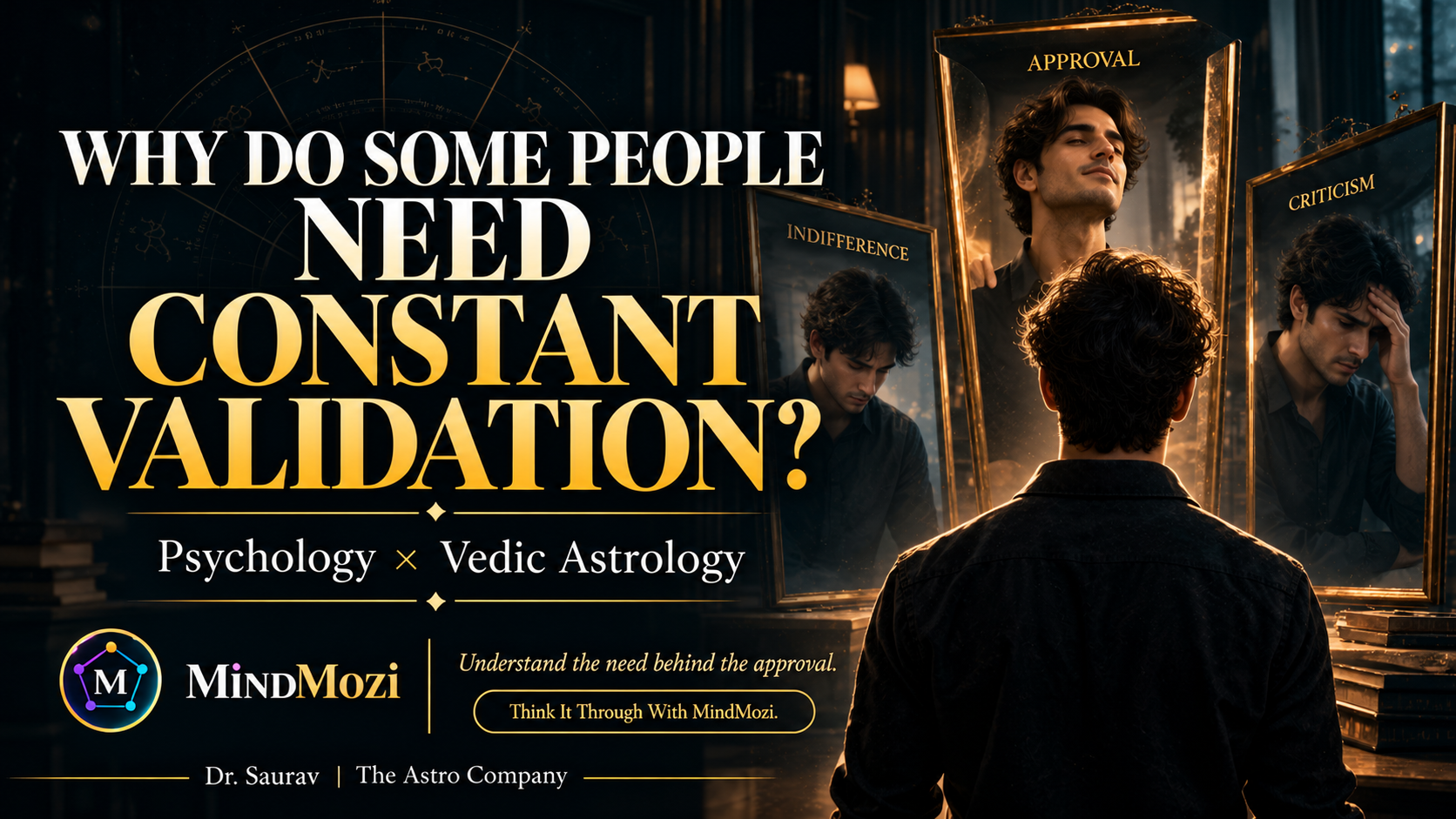
The psychology of approval-seeking, conditional self-worth, and the quiet fear of not being enough.
Have you ever noticed how some people can achieve something meaningful and still struggle to feel good about themselves?
They receive compliments, but they wonder whether the compliments are genuine. Someone appreciates them, but they need to hear it again. A message goes unanswered, and their mind begins constructing explanations. They make a decision, then repeatedly ask other people whether they made the right one.
From the outside, this can look like insecurity, attention-seeking, or a desire to be admired.
But sometimes, something more fundamental is happening.
The person may not simply want approval. They may be using approval to determine whether they are worthy.
That distinction changes how we understand the behaviour.
1. The difference between wanting appreciation and needing validation
Wanting appreciation is a normal human experience. We are social beings, and feedback from people we care about can reassure us, strengthen relationships, and help us understand how our behaviour affects others.
The problem begins when appreciation stops being something that feels good and becomes something a person feels they cannot function without.
Consider two people who receive no response after sharing an important achievement.
The first person might feel disappointed and eventually move on.
The second may begin questioning the achievement itself. Perhaps it was not impressive. Perhaps nobody cares. Perhaps they are not as talented as they thought.
The event is similar. The interpretation is different.
For the second person, silence may feel less like an absence of feedback and more like evidence against their own worth.
This is not a diagnosis. Nor does it mean that every person who seeks reassurance has low self-esteem. Context, temperament, relationship experiences, stress, and the behaviour of other people all matter.
The important question is not simply, “How much reassurance do you need?”
It is: “What does it mean about you when reassurance is missing?”
2. When self-worth becomes conditional
Psychologists Jennifer Crocker and colleagues have studied a concept known as contingencies of self-worth: the domains in which people base their sense of value on success, approval, appearance, achievement, or other external conditions.
Their research suggests that self-esteem is not just about how positively a person sees themselves. It also matters what that positive self-view depends on. <Link url=”https://pubmed.ncbi.nlm.nih.gov/11488379/” title=”Read Crocker and Wolfe’s review on contingencies of self-worth”/>.
Imagine someone whose internal rule is:
- I am worthy if people admire me.
- I am lovable if I am always useful.
- I am successful if I outperform others.
- I am attractive if other people confirm it.
- I am a good person if nobody is disappointed in me.
These rules can motivate achievement and social sensitivity. But they also create vulnerability.
If your worth depends on other people’s reactions, then your emotional stability depends partly on something you cannot control.
People change their minds. They get distracted. They have different preferences. They fail to communicate. They sometimes behave unfairly.
A person whose self-worth is conditional may experience these ordinary events as personal verdicts.
A delayed reply becomes rejection. Constructive criticism becomes humiliation. Someone else’s success becomes evidence of personal inadequacy.
The problem is not that feedback matters. The problem is that feedback has been given the authority to define the self.
3. Why might this pattern develop?
There is rarely one universal cause. Several pathways may contribute, and they can overlap.
A. Affection that felt conditional
Some people grow up receiving more approval when they perform well, behave perfectly, achieve something, or meet other people’s expectations.
A child may gradually learn that being impressive is safer than simply being themselves.
The lesson does not have to be spoken aloud. It can emerge through repeated experiences: warmth after success, disappointment after mistakes, or attention that seems to depend on usefulness.
Later in life, the person may continue trying to earn what they want to experience as unconditional acceptance.
This is one possible developmental pathway, not an assumption about every person who seeks validation.
B. Unpredictable relationships
When attention or affection is inconsistent, people may become more alert to changes in tone, availability, and behaviour.
They may repeatedly check whether the relationship is still secure.
However, we should distinguish an internal pattern from a genuinely unreliable relationship. If another person regularly withdraws affection, breaks promises, or uses silence to control you, the resulting distress cannot fairly be explained only as your insecurity.
Sometimes reassurance-seeking reflects an old fear. Sometimes it is a response to a real lack of reliability. Sometimes both are present.
C. Identity built around performance
Achievement can provide direction, competence, and satisfaction. But if a person learns to measure their entire value through performance, every setback becomes emotionally expensive.
A failed project is no longer just a failed project. It becomes, “Maybe I am a failure.”
Crocker and colleagues have discussed how pursuing self-esteem through external conditions can carry costs for learning, relationships, and self-regulation. <Link url=”https://doi.org/10.1111/j.0963-7214.2005.00364.x” title=”Read the research on the costs of contingent self-worth”/>.
The irony is that a person may become highly accomplished while remaining unable to feel secure about their accomplishments.
D. Social comparison
Modern life makes comparison unusually accessible. We can constantly see other people’s appearances, careers, relationships, purchases, achievements, and carefully selected moments.
When identity is already dependent on external evaluation, comparison can become a continuous examination.
The person is no longer asking, “Am I growing?”
They are asking, “Am I impressive enough compared with everyone else?”
The standard keeps moving because there will always be someone who appears more successful, attractive, popular, or certain.
4. Why reassurance often works — and why the relief may not last
Reassurance can genuinely help. A caring partner saying, “I love you, and we are okay,” can be meaningful and appropriate.
The difficulty arises when reassurance becomes the only way to manage uncertainty.
A possible cycle looks like this:
Uncertainty → anxious interpretation → request for reassurance → temporary relief → uncertainty returns.
The relief is real, but the person may not develop confidence in their ability to tolerate uncertainty without immediately resolving it.
Over time, the question can change from “Do they care about me?” to “Can I feel okay only when they prove that they care?”
This is one reason repeated reassurance may not solve the underlying problem.
The goal is not to stop asking for support. Healthy relationships need communication, affection, and repair. The goal is to develop more than one source of emotional stability.
5. What does constant validation look like in relationships?
It can take many forms:
- Repeatedly asking whether a partner is upset, even after receiving a clear answer.
- Interpreting a busy day as a sign of reduced love.
- Feeling threatened when a partner appreciates someone else.
- Overexplaining decisions because disagreement feels intolerable.
- Saying yes to avoid disappointing people.
- Feeling responsible for keeping everyone happy.
- Seeking praise for every important decision.
- Becoming unusually distressed by criticism, even when it is delivered respectfully.
These behaviours do not automatically indicate a psychological disorder. Nor do they all have the same motivation.
One person may fear abandonment. Another may fear being ordinary. Someone else may be trying to avoid conflict because disagreement has previously carried a high emotional cost.
The visible behaviour can look similar while the underlying fear differs.
That is why understanding the function of a behaviour is often more useful than simply labelling it.
6. A Vedic astrology perspective: the symbolic language of validation
Vedic astrology offers a traditional symbolic framework for exploring themes such as identity, relationships, emotional security, recognition, and self-worth.
It is important to keep the distinction clear: psychological research supports concepts such as contingent self-worth, but it does not establish that planetary placements cause validation-seeking behaviour or reliably diagnose it.
Within a traditional astrological reading, several factors might be explored as interpretive themes:
The Moon is associated with the mind, emotional experience, and a sense of inner security. An astrologer might examine its condition and associations when discussing how someone processes emotional feedback.
The Sun is associated with identity, authority, confidence, and recognition. Symbolically, it may prompt questions about the relationship between self-respect and external status.
Venus is associated with affection, attraction, harmony, and relational pleasure. Its symbolism can open a discussion about the difference between enjoying love and depending on another person’s approval to feel lovable.
The 1st house traditionally concerns the self and personal identity, while the 7th house concerns partnership and one-to-one relationships. The 10th house is associated with public role, work, and recognition.
These are interpretive associations, not psychological measurements. No single planet, house, aspect, or placement should be treated as proof that someone needs constant validation.
The more useful question is not, “Which planet makes a person insecure?”
It is, “What does this symbolic framework invite us to examine about identity, attachment, recognition, and emotional dependence?”
Astrology can provide a language for reflection. Psychological evidence should be used when making claims about behaviour, development, and mental health.
7. How can someone become less dependent on external approval?
The answer is not to become indifferent to other people. Human connection matters. The aim is to care about others’ opinions without allowing those opinions to become the sole measure of personal worth.
Step 1: Identify the meaning you attach to silence
When someone does not respond, pause before deciding what it means.
Ask yourself:
- What actually happened?
- What story am I telling myself about it?
- What other explanations are possible?
- What evidence would help me distinguish them?
This creates space between an event and the conclusion you draw from it.
Step 2: Separate behaviour from identity
Instead of “I failed, so I am incompetent,” try “This attempt did not work; what can I learn from it?”
Instead of “They are disappointed, so I am a bad person,” ask whether you made a genuine mistake, whether their expectation was reasonable, and whether repair is needed.
You can take responsibility without turning every mistake into a verdict on your entire identity.
Step 3: Practise making small decisions without a vote
Choose something low-risk — what to wear, what to read, how to organise your day — and make the decision without asking several people to confirm it.
The purpose is not to prove that other people are wrong. It is to learn that uncertainty does not always require outside permission.
Step 4: Ask for connection directly
Instead of testing someone, withdrawing to see whether they chase you, or repeatedly asking indirect questions, try expressing the actual need.
For example: “I’ve been feeling a little disconnected. Could we spend some time together tonight?”
Direct communication allows another person to respond to a real request rather than an unspoken test.
Step 5: Build multiple sources of self-respect
Develop values and activities that matter even when nobody is watching: learning, integrity, creativity, physical care, meaningful work, friendship, or service.
The point is not to replace approval with achievement as another rigid condition for worth.
It is to develop a more stable relationship with yourself — one in which success can be celebrated and failure can be examined without deciding that your entire value has changed.
Step 6: Seek support when the pattern becomes costly
If approval-seeking repeatedly disrupts relationships, work, sleep, or emotional well-being, a qualified mental health professional can help explore the pattern and develop more sustainable responses.
You do not need to wait until a problem becomes severe to ask for help.
8. Questions worth asking yourself
Take a moment with these questions. You do not need to answer them perfectly.
- When someone does not approve of my decision, do I reconsider the decision — or my worth as a person?
- Do I want appreciation, or do I need it to feel emotionally safe?
- Can I tolerate being misunderstood by someone whose opinion matters to me?
- Do I agree with people because I genuinely agree, or because disagreement makes me afraid?
- What parts of my identity remain meaningful when nobody praises me?
- If I trusted my own judgement a little more, what would I do differently?
These questions are not a test. They are a way to notice where your emotional stability may have become too dependent on external feedback.
The deeper question: who gets to decide your worth?
There is nothing wrong with wanting to be loved, respected, appreciated, or understood.
The difficulty begins when the absence of those things becomes evidence that you are fundamentally inadequate.
You can value someone’s opinion without treating it as the final authority on your identity. You can accept criticism without collapsing into shame. You can want reassurance without requiring another person to repeatedly rescue you from every uncertainty.
Perhaps emotional maturity is not the point at which we stop caring what people think.
Perhaps it is the point at which we stop handing other people the exclusive responsibility of deciding what we should think of ourselves.
That is a more realistic goal than becoming completely independent of approval — and a far more humane one.
Explore the question further
If you want to reflect on your patterns through psychology, Vedic astrology, and philosophical perspectives, you can explore them with MindMozi — Five Minds. One App. Total Clarity. It is designed to help you think through personal questions from different perspectives, rather than relying on a single answer.
For a personal Vedic astrology consultation, you can connect with Dr. Saurav Chaturvedi through The Astro Company.
This article is educational and is not a substitute for individual psychological assessment or therapy.