
Imagine someone tells you:
“You are naturally impatient.”
“You tend to overthink relationships.”
“You have a strong need for independence.”
“You are ambitious.”
“You struggle with authority.”
Now imagine they add:
“This is visible in your birth chart.”
A natural question follows:
If my chart already describes these tendencies, how much choice do I really have?
If astrology can describe patterns in our behaviour, are we actually choosing?
Or are we simply acting out a script?
This question sits at the intersection of astrology, psychology and philosophy.
And the answer is much more interesting than either “everything is predetermined” or “we have complete freedom.”
The difference between a tendency and a decision
Consider someone who has a naturally reactive temperament.
They may become angry quickly.
But there is a difference between:
feeling anger
and
choosing what to do with that anger.
The first may happen automatically.
The second introduces a layer of agency.
This distinction is important because human behaviour is rarely produced by a single factor.
Biology matters.
Environment matters.
Learning matters.
Personality matters.
Social circumstances matter.
And so do conscious decisions.
So even if we accept that people have relatively stable tendencies, that doesn’t automatically mean every behaviour is predetermined.
Psychology doesn’t give us a simple answer either
Interestingly, psychology itself has spent decades examining the question of free will.
Researchers have studied what happens when people’s belief in free will is weakened.
A large meta-analysis covering 145 experiments found that such manipulations can reduce people’s belief in free will and increase belief in determinism — but did not find clear evidence for broad downstream behavioural consequences. PubMed
Other research suggests that people’s beliefs about free will are connected to how they judge responsibility, morality and other people’s behaviour. PubMed
So even psychology doesn’t simply conclude:
“Free will is real.”
or
“Free will is an illusion.”
The philosophical problem remains.
Maybe freedom doesn’t mean having no influences
This is where the discussion becomes more interesting.
Suppose you were born with a naturally anxious temperament.
You didn’t choose that starting point.
Suppose you grew up in an environment that made you cautious.
You didn’t choose that either.
Suppose your experiences taught you to avoid rejection.
Again, you didn’t consciously design that pattern.
But now imagine that you recognise it.
You notice:
“Whenever someone gets emotionally distant, I become desperate for reassurance.”
That awareness creates a new possibility.
You can still feel the anxiety.
But perhaps you don’t have to act on it in exactly the same way.
That may be where a meaningful form of freedom begins.
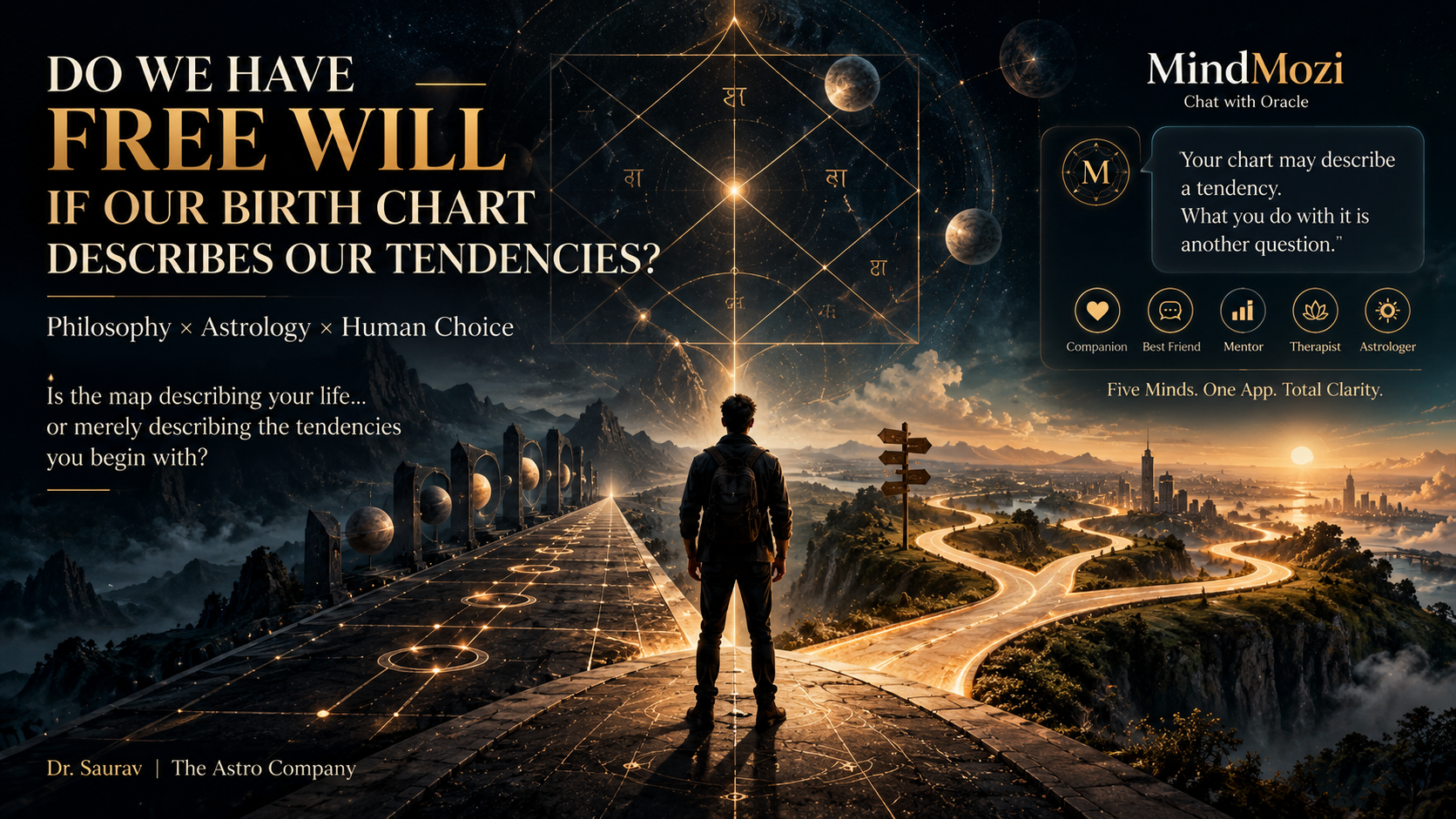
The birth chart as a map, not a command
This is where Vedic astrology offers an interesting philosophical model.
A birth chart can be interpreted as describing tendencies, patterns, predispositions and areas of experience.
It does not necessarily have to be interpreted as a list of commands.
Your chart may describe how you are inclined to respond.
It doesn’t automatically mean you must respond that way every time.
A useful metaphor is:
A chart may describe the terrain.
It doesn’t necessarily determine every step you take across it.
A mountain makes one route harder.
A river makes another route easier.
But there can still be more than one way to travel.
Some contemporary Jyotish interpretations similarly distinguish between karmic conditions/tendencies and the choices made within those conditions. Vedic Astrology
That distinction is philosophically important.
Because otherwise astrology becomes fatalism.
And fatalism is not the only way to understand karma.
Karma doesn’t have to mean “everything is fixed”
The popular version of karma is often:
“Whatever happens was already destined.”
But the philosophical discussion is more nuanced.
Traditional Indian thought contains distinctions between different dimensions of karma and action.
One common interpretive framework distinguishes:
Sanchita — accumulated karma
Prarabdha — karma already unfolding
Kriyamana / Agami — karma being generated through present action
The terminology and interpretations vary across traditions, but the underlying philosophical idea is useful:
There can be conditions you inherit without every future action being predetermined.
In that sense, your starting point and your response are not necessarily the same thing.
So where does free will actually exist?
Maybe not in choosing everything.
You didn’t choose your birth.
You didn’t choose your parents.
You didn’t choose your early environment.
You didn’t choose every psychological tendency you developed.
You don’t control everything that happens to you.
But there may be a smaller and more practical form of freedom:
What do I do with what I have been given?
You inherit a temperament.
What do you build with it?
You inherit certain fears.
Do you obey them forever?
You experience anger.
Do you turn it into destruction, boundaries or disciplined action?
You experience desire.
Do you become controlled by it?
Or can you observe it?
This is where psychology, philosophy and astrology start speaking to each other.
Awareness may change the equation
Imagine two people with very similar tendencies.
Both become insecure when they feel rejected.
Person A never examines the pattern.
They react automatically.
Person B recognises it.
They start noticing:
“This isn’t the first time I’ve done this.”
They pause.
They question the interpretation.
They choose a different response.
The emotional tendency may still exist.
But the behavioural outcome changes.
That is an important distinction:
Awareness doesn’t necessarily remove the tendency.
It can change your relationship with it.
The astrology interpretation
From a Vedic perspective, different planets and combinations are traditionally interpreted as representing different tendencies.
Mars can symbolically represent assertion, aggression and action.
Saturn can represent restraint, responsibility, fear and limitation.
Moon can represent emotional patterns and psychological security.
Rahu can represent intense desire, novelty and unconventional impulses.
But saying:
“Mars makes you angry.”
is very different from saying:
“Mars symbolically represents a pattern through which we can examine aggression and assertion.”
The second is a more intellectually honest way to use astrology.
It doesn’t pretend astrology has scientifically established causal power over human behaviour.
Instead, astrology becomes a symbolic language for self-reflection.
The deeper philosophical question
Perhaps the question isn’t:
“Do I have complete free will?”
Maybe that standard is impossible.
Perhaps the more useful question is:
“How much freedom can I create within the conditions I didn’t choose?”
That is a very different question.
You may not control the terrain.
But you may still influence how you navigate it.
You may not control your first emotional reaction.
But perhaps you can influence your second response.
You may not choose your tendencies.
But you can become conscious of them.
And consciousness changes the relationship between impulse and action.
Try this experiment
Think about one pattern you repeatedly see in yourself.
Maybe:
“I always chase people who pull away.”
“I always avoid difficult conversations.”
“I get defensive when criticised.”
“I need to control everything.”
“I lose interest when things become stable.”
Now ask:
“Did I choose this tendency?”
Maybe not.
Then ask:
“Do I have to obey it?”
That’s a different question.
And perhaps that second question is where your practical form of free will begins.
Where MindMozi fits in
This is exactly the kind of question I wanted MindMozi to explore.
MindMozi is an AI trained by me across psychology, astrology and philosophy.
Instead of giving you one fixed perspective, MindMozi lets you approach a question through different personalities.
Mentor — What should I actually do?
Best Friend — What am I refusing to see?
Oracle — What does the astrological pattern suggest?
Companion — Can I simply think this through with someone?
Because sometimes the most useful answer isn’t:
“This is your destiny.”
It’s:
“This is your pattern. Now what are you going to do with it?”
The answer may be somewhere between fate and freedom
Maybe our lives are neither completely scripted nor completely unrestricted.
Maybe we begin with conditions.
Temperament.
Family.
Culture.
Biology.
Experiences.
Circumstances.
Perhaps astrology symbolically adds another layer to that conversation.
But within those conditions, there may still be room for awareness, interpretation and choice.
Your birth chart may describe the weather.
It doesn’t necessarily decide whether you carry an umbrella.
And perhaps that is the most useful way to think about free will:
You may not choose every condition of your life.
But you can become more conscious of how you respond to them.
That space between what happens and what you do with it may be where freedom begins.
Want to explore your own patterns?
You can consult Dr. Saurav Chaturvedi through The Astro Company to explore your birth chart from a Vedic perspective.
Or explore the question conversationally with MindMozi — an AI trained by Dr. Saurav across psychology, astrology and philosophy.
Research & Further Reading
- Genschow et al. — Manipulating Belief in Free Will and Its Downstream Consequences: A Meta-Analysis.
- Clark, Winegard & Shariff — Motivated Free Will Belief.
- St Quinton & Crescioni — research examining free-will beliefs and health behaviour.
- Review literature on free-will beliefs and social behaviour.
- Philosophical literature on determinism, compatibilism and moral responsibility.
- Traditional and contemporary discussions of karma, choice and Jyotisha.
The psychological research does not establish that astrology predicts behaviour or removes free will. The astrology section above is presented as a traditional/symbolic interpretive framework.