
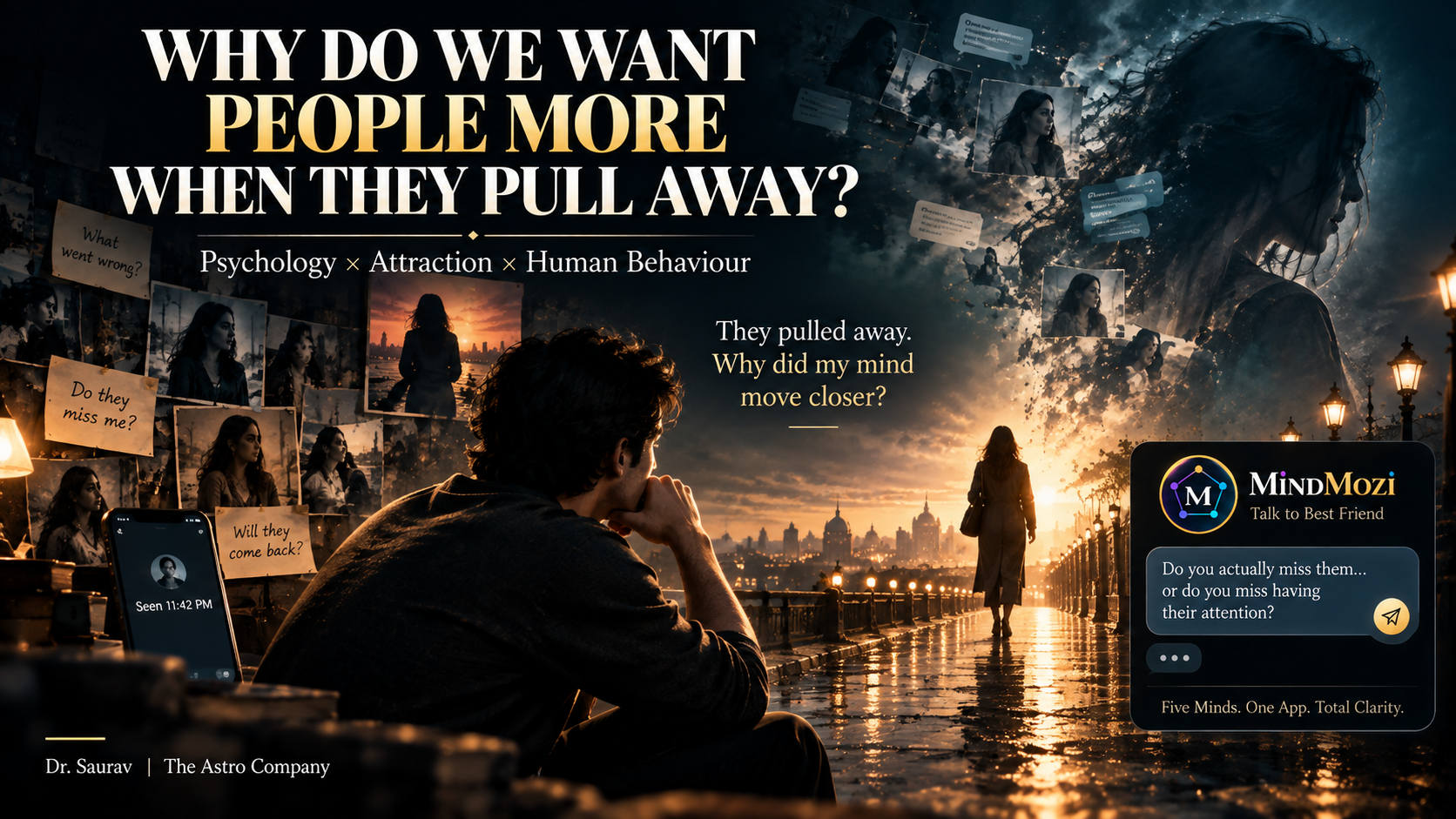
Have you ever noticed something strange?
Someone is available.
They text you.
They show interest.
They want to spend time with you.
And somehow, you don’t feel quite as obsessed.
Then they become distant.
Their replies become slower.
They stop initiating.
They seem less interested.
And suddenly…
you can’t stop thinking about them.
Why?
Is it love?
Is it attachment?
Is it ego?
Is it the fear of losing them?
Or is there something happening inside the psychology of uncertainty itself?
The answer is: sometimes, several things are happening simultaneously.
The moment certainty disappears, attention can increase
When someone is consistently available, you have information.
You know where you stand.
You don’t need to constantly interpret their behaviour.
But when they pull away, that certainty disappears.
Now your mind has questions:
Do they still like me?
What changed?
Did I do something wrong?
Are they interested in someone else?
Will they come back?
And suddenly, the person occupies much more mental space.
Research has actually found something remarkably relevant here.
In a well-known experiment, participants who were uncertain about how much a potential romantic partner liked them reported thinking about that person more — and this increased attraction. The uncertain group was actually more attracted than the group who knew the person liked them a lot. PubMed
So uncertainty isn’t always the opposite of attraction.
Sometimes:
Uncertainty can amplify attention.
We don’t always desire the person. Sometimes we desire resolution.
This distinction is incredibly important.
Imagine receiving a clear message:
“I don’t think we’re compatible. I wish you well.”
Painful?
Yes.
But psychologically, there is closure.
Now imagine:
“I don’t know what I want right now.”
And then silence.
The second situation can occupy your mind for much longer.
Because the brain is still trying to solve the problem.
You aren’t simply thinking:
“I want them.”
You may actually be thinking:
“I need to know what happened.”
And those are not the same psychological experience.
Sometimes what feels like intense attraction is partly unfinished cognitive processing.
Rejection can activate something deeper
For some people, another mechanism enters the picture:
rejection sensitivity.
Rejection sensitivity refers to a tendency to anxiously expect, readily perceive and strongly react to rejection.
Research has linked rejection sensitivity with the way people process interpersonal situations and respond to perceived rejection. PubMed
So when someone pulls away, a rejection-sensitive person may not experience it as:
“They’re busy.”
Their mind may interpret it as:
“They’re losing interest.”
And then the emotional system becomes activated.
They monitor.
They analyse.
They seek reassurance.
They reread conversations.
They check social media.
The person hasn’t necessarily become more compatible.
But the person’s psychological importance has increased.
The paradox of attention
Here’s another interesting mechanism.
When someone is available, your attention can move elsewhere.
Friends.
Work.
Family.
Hobbies.
Your own life.
But when someone withdraws, your attention can become disproportionately focused on them.
And attention itself can reinforce perceived importance.
You think about them more.
Because you think about them more, they feel more important.
Because they feel more important, you think about them even more.
A loop develops:
Distance → uncertainty → attention → rumination → perceived importance → more attention
And suddenly you are asking:
“Why do I want this person so badly?”
But part of the answer may simply be:
“Because I have been thinking about them so much.”
This is where attachment becomes important
Attachment patterns can influence how people respond to closeness and distance.
Someone with stronger attachment anxiety may strongly desire closeness while simultaneously being highly sensitive to signs of rejection.
Research on attachment insecurity and relationship uncertainty has found links between attachment orientations, uncertainty and emotional responses to relationship-threatening situations. PubMed
This can create a particularly painful dynamic.
When the other person comes closer:
“Finally, I’m safe.”
When they move away:
“I’m losing them.”
So the emotional intensity isn’t necessarily proportional to the quality of the relationship.
It may be proportional to the threat of losing the relationship.
That’s a very different thing.
And sometimes it’s psychological reactance
There is another fascinating concept:
psychological reactance.
When people perceive that a freedom or choice is being restricted, they can become motivated to restore that freedom.
Think about being told:
“You can’t have this.”
Suddenly, you want it more.
Relationships can sometimes activate a similar process.
Someone who was freely available becomes unavailable.
Your mind can experience that withdrawal as a loss of choice:
“Wait. I didn’t decide to stop wanting them.”
And now you want to regain what feels like it was taken away.
Research on relationships has examined this phenomenon through the idea of relationship reactance and the “forbidden fruit” effect. PubMed
But here’s the uncomfortable part
Sometimes we don’t want the person.
We want their validation.
These are not the same thing.
Ask yourself:
If this person suddenly came back tomorrow and said:
“I want you. I’m completely available.”
Would you still want them?
Or would the intensity immediately decrease?
That’s a powerful experiment.
Because if desire collapses as soon as certainty returns, you may have been responding partly to:
uncertainty, rejection, ego or validation.
Not necessarily compatibility.
“I miss them” can mean several different things
When someone says:
“I miss them.”
That statement can contain very different psychological experiences.
You may miss:
- their personality
- their companionship
- physical intimacy
- emotional safety
- the future you imagined
- the attention they gave you
- the validation they provided
- the version of yourself you experienced around them
- or simply the certainty that they wanted you
These are not interchangeable.
And confusing them can keep people attached to relationships that aren’t actually good for them.
Astrology gives us another lens
This is where Vedic astrology can become an interesting symbolic framework.
The Moon is traditionally associated with emotional security, attachment, memory and the mind.
Venus is associated with attraction, pleasure, bonding and relational desire.
Rahu is traditionally associated with amplification, obsession, unconventional desire and the tendency to intensify whatever it touches.
The 7th house is traditionally connected with partnership and significant one-to-one relationships.
From a symbolic perspective, certain combinations involving these factors can be interpreted as themes around:
desire + attachment + uncertainty + intensity.
But this needs an important qualification:
Astrology does not scientifically establish that planets cause someone to become obsessed with an unavailable person.
The astrological framework is interpretive.
Psychology gives us mechanisms we can investigate empirically.
Astrology gives us another symbolic language through which people may reflect on recurring patterns.
Keeping those two things separate makes the conversation much more intellectually honest.
So why do we sometimes want people more when they pull away?
There isn’t one universal explanation.
It may involve:
Uncertainty — “Where do I stand?”
Rejection sensitivity — “Are they leaving me?”
Attachment anxiety — “I need closeness again.”
Reactance — “You can’t take this choice away from me.”
Rumination — “I need to figure out what happened.”
Validation — “I need to know they still want me.”
Scarcity — “Now that they’re less available, they seem more valuable.”
And sometimes…
genuine love.
The difficult part is figuring out which one is operating in your particular situation.
Try this three-question test
The next time someone pulls away and you suddenly want them much more, ask yourself:
1. If they became completely available tomorrow, would I still want them?
2. Do I miss the person — or do I miss being wanted by them?
3. If I knew with certainty that they would never come back, what exactly would I be grieving?
Those questions can separate attachment from attraction.
And sometimes they reveal something we don’t particularly enjoy discovering:
We weren’t chasing the person.
We were chasing the feeling of being chosen.
MindMozi: another perspective before you act
This is exactly the kind of psychological question that can benefit from another perspective.
MindMozi is an AI trained by me across psychology, astrology and philosophy.
You can approach the same situation through different personalities.
Best Friend — “Tell me honestly what I’m doing.”
Mentor — “Help me understand what I should do next.”
Oracle — “Give me an astrological perspective on this pattern.”
AI Companion — “Let me think this through without being judged.”
Because sometimes you don’t need someone to tell you:
“Text them.”
or
“Forget them.”
You need someone to help you understand:
“Why did their distance change my feelings so dramatically?”
The deeper question
Maybe the most important question isn’t:
“Why do I want them more now that they’re pulling away?”
It’s:
“What does their withdrawal activate inside me?”
Because their distance may be revealing something that was already there.
A fear of rejection.
A need for validation.
An attachment pattern.
A fear of abandonment.
A desire to regain control.
Or simply the human discomfort of not knowing.
And once you understand what has actually been activated…
you get something extremely valuable back:
choice.
You can decide whether you actually want the person.
Or whether you simply want the feeling you lost when they walked away.
Want to explore this in your own birth chart?
You can consult Dr. Saurav Chaturvedi through The Astro Company.
Or explore the pattern conversationally with MindMozi — an AI trained by Dr. Saurav across psychological, astrological and philosophical perspectives.
Research & Further Reading
- Whitchurch, E. R., Wilson, T. D., & Gilbert, D. T. — “He loves me, he loves me not…”: Uncertainty can increase romantic attraction. PubMed
- Downey, G., & Feldman, S. I. — Implications of rejection sensitivity for intimate relationships. PubMed
- Richter et al. (2024) — Rejection in romantic relationships: Does rejection sensitivity modulate emotional responses to perceptions of negative interactions? PubMed
- Mikulincer et al. — The pushes and pulls of close relationships: Attachment insecurities and relational ambivalence. PubMed
- DeWall et al. — Forbidden fruit: Inattention to attractive alternatives provokes implicit relationship reactance. PubMed
- Houle, Barker & Pronin — Playing Hard-to-Get: A New Look at an Old Strategy. PubMed