
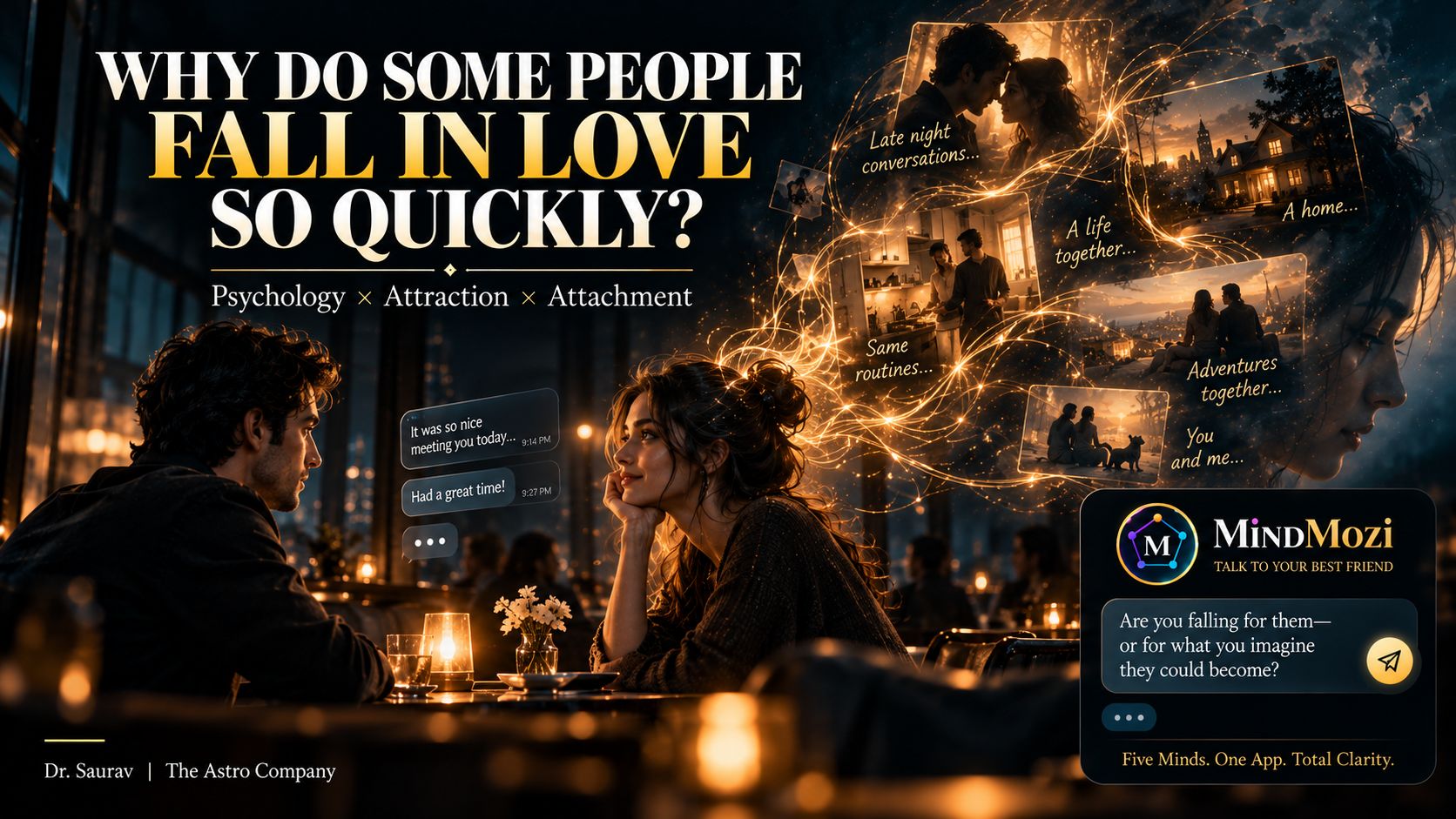
Why Do Some People Fall in Love So Quickly?
Psychology × Attraction × Attachment
Some people need months to develop feelings. Others meet someone, have two meaningful conversations, and begin imagining a future together.
They think about the person constantly. They replay conversations, interpret small gestures, and feel emotionally connected long before they truly know who the other person is.
Is this a sign of extraordinary romantic sensitivity? A deep capacity to love? An anxious attachment pattern? Or are they sometimes falling in love with an imagined version of someone?
The answer is more complicated than simply saying that some people love harder than others.
1. The mind can build a relationship before one exists
Imagine meeting someone who makes you feel understood. They listen attentively, share your humour, and seem interested in your life.
You have met them only a few times, but your mind has already started filling in the gaps.
You imagine how supportive they would be during difficult times. You picture future conversations, trips, intimacy, and a relationship in which you finally feel understood.
The problem is not that imagining a future is inherently unhealthy. It is that the imagined relationship can develop faster than your knowledge of the actual person.
You know how they make you feel. You may not yet know how they handle conflict, responsibility, disappointment, boundaries, or commitment.
In other words, you have experienced a feeling—but you have not yet gathered enough evidence about compatibility.
2. Why does this happen?
There is no single psychological explanation for falling in love quickly. Several processes may contribute, and they do not apply to everyone.
A. You may be responding to what the person represents
Sometimes, attraction is about more than the person in front of you.
They may represent emotional safety, excitement, validation, belonging, freedom, or the possibility of finally being chosen.
Someone who has felt lonely for years may experience a particularly powerful connection with a person who seems attentive. Someone who has spent years feeling misunderstood may become deeply invested in the first person who appears to understand them.
The attraction can be genuine. But part of its intensity may come from what the person symbolises.
Ask yourself:
Am I drawn to who this person consistently is—or to how I imagine my life will feel with them?
B. Your imagination fills in missing information
Early relationships contain uncertainty. You do not yet know the other person’s full personality, history, values, or limitations.
When information is incomplete, your interpretation plays a larger role.
You may interpret a thoughtful message as evidence of exceptional emotional maturity. You may interpret shared interests as proof of profound compatibility. You may mistake a few intimate conversations for a complete understanding of someone’s character.
This is one reason early attraction can feel almost magical: you are responding partly to reality and partly to the meaning you have assigned to it.
The imagined version may be wonderful. The real person may be wonderful too. But they are not yet the same thing.
C. Attachment patterns may influence the pace
People differ in how they experience closeness, uncertainty, and the possibility of rejection.
For some people with higher attachment anxiety, a new romantic connection can quickly become emotionally significant. They may worry about losing the connection, look for signs of reciprocation, or seek reassurance before the relationship has developed enough stability.
Others may fall quickly because they genuinely enjoy intimacy, are comfortable expressing affection, or have had positive experiences with relationships.
Attachment theory offers useful questions, but it should not become a shortcut for diagnosing someone. Falling in love quickly does not automatically mean a person has anxious attachment.
Research has linked insecure attachment dimensions—particularly anxiety and avoidance—with poorer relationship-quality outcomes across many studies. That does not mean attachment alone determines whether a relationship succeeds.
D. Intensity can be mistaken for compatibility
A powerful emotional experience tells you something about your internal response. It does not, by itself, tell you whether two people can build a healthy relationship.
Psychologist Robert Sternberg’s triangular theory describes love in terms of three components: intimacy, passion, and commitment.
Passion can emerge quickly. Emotional intimacy may begin early. But commitment involves a decision to sustain a relationship, and meaningful knowledge of another person develops through experience.
A useful distinction is this:
- Attraction: I feel drawn to you.
- Infatuation: I think about you intensely and imagine what we could become.
- Growing intimacy: I am learning who you are, including your vulnerabilities and limitations.
- Mature love: Affection is supported by knowledge, trust, reciprocity, and the choices we make over time.
These experiences can overlap. They are not rigid stages that everyone must follow. The point is simply that strong feelings and reliable knowledge are not identical.
3. Is falling in love quickly a red flag?
Not necessarily.
Some relationships begin with immediate attraction and develop into lasting partnerships. Some people are emotionally expressive, open to intimacy, and clear about what they want.
The speed of the feeling is less informative than what happens alongside it.
Consider these questions:
- Can you tolerate learning something about the person that does not fit your initial impression?
- Can you maintain your own friendships, work, interests, and routines?
- Can you respect their pace without demanding immediate certainty?
- Are you interested in their actual values and behaviour, or mostly in how they make you feel?
- Can you accept that a promising connection might not become a relationship?
A fast-growing connection becomes more concerning when it requires you to ignore incompatibility, abandon boundaries, overlook disrespect, or treat uncertainty as an emergency.
The goal is not to suppress your feelings. It is to allow your understanding to catch up with them.
4. The difference between emotional openness and emotional urgency
Emotional openness says:
“I like you. I want to know you better. I am willing to see where this goes.”
Emotional urgency says:
“I like you so much that I need to know what we are, what you feel, and where this is going—right now.”
Both can involve genuine affection. But urgency can make it difficult to see the other person clearly.
When the relationship becomes a source of constant reassurance, the person may stop asking whether the connection is genuinely compatible and start asking whether the connection is secure.
Those are different questions.
A healthy relationship does not require you to remain emotionally detached. It asks you to remain curious even when you feel strongly.
5. The Vedic astrology perspective: Venus, Moon, Rahu and the 5th house
Vedic astrology offers a traditional symbolic language for exploring attraction and emotional investment. It is important to distinguish this interpretive framework from psychological science: astrology has not been established as a scientifically validated method for explaining why a person falls in love quickly.
Within traditional interpretation, different factors may be explored:
Venus (Shukra): Symbolically associated with attraction, affection, pleasure, romance, and what a person finds desirable.
Moon (Chandra): Associated with emotional needs, subjective experience, familiarity, and the sense of emotional security a person seeks.
Rahu: In some interpretive traditions, associated with amplification, fascination, unconventional desires, and becoming preoccupied with a particular experience or possibility.
The 5th house: Commonly associated with romance, attraction, and the experience of falling in love.
The 7th house: Associated with partnership and the dynamics of committed relationships.
An astrologer might examine how these factors interact within a complete chart, alongside relevant planetary periods and other traditional considerations. No single placement should be treated as proof that someone will fall in love quickly, idealise partners, or experience attachment difficulties.
The useful question is not simply, “Which placement makes someone fall in love fast?”
It is: What patterns of desire, emotional security, romantic imagination, and partnership might this chart invite us to explore?
Psychology can investigate behaviour through empirical research. Astrology can offer a symbolic vocabulary for reflection. Their contributions should be presented honestly rather than treated as interchangeable forms of evidence.
6. How to slow down without becoming emotionally unavailable
You do not need to play games, act indifferent, or hide your feelings.
Try these five practices:
1. Separate facts from interpretations.
Write down what the person has actually done, then what you believe those actions mean. Notice the difference.
2. Let consistency accumulate.
Observe how they behave across ordinary days, disagreements, inconvenience, and moments when they do not get what they want.
3. Keep your life intact.
Continue investing in your friendships, health, interests, and work. A new relationship can become important without becoming your entire emotional world.
4. Communicate honestly without demanding premature certainty.
You can express interest while accepting that both people need time to discover what the connection means.
5. Ask better questions.
Instead of only asking, “How strongly do I feel?”, also ask, “What have I learned about this person? How do we handle differences? Do their actions match their words?”
The purpose of slowing down is not to make love less intense. It is to give reality enough time to participate in the process.
7. A deeper question: what are you hoping love will change?
Sometimes, falling in love quickly is connected to a powerful hope: that another person will finally make life feel complete.
Perhaps you hope to feel chosen, understood, safe, desirable, or less alone.
These are human needs. There is nothing shameful about wanting them.
But when a new person becomes the imagined solution to several unmet needs, the relationship can acquire a significance far beyond what the two people have actually built.
You may start protecting the possibility of the relationship rather than evaluating the relationship itself.
That is when self-awareness becomes especially valuable.
Ask yourself:
- What am I hoping this person will make me feel?
- What do I genuinely know about them?
- Which parts of my imagined future are supported by their actions?
- Can I enjoy this connection without needing it to become everything I hope for?
Final thought
Falling in love quickly does not necessarily mean you are naive, needy, or incapable of mature relationships.
It may mean you are emotionally open. It may reflect your temperament, your experiences, your attachment tendencies, or the significance you assign to a new connection.
The important distinction is between feeling deeply and knowing deeply.
You can feel something extraordinary about a person before you know whether you are compatible with them.
Let the feeling be real. Let the curiosity remain. And give the person enough time to become more than the possibility you first saw in them.
Explore your own patterns
Want to explore how your emotional needs, relationship history, and romantic expectations influence your choices?
MindMozi is an AI trained by Dr. Saurav across psychological, astrological, and philosophical perspectives. You can explore the question with different conversational personalities—from a caring companion to an honest best friend or a strict mentor.
Want to examine your relationship patterns through your birth chart? You can consult Dr. Saurav Chaturvedi through The Astro Company.
Research & Further Reading
- Sternberg, R. J. (1986). “A Triangular Theory of Love.” Psychological Review, 93(2), 119–135. https://doi.org/10.1037/0033-295X.93.2.119
- Li, T., & Chan, D. K. S. (2012). “How Anxious and Avoidant Attachment Affect Romantic Relationship Quality Differently: A Meta-Analytic Review.” European Journal of Social Psychology, 42(4), 406–419. https://doi.org/10.1002/ejsp.1842
- Sternberg, R. J., & Sternberg, K. (2024). “A RELIC Theory of Love: The Role of Interpersonal, Intrapersonal, and Extrapersonal Elements in Love.” Theory & Psychology, 34(5), 671–698. https://doi.org/10.1177/09593543241270922
These works offer frameworks for understanding love, attachment, and relationship development; they do not establish a single cause for rapid romantic attachment.