
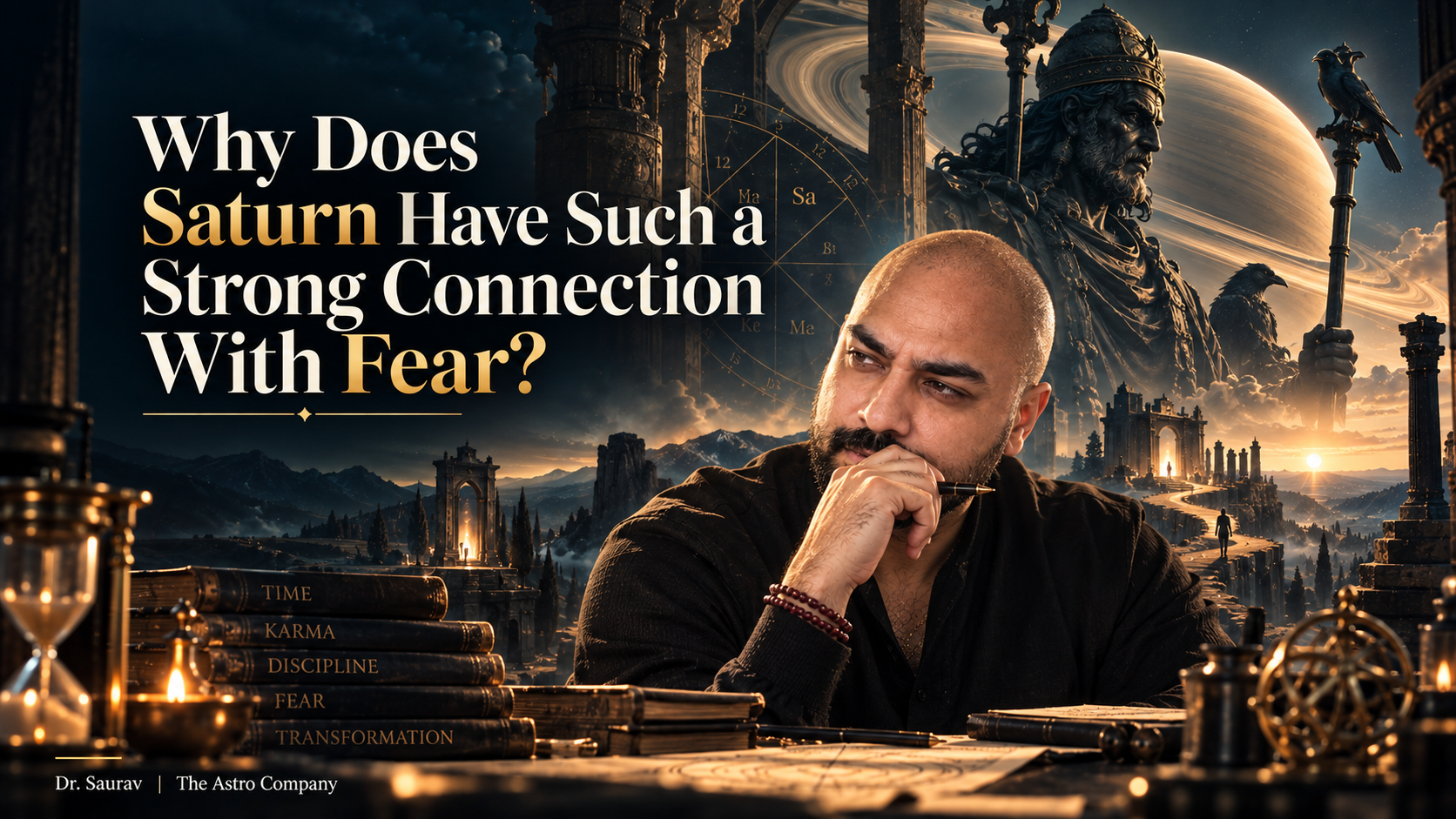
Why Does Saturn Have Such a Strong Connection With Fear?
There is a reason Saturn has acquired such a powerful reputation in astrology.
Mention Saturn, and people often think of delay, restriction, loneliness, responsibility, punishment—and above all, fear.
But what if Saturn’s connection with fear is not really about punishment?
What if it is about something much more fundamental to human psychology:
Our difficulty with uncertainty, limitation and lack of control.
Why does uncertainty create fear?
Human beings don’t respond only to what is happening.
We also respond to what might happen.
When the future is uncertain, the mind has to operate without complete information. Psychological research has consistently examined intolerance of uncertainty as an important factor associated with anxiety and worry. Contemporary research treats it as a broader psychological construct rather than something limited to one particular disorder.
Think about the situations that commonly generate fear:
What if I fail?
What if I lose my job?
What if the relationship ends?
What if my health changes?
What if my efforts don’t produce results?
The common element is not always the event itself.
It is the inability to know—and control—the outcome.
And this is where Saturn becomes psychologically interesting as a symbolic archetype.
Saturn represents what cannot be rushed
In traditional Vedic astrology, Saturn is associated with time, discipline, responsibility, labour, limitation and delayed results.
These are not necessarily pleasant themes.
But they are fundamental realities.
You cannot negotiate with time.
You cannot force every result to arrive when you want it.
You cannot eliminate every consequence of your actions.
And you cannot avoid every responsibility forever.
Saturn therefore represents a confrontation with reality as it is, rather than reality as we wish it were.
Traditional Jyotish interpretations commonly associate Shani with time, work, duty, delay and lessons that require patience.
But this is where the usual interpretation of Saturn as simply “bad” becomes too simplistic.
Fear and structure are two sides of the same experience
Consider a deadline.
The deadline creates pressure.
But the same deadline can also create structure.
A difficult responsibility can feel restrictive.
But taking responsibility can also build competence.
A limitation can frustrate us.
But limitations can force us to develop skills we might otherwise never develop.
This creates an interesting psychological paradox:
The thing that initially creates fear can sometimes become the thing that creates maturity.
Saturn, symbolically, sits exactly in this territory.
Saturn doesn’t necessarily represent fear itself
A more useful interpretation might be:
Saturn represents the circumstances in which we encounter our fear of limitation, uncertainty and consequence.
That distinction matters.
Suppose Saturn is associated with career pressure in a person’s chart.
The question doesn’t have to be:
“Will Saturn destroy my career?”
A more psychologically useful question is:
“What happens to my psychology when success cannot be guaranteed?”
Do I become anxious?
Do I procrastinate?
Do I become excessively controlling?
Do I withdraw?
Do I become more disciplined?
Do I learn patience?
The astrological symbolism becomes much more interesting when we ask these questions.
Why does Saturn feel different from other planets?
Different planets are traditionally given different psychological and behavioural symbolism.
Venus is associated with attraction, pleasure and relationships.
Mars with action, desire and assertion.
Jupiter with expansion, meaning and growth.
The Moon with emotional experience and mental fluctuations.
Saturn introduces something different:
limits.
And human beings often discover themselves most clearly when something stops being easy.
When everything is working, we may never discover how much uncertainty we can tolerate.
When circumstances become restrictive, our psychological patterns become visible.
This is one reason Saturn can become such a powerful symbolic archetype.
Saturn and the psychology of delayed gratification
Modern psychology also gives us a useful parallel here.
Much of adult development involves learning that immediate relief is not always the same thing as long-term wellbeing.
We delay gratification.
We tolerate discomfort.
We work toward outcomes that may take years.
We accept temporary frustration in exchange for a future goal.
Saturn symbolically represents this temporal dimension:
the willingness to remain committed when the reward is not immediate.
This does not mean every difficult experience is automatically beneficial.
Difficulty can genuinely harm people.
Nor does astrology provide scientific evidence that Saturn causes psychological states.
Psychology and astrology are different knowledge systems.
Psychology investigates behaviour and mental processes through empirical methods.
Astrology offers a symbolic framework for interpreting patterns and experience.
The value of placing them side by side is not to pretend they are the same.
It is to ask whether they can give us different ways of thinking about the same human question.
Perhaps Saturn’s greatest lesson is not suffering
The popular version of Saturn is:
“You will suffer until you learn your lesson.”
I find the psychologically richer interpretation to be different.
Saturn asks:
“What can you become capable of when you stop expecting life to remove every limitation?”
That question changes the entire meaning of the archetype.
Fear becomes information.
Restriction becomes a boundary.
Delay becomes a test of persistence.
Responsibility becomes an opportunity for competence.
Time becomes part of the process rather than the enemy.
And maturity becomes less about becoming fearless and more about becoming capable of functioning despite uncertainty.
The Saturn question
If Saturn represents the part of life that we cannot control, perhaps its deepest psychological question is:
What happens to you when life refuses to give you certainty?
Do you panic?
Do you avoid?
Do you try to control everything?
Do you blame circumstances?
Or do you gradually develop the capacity to tolerate uncertainty and continue moving?
That is a very different way of looking at Saturn.
Not as the planet that comes to punish us.
But as a symbolic representation of the parts of life that force us to confront time, limits, responsibility and reality.
And perhaps that is why Saturn has such a strong connection with fear.
We don’t necessarily fear Saturn.
We fear what Saturn represents: the things we cannot control.
Explore Your Own Pattern
This is one of the questions I explore through The Astro Company, where Vedic astrology is approached alongside psychology and human behaviour.
For those who prefer an interactive exploration, MindMozi is an AI trained by Dr. Saurav across psychological, astrological and philosophical perspectives.
The goal is not simply to ask:
“What will happen to me?”
But to ask a more useful question:
“What does my pattern reveal about how I respond to what happens?”
Sometimes the most interesting astrological questions are not about prediction.
They are about understanding ourselves.
Research & Further Reading
- Carleton, R. N. — The Intolerance of Uncertainty Construct in the Context of Anxiety Disorders — Expert Review of Neurotherapeutics.
- Carleton, R. N. — Into the Unknown: A Review and Synthesis of Contemporary Models Involving Uncertainty — Journal of Anxiety Disorders.
- Dugas, M. J., Koerner, N. & Freeston, M. — State of the Science: Intolerance of Uncertainty — Behavior Therapy, 2026.
- Wilson, E. J. et al. — The Impact of Psychological Treatment on Intolerance of Uncertainty in Generalized Anxiety Disorder — Journal of Anxiety Disorders.
- Näsling, J. et al. — Effect of Psychotherapy on Intolerance of Uncertainty: A Systematic Review and Meta-Analysis.