
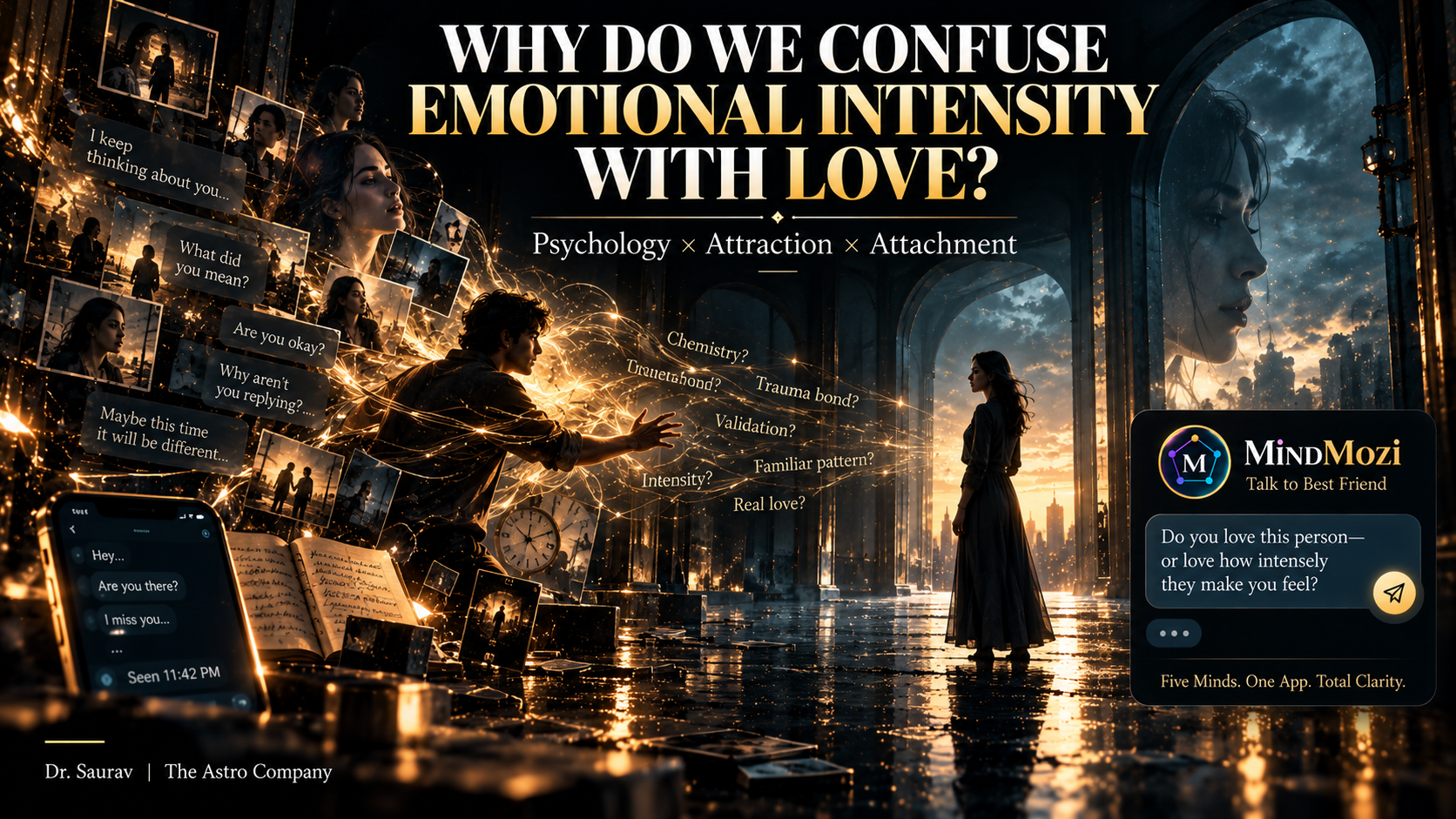
Why Do We Confuse Emotional Intensity With Love?
Have you ever felt so strongly about someone that you became convinced they must be special?
You think about them constantly.
Their messages can change your entire mood.
A little affection makes you feel euphoric. A little distance makes you anxious.
You replay conversations, analyse their behaviour and wonder what the relationship means.
And because the emotions are so powerful, you reach a conclusion:
“I have never felt this way before. This must be love.”
But what if emotional intensity and love are not always the same thing?
What if part of what you’re experiencing is attraction, uncertainty, attachment anxiety or the desire to feel chosen?
This doesn’t mean your feelings are fake. It means that powerful feelings can have several different causes.
And understanding those causes can change how you approach relationships.
1. Intensity tells you how strongly you feel, not necessarily how well you fit together
Imagine two relationships.
In the first, you feel an overwhelming attraction. You think about the person constantly. You experience extraordinary highs when they are affectionate and painful lows when they become distant.
In the second, attraction is present, but so are consistency, mutual respect, emotional safety and the ability to disagree without fearing the relationship will collapse.
Which relationship feels more exciting?
The answer may be the first.
Which relationship is more compatible with your long-term wellbeing?
You cannot determine that from emotional intensity alone.
Intensity tells you something about the strength of your experience. It doesn’t automatically tell you whether your values align, whether you can trust each other or whether the relationship can withstand ordinary difficulties.
A powerful feeling is real as an experience. Its interpretation still needs examination.
2. Uncertainty can make someone occupy more of your mind
When someone is consistently interested in you, you have fewer unanswered questions.
You know they want to see you. You understand where you stand. You don’t need to interpret every message.
But when their interest becomes unpredictable, your attention may increase.
Why did they take so long to reply?
Were they genuinely busy?
Did something change?
Are they losing interest?
Should you contact them first?
Research has found that uncertainty about a potential romantic partner’s feelings can increase attraction and thoughts about that person under certain conditions.
That finding is interesting, but it doesn’t mean uncertainty always increases attraction or that every intense relationship is driven by anxiety.
It does suggest that how much you think about someone is not a reliable measure of how compatible you are with them.
Sometimes you are thinking about the person.
Sometimes you are trying to resolve the uncertainty surrounding them.
And sometimes both are happening.
3. Emotional highs and lows can become part of the attraction
Consider a relationship that alternates between intense closeness and painful distance.
One day, you feel wanted.
The next, you feel ignored.
Then the person returns with affection, and the relief is enormous.
You may experience that reunion as evidence of how deeply you love them.
But some of that emotional high may be relief after distress.
The contrast between rejection and reassurance can make the reassuring moment feel especially powerful.
This is one reason it is worth looking at the entire relationship rather than judging it by its best moments.
Ask yourself:
Does this person consistently treat me well?
Or do the occasional moments of affection feel extraordinary because they follow periods of uncertainty?
A relationship does not become healthy simply because its good moments feel wonderful.
4. Attachment can influence how we experience attraction
Attachment theory examines how people respond to closeness, dependence and perceived rejection.
Someone with higher attachment anxiety may become particularly sensitive to signs that a partner is losing interest.
A delayed reply can trigger worry.
A change in tone can create fear.
A disagreement can feel like a threat to the entire relationship.
This doesn’t mean that every anxious person confuses intensity with love, or that someone who wants reassurance necessarily has an attachment problem.
It means that our expectations about closeness can influence how we experience romantic situations.
A meta-analysis of 73 studies, involving 21,602 individuals, found that insecure attachment dimensions—anxiety and avoidance—were associated with poorer relationship-quality indicators across cognitive, emotional and behavioural domains.
The practical implication is not to label yourself or your partner.
It is to notice whether your emotional experience is being shaped by the relationship itself, your interpretation of it, or a combination of both.
5. Chemistry is not the same as compatibility
Chemistry can be immediate.
Compatibility reveals itself over time.
You may have extraordinary physical attraction to someone whose values are incompatible with yours.
You may feel fascinated by someone who cannot communicate openly.
You may share intense conversations with someone who is unreliable when you need support.
None of these possibilities means the attraction is imaginary.
It means attraction is only one part of the relationship.
Consider five questions:
- Can we communicate honestly?
- Do our core values fit reasonably well?
- Can we disagree without humiliation or intimidation?
- Are our efforts and commitments reasonably reciprocal?
- Do I feel free to be myself around this person?
These questions may not create the same immediate rush as attraction.
But they help reveal whether a relationship can support a life, not merely produce an emotion.
6. Why calm relationships can initially feel less exciting
If you are accustomed to unpredictable relationships, consistency may feel unfamiliar.
You may wonder whether something is missing.
Where is the suspense?
Why am I not checking my phone constantly?
Why am I not thinking about this person every minute?
One possibility is that your mind has become accustomed to uncertainty.
But there are other explanations, too. The attraction may genuinely be weak, your personalities may not fit, or the relationship may still be developing.
Calm does not automatically mean compatibility. Intensity does not automatically mean dysfunction.
The task is to distinguish genuine lack of attraction from the unfamiliarity of emotional steadiness.
A healthy relationship can contain excitement, sexual chemistry, longing and passion. It simply doesn’t require chronic uncertainty to keep those feelings alive.
7. The Vedic astrology perspective
Vedic astrology provides a traditional symbolic framework for reflecting on attraction, emotional needs and relationship tendencies.
Venus is traditionally associated with attraction, affection, pleasure and relational preferences.
The Moon is considered when exploring emotional security, memory and habitual responses.
Mars is associated with desire, assertion and physical drive.
Rahu is often interpreted through themes of amplification, fixation, novelty and intense desire.
The seventh house is traditionally associated with partnership, while the fifth house is often examined in relation to romance and attraction.
Within Jyotisha, astrologers may examine these factors together with their lords, aspects, conjunctions, the Navamsha (D9) and relevant planetary periods.
The important point is that a single placement should not be used to declare that someone is destined for obsessive love or unhealthy relationships.
These are traditional astrological interpretations, not scientifically established explanations of romantic behaviour.
A useful symbolic question might be:
Am I responding to genuine compatibility, the excitement of desire, the need for emotional reassurance, or some combination of these?
Psychology can help investigate observable behaviour and emotional processes. Astrology can provide a traditional symbolic vocabulary for reflection. They should not be presented as though they have the same evidential status.
8. A simple test: What happens when the intensity settles?
Imagine that the uncertainty disappears.
The person communicates consistently.
You know they care about you.
You no longer have to compete for their attention.
Now ask yourself:
Would I still enjoy their personality?
Would I respect their choices?
Would we still have meaningful conversations?
Would I want to build an ordinary life with them?
Would I still feel attracted to them without the chase?
If your interest remains, there may be a genuine connection beneath the intensity.
If your interest changes dramatically, it may be worth examining how much uncertainty, validation or pursuit was contributing to your feelings.
Neither answer automatically settles the question. It simply gives you more information.
9. Try the intensity-versus-compatibility audit
Think about the person you feel most intensely about right now, or a relationship that affected you deeply.
Rate each statement from 0 to 10.
Emotional intensity: How strongly does this person affect my mood?
Consistency: How reliably do their words and actions match?
Compatibility: How well do our values, priorities and expectations fit?
Emotional safety: Can I express my needs without being afraid of humiliation or punishment?
Reciprocity: Are both of us investing in the relationship?
Now compare your answers.
If intensity is high but consistency, compatibility and emotional safety are low, don’t ignore that discrepancy.
It doesn’t prove the relationship is wrong. But it suggests that the strength of your feelings deserves a closer examination.
The goal isn’t to reduce love to a score.
It is to stop allowing one powerful feeling to answer every question about a relationship.
10. Where MindMozi fits in
This is exactly the kind of question I wanted MindMozi to help people explore.
MindMozi is an AI trained by me across psychological, astrological and philosophical perspectives.
You can approach the same situation through different personalities:
Best Friend: Help me see what I might be refusing to acknowledge.
Mentor: Help me distinguish feelings from decisions and examine my options.
Oracle: Explore the traditional astrological perspective on attraction and relationship tendencies.
AI Companion: Give me space to think through what I’m experiencing.
The goal is not to let AI decide whether you are in love.
It is to help you ask better questions, examine your assumptions and make decisions more consciously.
For persistent emotional distress or difficult relationship dynamics, a qualified mental health professional can offer support beyond an AI conversation.
The deeper question
Perhaps the question isn’t:
“Why do I feel so much for this person?”
Perhaps it is:
“What exactly am I feeling, and what does it tell me about this relationship?”
You may feel desire.
You may feel attachment.
You may feel excitement, insecurity, admiration, affection or genuine love.
Several of these can exist together.
You don’t have to dismiss the intensity of your feelings.
But you also don’t have to treat intensity as proof that someone is right for you.
Love is not measured only by how powerfully someone affects you. It is also revealed by how you treat each other, how you handle difficulty and what you are able to build together.
Want to explore your relationship tendencies through your own birth chart? You can consult Dr. Saurav Chaturvedi through The Astro Company.
Or explore the question conversationally with MindMozi—an AI trained by Dr. Saurav across psychology, astrology and philosophy.
Research & Further Reading
- Sprecher, S. (1998). Passionate and Companionate Love in Courting and Young Married Couples. Sociological Inquiry. https://doi.org/10.1111/j.1475-682X.1998.tb00459.x
- Li, T., & Chan, D. K. S. (2012). How anxious and avoidant attachment affect romantic relationship quality differently: A meta-analytic review. European Journal of Social Psychology, 42(4), 406–419. https://doi.org/10.1002/ejsp.1842
- White, G. L., & Kight, T. D. (1984). Misattribution of arousal and attraction: Effects of salience of explanations for arousal. Journal of Experimental Social Psychology, 20(1), 55–64. https://doi.org/10.1016/0022-1031(84)90012-X
- Aron, A., & Henkemeyer, L. (1995). Marital Satisfaction and Passionate Love. Journal of Social and Personal Relationships, 12(1), 139–146. https://doi.org/10.1177/0265407595121010
Research note: These studies examine aspects of love, attraction, attachment and relationship quality. They do not establish that astrology causes or predicts romantic intensity.