
Why Do Some People Repeat the Same Relationship Patterns?
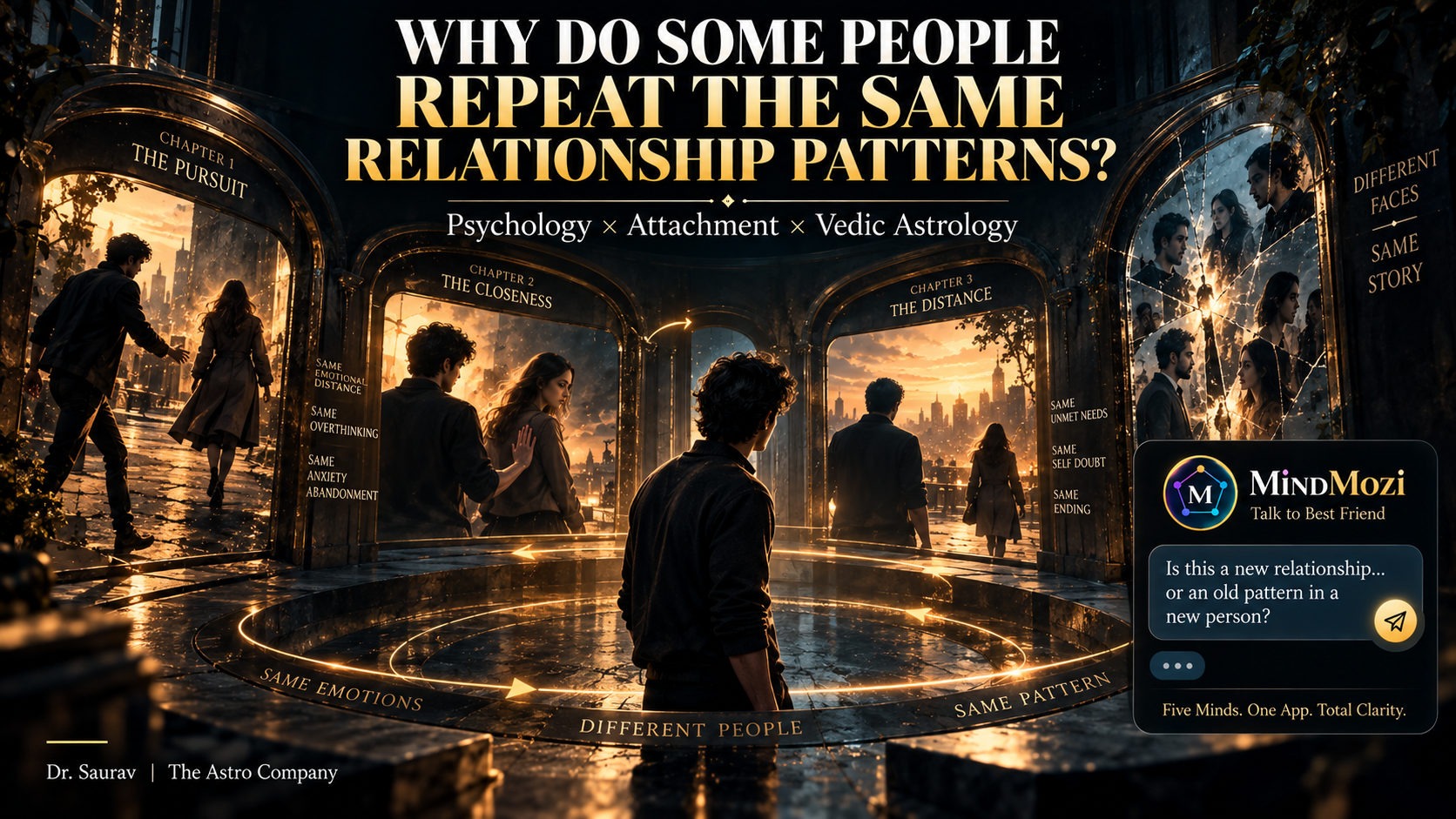
Different person. Different circumstances. Different beginning.
And yet, somehow, the relationship ends in a familiar place.
One person keeps choosing emotionally unavailable partners.
Another becomes anxious whenever someone stops replying.
Someone else repeatedly sacrifices their needs to keep a relationship alive.
And another person leaves whenever genuine intimacy begins to develop.
Eventually, a question appears:
Why does this keep happening to me?
It is tempting to conclude that we simply have bad luck in love. Sometimes circumstances genuinely are unfortunate. But when similar emotional dynamics repeatedly appear across different relationships, it may be worth examining something beyond the people we choose.
It may be time to examine the pattern we bring into the relationship.
1. Different people can activate the same old pattern
Imagine someone who repeatedly becomes attracted to emotionally distant partners.
The people are different. Their backgrounds are different. Their personalities are different.
But the emotional experience is remarkably similar.
At first, there is excitement.
Then the other person becomes inconsistent.
Our protagonist begins to worry, tries harder to maintain closeness and becomes increasingly preoccupied with the relationship.
Eventually, the relationship becomes exhausting.
The next person appears completely different.
And the same sequence begins again.
What connects these relationships?
It may not be a particular type of partner. It may be a familiar way of interpreting closeness, responding to uncertainty and trying to secure affection.
Sometimes we repeat a relationship pattern because we keep responding to a familiar emotional situation in a familiar way.
2. Familiarity can feel like compatibility
One of the most interesting questions in relationships is why certain dynamics feel immediately compelling, even when they eventually cause distress.
Familiarity can influence what feels normal to us.
If someone has learned that affection is unpredictable, they may become accustomed to working hard for reassurance.
If disagreement was punished in their earlier environment, they may find it difficult to express needs directly.
If approval was conditional, they may become highly attentive to other people’s moods.
These experiences do not automatically determine adult relationships. Nor does everyone with a difficult childhood repeat the same patterns.
But learned expectations can influence how we interpret and respond to relationships.
Research on early maladaptive schemas — enduring patterns of beliefs and expectations about ourselves and other people — has found associations between these schemas and interpersonal problems. A 2020 meta-analysis examined 49 studies and found a moderate overall positive association, while noting that evidence for causation was limited.
The important distinction is this:
What feels familiar is not necessarily what is healthy.
And what feels unfamiliar is not necessarily wrong.
3. The attachment cycle
Attachment theory offers another useful lens.
People differ in how they respond to closeness, dependence, uncertainty and perceived rejection.
Consider two broad patterns.
One person becomes anxious when a partner seems distant. They seek reassurance, want to discuss the relationship immediately and may interpret silence as rejection.
Another person feels overwhelmed when emotional demands increase. They withdraw, avoid difficult conversations or need more distance before they can engage.
When these patterns meet, a cycle can develop.
One person pursues.
The other withdraws.
The withdrawal intensifies the first person’s anxiety.
The pursuit intensifies the second person’s need for distance.
Both may believe the problem is entirely the other person’s behaviour.
But the interaction itself has become part of the problem.
Attachment is not a permanent label or a diagnosis. People’s responses can vary across relationships and circumstances. The purpose of this framework is to help us recognise what happens between people, not to categorise a partner as irredeemably anxious or avoidant.
4. Why do we keep doing something that hurts us?
Because a pattern can provide a short-term psychological benefit even when it creates a long-term problem.
Consider someone who avoids expressing their needs because they fear rejection.
In the short term, avoiding the conversation reduces anxiety.
But the underlying need remains unmet.
Resentment builds.
The relationship becomes less satisfying.
Eventually, the person feels unseen and unappreciated.
They may then conclude that they always end up with partners who don’t understand them.
That conclusion may contain some truth. Their partners may genuinely be unresponsive.
But another question is worth asking:
What role does my own response play in keeping this situation going?
This is not about blaming yourself for another person’s behaviour. It is about distinguishing what you cannot control from what you may be able to change.
You cannot make another person emotionally available.
You may, however, be able to recognise unavailability earlier, communicate your needs more clearly and decide how long you are willing to remain in an unsatisfying dynamic.
That is a meaningful form of agency.
5. The schema beneath the relationship
Schema therapy describes enduring patterns that can shape how people interpret themselves, others and relationships.
For example:
Abandonment: “People I depend on will eventually leave.”
Emotional deprivation: “My emotional needs will never really be met.”
Mistrust: “If I let my guard down, someone will take advantage of me.”
Defectiveness: “If someone sees the real me, they will reject me.”
Self-sacrifice: “My needs matter less than everyone else’s.”
These are illustrative beliefs, not diagnoses. People may experience several patterns, and their experiences may not fit neatly into any one category.
Now imagine someone who believes that people eventually leave.
When a partner becomes quiet, they may interpret the silence as evidence that abandonment is approaching.
They seek reassurance.
Their partner may feel pressured and withdraw further.
The withdrawal appears to confirm the original belief.
The cycle becomes self-reinforcing.
This does not mean the person imagined the problem or caused the other person’s behaviour. It means that an existing expectation may influence how an ambiguous situation is interpreted and handled.
The belief becomes part of the relationship experience.
6. Are we choosing the wrong people, or responding to them in familiar ways?
Sometimes we genuinely choose partners whose behaviour is incompatible with our needs.
Sometimes we overlook warning signs because attraction is strong.
Sometimes we remain too long because we hope the relationship will become what we imagined.
And sometimes we respond to a reasonably ordinary disagreement as though it signals the end of the relationship.
These possibilities can coexist.
A useful analysis separates three things:
Partner selection: Who am I drawn to, and what do I overlook?
Interpretation: What meaning do I assign to their behaviour?
Response: What do I do when I feel insecure, disappointed or threatened?
Changing only one of these may not be enough.
For instance, choosing a more emotionally available partner may help, but it may not automatically resolve a persistent fear of rejection.
Likewise, learning to regulate anxiety does not mean accepting a partner who repeatedly disrespects boundaries.
The aim is not to make yourself tolerate more.
It is to develop a clearer understanding of what is happening and respond more deliberately.
7. The Vedic astrology perspective
Vedic astrology offers a traditional symbolic framework for reflecting on relationship tendencies.
The seventh house is associated with partnership and significant one-to-one relationships.
Venus is traditionally connected with attraction, affection, pleasure and relational values.
The Moon is considered when exploring emotional security, attachment and habitual responses.
The fifth house may be examined in relation to romance and attraction, while the eighth and twelfth houses can be interpreted in broader themes involving vulnerability, intimacy, loss, privacy and emotional entanglement.
Depending on the school of Jyotisha, practitioners may also examine the seventh lord, Venus, the Navamsha (D9), relevant planetary periods and repeated themes across the chart.
But an important distinction must remain clear.
A placement should not be used to declare that someone is destined to choose unavailable partners, experience betrayal or repeat a particular relationship outcome.
These are traditional astrological interpretations, not scientifically established causal explanations of relationship behaviour.
A more constructive approach is to use the chart as a framework for reflection:
- What relationship tendencies am I examining?
- What do I repeatedly expect from other people?
- Where might I need stronger boundaries or greater emotional awareness?
- What choices remain available to me?
The chart becomes a prompt for inquiry rather than a sentence passed on someone’s future.
8. Awareness creates an opportunity to respond differently
Recognising a pattern does not make it disappear overnight.
Someone who fears abandonment may still feel anxious when a partner becomes distant.
Someone who avoids conflict may still feel an urge to shut down during a difficult conversation.
The difference is that they can begin to recognise what is happening.
Instead of immediately reacting, they might pause and ask:
“What do I know about this situation, and what am I assuming?”
“What am I feeling right now?”
“What response would be consistent with the kind of relationship I want?”
“Is this a temporary difficulty, a recurring incompatibility or a genuine warning sign?”
These questions create room for more deliberate choices.
Psychological work may also help people examine longstanding beliefs, communicate needs and develop healthier responses. Research on schema therapy suggests that schemas can be relevant targets for treatment, although the strength of evidence varies across conditions and approaches.
The point is not to achieve perfect relationships.
It is to become less automatic in the patterns that shape them.
9. A five-question relationship audit
Think about your last two or three significant relationships.
Write down your answers without trying to make yourself look good or bad.
1. What initially attracted me to each person?
Was it their values and emotional availability, or was the intensity of the pursuit itself especially compelling?
2. When did I first notice something felt wrong?
Did I acknowledge it, communicate about it or explain it away?
3. What did I do when I felt insecure?
Did I pursue, withdraw, over-explain, become controlling, avoid the conversation or pretend not to care?
4. What did I repeatedly hope the other person would finally give me?
Reassurance, approval, stability, freedom, validation or a feeling of being chosen?
5. What could I do differently without taking responsibility for someone else’s choices?
Perhaps communicate sooner. Set a boundary. Slow down. Choose based on compatibility rather than intensity. Or leave a dynamic that repeatedly harms you.
Look for themes, not verdicts.
One difficult relationship does not establish a lifelong pattern. And a repeated pattern does not mean you are broken.
It means there may be something worth understanding.
10. Where MindMozi fits in
This is the kind of question I wanted MindMozi to help people explore.
MindMozi is an AI trained by me across psychological, astrological and philosophical perspectives.
You can approach the same relationship through different conversational personalities.
Best Friend: Help me look honestly at what is happening.
Mentor: Help me identify my options and next steps.
Oracle: Explore the traditional astrological interpretation of my relationship tendencies.
AI Companion: Let me think through the situation without feeling judged.
The goal is not to have an AI decide whom you should love.
It is to help you examine the questions you may be avoiding, distinguish your assumptions from observable behaviour and consider your options more clearly.
For serious distress, unsafe relationships or persistent difficulties, a qualified mental health professional can provide support that an AI conversation cannot replace.
The deeper question
Perhaps the most useful question is not:
“Why do I always meet the wrong people?”
It is:
“What keeps repeating in the way I choose, interpret and respond to relationships?”
Sometimes the pattern is in the people we choose.
Sometimes it is in what we tolerate.
Sometimes it is in the meaning we assign to distance, disagreement or intimacy.
And sometimes we have been trying so hard to make a relationship work that we have stopped asking whether it actually works for us.
You do not have to blame yourself for the past to learn from it.
You do not have to repeat a pattern simply because it is familiar.
And you do not have to accept poor treatment in the name of personal growth.
The people in your future may be different.
But the most important change may begin when you start recognising the pattern before it reaches the same ending.
Want to explore relationship tendencies through your own birth chart? You can consult Dr. Saurav Chaturvedi through The Astro Company.
Or explore the question conversationally with MindMozi — an AI trained by Dr. Saurav across psychology, astrology and philosophy.
Research & Further Reading
- Janovsky, T. et al. (2020). The relationship between early maladaptive schemas and interpersonal problems: A meta-analytic review. Clinical Psychology & Psychotherapy. https://pubmed.ncbi.nlm.nih.gov/32112606/
- Bär, A. et al. (2023). Early Maladaptive Schemas and Schema Modes in clinical disorders: A systematic review. Psychology and Psychotherapy. https://pubmed.ncbi.nlm.nih.gov/37026578/
- Pilkington, P. D. et al. (2021). Adverse childhood experiences and early maladaptive schemas in adulthood: A systematic review and meta-analysis. Clinical Psychology & Psychotherapy. https://pubmed.ncbi.nlm.nih.gov/33270299/
- Mikulincer, M. et al. (2002). Attachment security in couple relationships: A systemic model and its implications for family dynamics. Family Process. https://pubmed.ncbi.nlm.nih.gov/12395567/
- Taylor, C. D. J. et al. (2017). Does schema therapy change schemas and symptoms? A systematic review across mental health disorders. Psychology and Psychotherapy. https://pubmed.ncbi.nlm.nih.gov/28035734/
Research note: The research above supports examining attachment, schemas and interpersonal difficulties. It does not establish that astrology predicts relationship outcomes or that a birth chart causes recurring relationship patterns.