
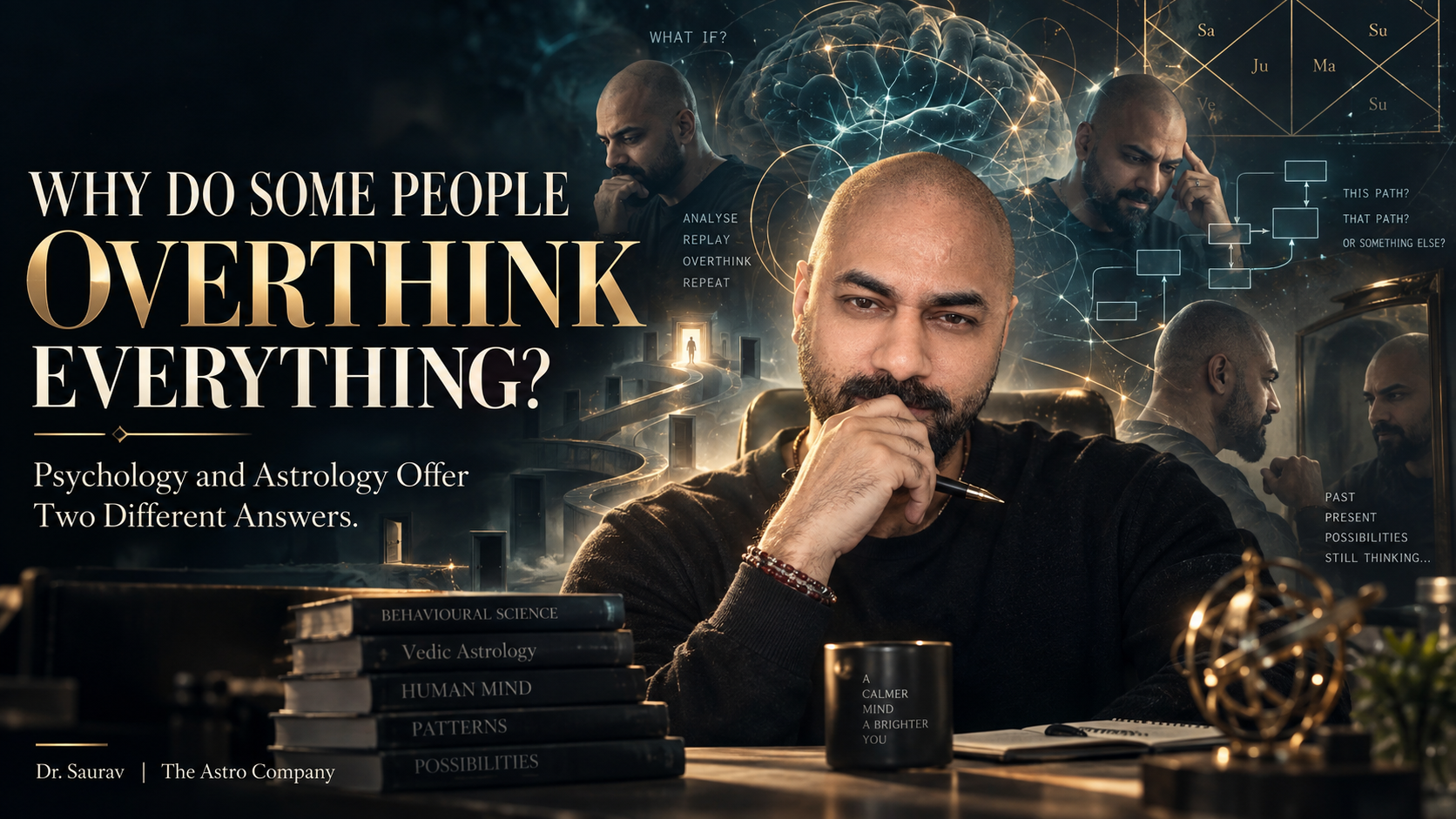
Why Do Some People Overthink Everything? Psychology and Astrology Offer Two Different Answers
There is a difference between thinking deeply and being unable to stop thinking.
One helps us understand a problem. The other can keep us trapped inside it.
You replay the conversation.
You reconsider the decision.
You imagine what could go wrong.
You remember something embarrassing from five years ago and suddenly wonder whether everyone else remembers it too.
Then another thought appears:
“Why am I still thinking about this?”
And that thought becomes another thought.
This is where ordinary reflection can turn into something psychologists call repetitive negative thinking—a broad pattern that includes processes such as rumination and worry. Research has linked persistent repetitive negative thinking with difficulties disengaging from no-longer-relevant material and with a range of psychological difficulties.
But there is another interesting question:
Why are some people seemingly more prone to this pattern than others?
Psychology has several answers.
Vedic astrology offers a very different one.
The interesting part is not deciding which framework is “correct.”
It is understanding what each framework is actually trying to describe.
When Thinking Stops Solving Problems
Healthy thinking usually has a direction.
There is a question.
You gather information.
You consider alternatives.
You make a decision.
You move on.
Overthinking often has no natural endpoint.
The mind keeps returning to the same material:
What if I had said something different?
What if they misunderstood me?
What if I make the wrong decision?
What if something goes wrong?
Why did they behave that way?
The problem isn’t necessarily the amount of intelligence involved.
In fact, an intelligent mind can become exceptionally good at generating additional possibilities.
The difficulty is knowing when the analysis has stopped producing useful information.
Research on rumination suggests that repetitive thinking can prolong negative mood, interfere with problem-solving and make it harder to respond flexibly when circumstances change.
A 2024 review describes repetitive negative thinking as involving difficulties in controlling and shifting mental activity—essentially, the mind has trouble disengaging from a thought process once it has begun.
So overthinking isn’t simply:
“thinking too much.”
Sometimes it is better understood as:
thinking without successfully transitioning from analysis to action, acceptance or disengagement.
Why Does the Brain Keep Returning to the Same Question?
One reason is that uncertainty is psychologically uncomfortable.
When an outcome remains unresolved, the mind may continue searching for information that could theoretically reduce that uncertainty.
This makes sense from a survival perspective.
If you haven’t figured out whether something is dangerous, important or unresolved, continuing to monitor it can seem useful.
But the modern mind can apply the same mechanism to situations that don’t have a definitive answer.
A relationship.
A career decision.
A social interaction.
A message someone hasn’t replied to.
The problem is that many human questions don’t have enough information to produce certainty.
You can analyse a conversation for three hours and still not know what another person was thinking.
At some point, more analysis stops increasing knowledge.
It simply increases mental activity.
But Why Are Some People More Prone to It?
This is where individual differences become important.
People differ in emotional sensitivity, cognitive style, tolerance for uncertainty, attentional habits, personality and learned ways of responding to distress.
There is also an important distinction between self-reflection and rumination.
Self-reflection can help us learn:
“That situation didn’t go well. What can I do differently next time?”
Rumination can sound more like:
“Why did that happen? Why did I do that? What did they think? What if I had…”
The first moves toward understanding.
The second can become circular.
This distinction matters because we shouldn’t romanticize overthinking as simply the price of being intelligent or sensitive.
Sometimes deep thinking is useful.
Sometimes the mind is simply stuck.
Then What Does Astrology Say?
Vedic astrology approaches this question differently.
It doesn’t begin with cognitive mechanisms.
It begins with symbolic patterns within a birth chart.
One of the most important factors is the Moon.
In Jyotisha, the Moon has traditionally been associated with the mind, emotional experience, perception and mental responsiveness.
Mercury is associated more with cognition, discrimination, communication and analytical processing.
That gives us an interesting symbolic distinction:
Moon → How the mind experiences and responds.
Mercury → How the mind processes, categorizes and communicates information.
From an astrological perspective, therefore, excessive mental activity might be explored through the condition of the Moon and Mercury, their signs, houses, relationships with other planets, and the broader chart context.
But there is an important caveat.
A statement such as:
“Moon in X sign means you will overthink”
is far too simplistic.
A birth chart is not a personality questionnaire with one variable.
Astrological interpretation traditionally depends on combinations, strength, house placement, aspects or planetary relationships, dispositors, dashas and the overall structure of the chart.
So even within astrology, one placement should not be treated as a complete psychological explanation.
Moon, Mercury and the Different Ways the Mind Can Get Stuck
Astrology can become particularly interesting when we stop asking:
“Which placement causes overthinking?”
and instead ask:
“What kind of mental pattern might this symbolism describe?”
A strongly emphasized Moon may traditionally invite questions around emotional responsiveness, memory, sensitivity and the need for psychological security.
Mercury may invite questions around analysis, categorization, communication and mental processing.
Saturn can introduce another dimension: caution, restraint, responsibility and concern about consequences.
Rahu can symbolically represent amplification, fixation, novelty and the hunger to know or experience more.
None of these should be treated as scientifically established causes of overthinking.
They are astrological lenses.
And that distinction is important.
Psychology and Astrology Are Not Saying the Same Thing
This is where the conversation becomes much more interesting.
Psychology asks:
What cognitive, emotional and behavioural processes contribute to repetitive thinking?
Astrology asks:
What symbolic patterns might describe a person’s relationship with mind, emotion, uncertainty, desire and control?
These are different questions.
Psychology works through empirical observation, measurement, experimentation and clinical research.
Astrology works through a symbolic interpretive tradition.
One should not be used to falsely “prove” the other.
But that doesn’t mean they cannot be placed in conversation.
For someone interested in self-understanding, astrology can function as a language for reflection, while psychology can provide evidence-based models for understanding behaviour.
The value lies partly in knowing where each framework begins and ends.
The Deeper Question: Are You Solving the Problem or Feeding the Loop?
The next time you catch yourself overthinking, try asking:
1. Is there actually new information available?
If yes, analysis may still be useful.
If no, you may be repeating information rather than discovering it.
2. Is this thought leading to an action?
If you can identify a useful next step, take it.
3. Is the question answerable?
Some questions simply aren’t.
You cannot know exactly what another person thinks.
You cannot guarantee that a decision will work.
You cannot eliminate every possible future risk.
4. Am I trying to achieve certainty where only probability is possible?
This is one of the most important questions.
Human beings often want certainty from situations that inherently contain uncertainty.
What Your Birth Chart Can Add to This Conversation
Astrology becomes more useful when it is used for self-observation rather than fatalism.
Instead of:
“My chart says I’m an overthinker.”
try:
“Does my chart give me a useful symbolic language for examining how I deal with uncertainty, emotion and analysis?”
That is a very different relationship with astrology.
Your chart doesn’t need to become a sentence.
It can become a question.
This Is Also Where MindMozi Comes In
This is one of the reasons I wanted to build MindMozi.
Many personal questions don’t fit neatly into one category.
“Why can’t I stop thinking about this person?”
is simultaneously a psychological question, a relationship question, a philosophical question and—if someone is interested in astrology—potentially an astrological question.
MindMozi is designed to explore these kinds of questions through psychological, astrological and philosophical perspectives, rather than forcing every personal problem into a single framework.
The goal isn’t to replace professional mental-health care or human consultation.
It is to create another space for structured self-exploration.
And Sometimes the Right Question Is Not “How Do I Stop Thinking?”
Sometimes it is:
What am I trying to solve?
Perhaps the mind is looking for reassurance.
Perhaps it wants certainty.
Perhaps it is afraid of making the wrong decision.
Perhaps something emotionally unresolved is demanding attention.
Perhaps the problem isn’t that you think too much.
Perhaps you haven’t yet identified what the thinking is trying to accomplish.
That is where psychology becomes useful.
And that is where astrology, when used thoughtfully, can offer another symbolic language for reflection.
Not a verdict.
Not a diagnosis.
Not a guarantee.
A lens.
A final thought
A quiet mind isn’t necessarily an empty mind.
The goal isn’t to stop thinking.
It is to develop the ability to know:
when to investigate,
when to decide,
when to act,
and when to let a thought pass.
Sometimes intelligence asks better questions.
Wisdom also knows when a question has been asked enough times.